Episode Description
This episode introduces the three ways of looking at geometry: as a practical tool, as a mathematical structure, and as a qualitative practice of direct experience. It lays the foundation for the series by showing why the third way matters and how it leads from drawing into questions of consciousness, meaning, and reality.
Three Ways to Look at Geometry
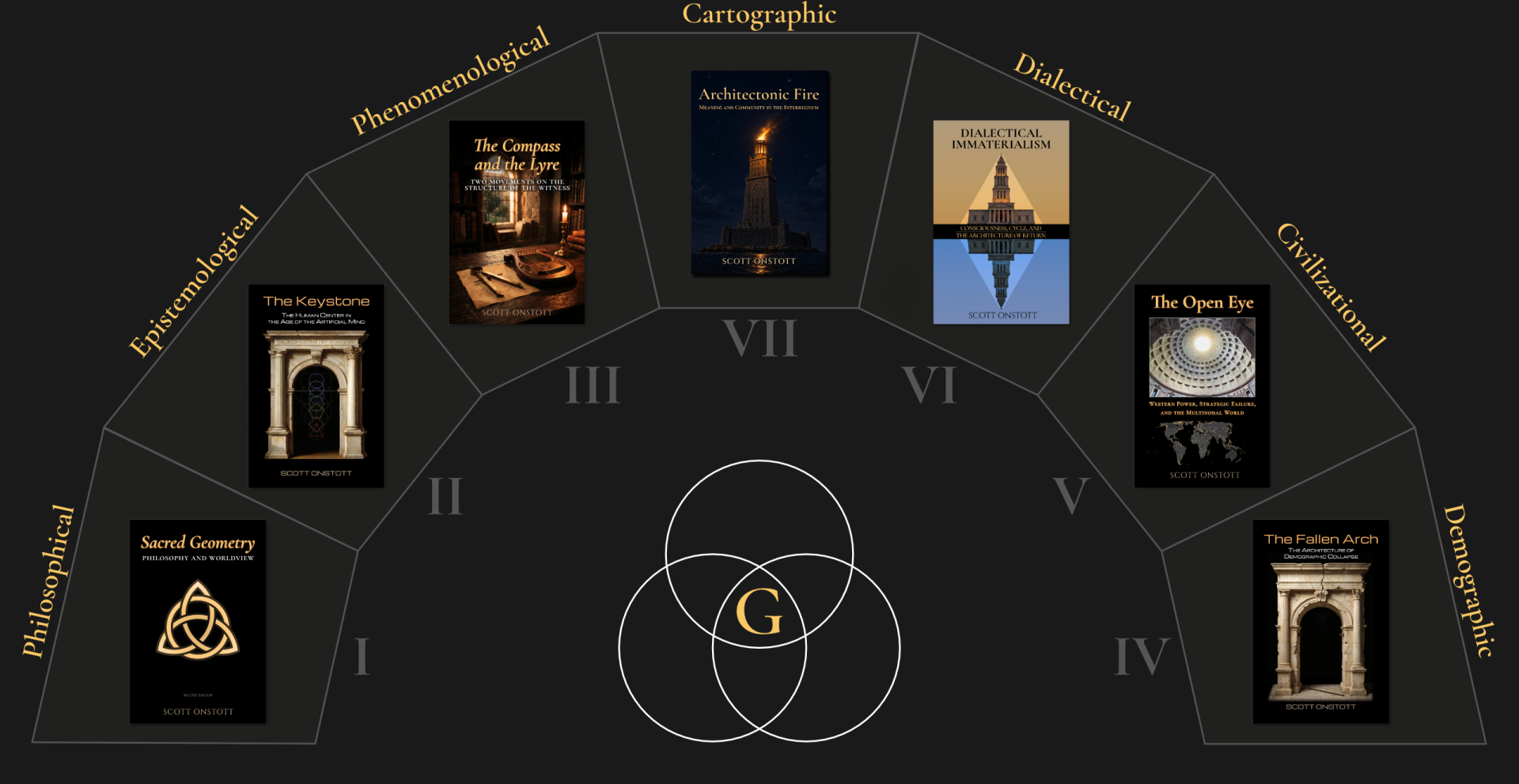
This is the first episode of a series called The Arch. Over the next year to 18 months I am going to work through all seven books in my nonfiction cycle, concept by concept, in order. If you have been a student of Sacred Geometry Academy and have mostly watched the drawing courses, this series is going to be something quite different. The drawings were always a practice. This series is about what that practice is for, philosophically.
The series begins here, with the first book, Sacred Geometry: Philosophy and Worldview. And that book begins here, with geometry itself. Specifically, with a distinction that most people have never been introduced to: the three ways of engaging with geometry, and why the third one is the one this entire body of work is built on.
"Geometry can be considered from at least three viewpoints. First as a technical exercise mostly serving industrialization. Secondly as a purely mathematical function. Thirdly, and most importantly, as a science of the soul. This has to be performed with the human hand and is fundamental to a deeper understanding of the Platonic wisdom tradition. Geometry is only fully understood by doing it." — Keith Critchlow (1933-2020)
Keith Critchlow was an artist, professor of architecture, and co-founder of the Temenos Academy in London. He was a central figure in the twentieth-century revival of sacred geometry, and he is a personal hero of mine. The distinction he draws here, between geometry as technical exercise, as mathematical function, and as science of the soul, is the starting point for everything that follows in this series.
Geometry's three viewpoints are not equally well known. The first is practical. The second is mathematical. The third is what Critchlow calls the science of the soul. Most people have encountered the first two. Almost nobody is introduced to the third. That third viewpoint is the one which, after years of immersion in the first two, led me to the rigorous, first-principles philosophy of mind and reality that the books in this series represent.
THE QUANTITATIVE USE
The quantitative use of geometry is geometry's most popular and by far its most practical. Using geometry to draft, design, dimension, and model forms, or to measure the world, is essential across countless technical professions: architecture, engineering, industrial design, circuit design, science, set design, animation, and more.
"As to the usefulness of geometry, it is as certain that no curious art or mechanic work can either be invented, improved, or performed without its assisting principles." — Benjamin Franklin (1706-1790)
My own career started with manual drafting in the 1980s, and I was a strong proponent of the tectonic shift that transformed numerous analog professions to digital tools. In that process we gained tremendous practical advantages. We can now quantify, design, simulate, and build things that were never possible before. It was a marvelous revolution.
But I can tell you that we also lost something essential in that process: the visceral linkage between hand, paper, and world that drawing with the human body used to bring. When you set a compass to a radius and swing an arc, your body knows the radius. It lives in your wrist. When you click a shape tool, no such knowledge enters you. The result may be more precise, but something real has been exchanged for that precision.
People experienced that natural connection from the origin of civilization until the early 1990s. Those whose careers started later are probably intellectually aware of what changed, but fewer are viscerally aware of what the sensibility of stylus, ruler, and compass meant to countless generations, not just as a skill but as a way of knowing space.
The quantitative use of geometry fulfills real human needs: to learn, build skills, work, achieve, and succeed. That is worth honoring. But it is not the whole story, and this book is about the rest of it.
THE MATHEMATICAL USE
Geometry's mathematical use is abstract and markedly different from its quantitative use. The mathematical use includes within itself an inner logic that was spotted early in the history of civilization.
Euclid, who lived in Alexandria and was likely born around 325 BC, is identified as the author of The Elements. He was probably less the discoverer of geometric theorems himself and more a brilliant chronicler of the common mathematical knowledge of his contemporaries, who were themselves informed by knowledge passed down from Egyptians, Sumerians, and other civilizations ancient even in Euclid's time.
"It is sometimes said that next to the Bible, Euclid's Elements may be the most translated, published, and studied of all the books produced in the Western world." — Bartel Leendert van der Waerden (1903-1996), historian of mathematics
Many people were subjected to the mathematical use in geometry class during secondary education, and most experienced it as unusually cruel punishment. That is not what this book is about.
But I do not think people appreciate just how influential the mathematical use of geometry has been in the development of rationality itself. Survey after survey finds that the majority of students believe mathematics is a set of rules to be memorized rather than a living structure to be understood. This is precisely the opposite of true, and the consequences run deeper than failing test scores.
When people cannot think in terms of logical structure, they are at the mercy of whoever is willing to think for them. Given the failure of stimulating conceptual thinking, it is no wonder pre-rational mythic belief has erupted onto the global stage. Democracy is itself a rational creation, and it requires at least that stage of cognition within its citizens to function effectively.
Euclid showed how geometry can teach us to think clearly. From a few simple axioms, an entire interconnected edifice of logic can be reconstructed in each mind, not memorized, but rebuilt. That is a completely different thing.
"Abraham Lincoln studied and nearly mastered the six books of Euclid since he was a member of Congress. He began a course of rigid mental discipline with the intent to improve his faculties, especially his powers of logic and language. He carried Euclid with him on the circuit till he could demonstrate with ease all the propositions in the six books; often studying far into the night, with a candle near his pillow, while his fellow-lawyers, half a dozen in a room, filled the air with interminable snoring." — William Herndon (1818-1891), law partner and biographer of Abraham Lincoln
THE QUALITATIVE USE
It is only from this third viewpoint, the viewpoint of quality, that we can perceive geometry's sacred dimension. This is what Critchlow described as something that has to be performed with the human hand to be fully understood. It is the viewpoint this book is concerned with.
Geometry's qualitative use does not require or impart rationality the way the mathematical use does, and it has none of the practical applications of the quantitative use. So what does qualitative mean here?
The word derives from the same root as quality, which points to the character or nature of something. In philosophy, qualia, the plural of quale, refers to the subjective, felt character of an experience: what it is actually like to perceive something from the inside. The redness of red. The taste of coffee. The particular aliveness of a piece of music that reaches you before you have had time to think about it. These are qualia.
You cannot transfer a quale through language. You can say "the sunset was orange" but you cannot pour what orange looks like into another person's mind through those words. The words point. The meaning lands in consciousness, or it does not.
This is the key insight: qualia exist only in consciousness. A camera records light frequencies, but it does not experience the color. A spectrometer measures wavelengths, but it does not see. Only a conscious being can experience what something is like, and that experience of what it is like is exactly what the qualitative use of geometry invites.
"It is through geometry that one purifies the eye of the soul." — Plato
When you draw a circle with a compass, something happens that cannot be fully captured by the coordinates of the arc. You experience the perfection of the form. Not as a measurement, not as a proof, but as a direct encounter with something that feels, unmistakably, true. This is the qualitative dimension: geometry as a direct experience of meaning rather than a tool for measuring or a system for proving.
Critchlow called this the science of the soul, and that phrase is more precise than it first appears. If the soul is the seat of subjective experience, the one for whom things have meaning, then geometry practiced qualitatively is a direct inquiry into the nature of that experience.
Sacred Anachronisms: Sacred Geometry and Long-Form Reading
If you want a handle on the sweep of history or a complex philosophical argument, there is no option but extended prose. Books offer our best chance to grapple with the world as a comprehensible whole rather than a whirling snowstorm of fragments because they allow us to make abstractions, draw analogies, and work out logical conclusions that are difficult to achieve in conversation or short-form media.
TESTIMONY ACROSS THE CENTURIES
Here is a small gathering of testimony from people across the ages who encountered geometry's qualitative dimension and found themselves reaching for the same language: eternal, purifying, illuminating, true.
"Geometry is knowledge of the eternally existent." — Pythagoras
"Geometry is the archetype of the beauty of the world." — Johannes Kepler
"It is the glory of geometry that from so few principles, fetched from without, it is able to accomplish so much." — Isaac Newton
"Geometry, to which I have devoted my life, is honoured with the title of the Key of Sciences." — Benjamin Peirce
"I have come to realize that each expression of sentiment is made by a movement governed by geometry. Geometry is everywhere present in nature. The entire rhythm of the body is governed by geometric law." — Auguste Rodin
The thread running through all of these is unmistakable: something about geometry exceeds the person doing it. The person draws, constructs, proves, and then encounters something that was already there. That encounter is the subject of this book.
WHAT THIS SERIES IS ABOUT
So there are three uses of geometry. The quantitative, which measures and builds. The mathematical, which proves and demonstrates. And the qualitative, which encounters.
The Sacred Geometry courses I have made over the years are a practice of that third kind. If you have taken one of them, you have had the direct experience the book presupposes. This series is what the book does next: it asks what that experience implies about the structure of reality, about consciousness, about meaning, and about what it means to be a human being at this particular moment in history.
Those are not small questions. The series across seven books works through them carefully, one stone at a time.
The next episode covers Chapter 2 of this book: "Unpacking Sacredness." If the qualitative use of geometry produces a felt sense of contact with something larger than the ordinary self, what kind of claim is that? What does it imply? Not a religious claim. Something more precise, and more verifiable.
That is where we go next.
That is where we go next.
BUY NOW


Created with