The Arch
A nonfiction seven-book cycle by Scott Onstott
Seven books tracing the architecture of reality, consciousness, civilization, and the human center
from the foundations of philosophical geometry to the pressures reshaping the modern world.
Click/Tap any cover to explore the cycle.
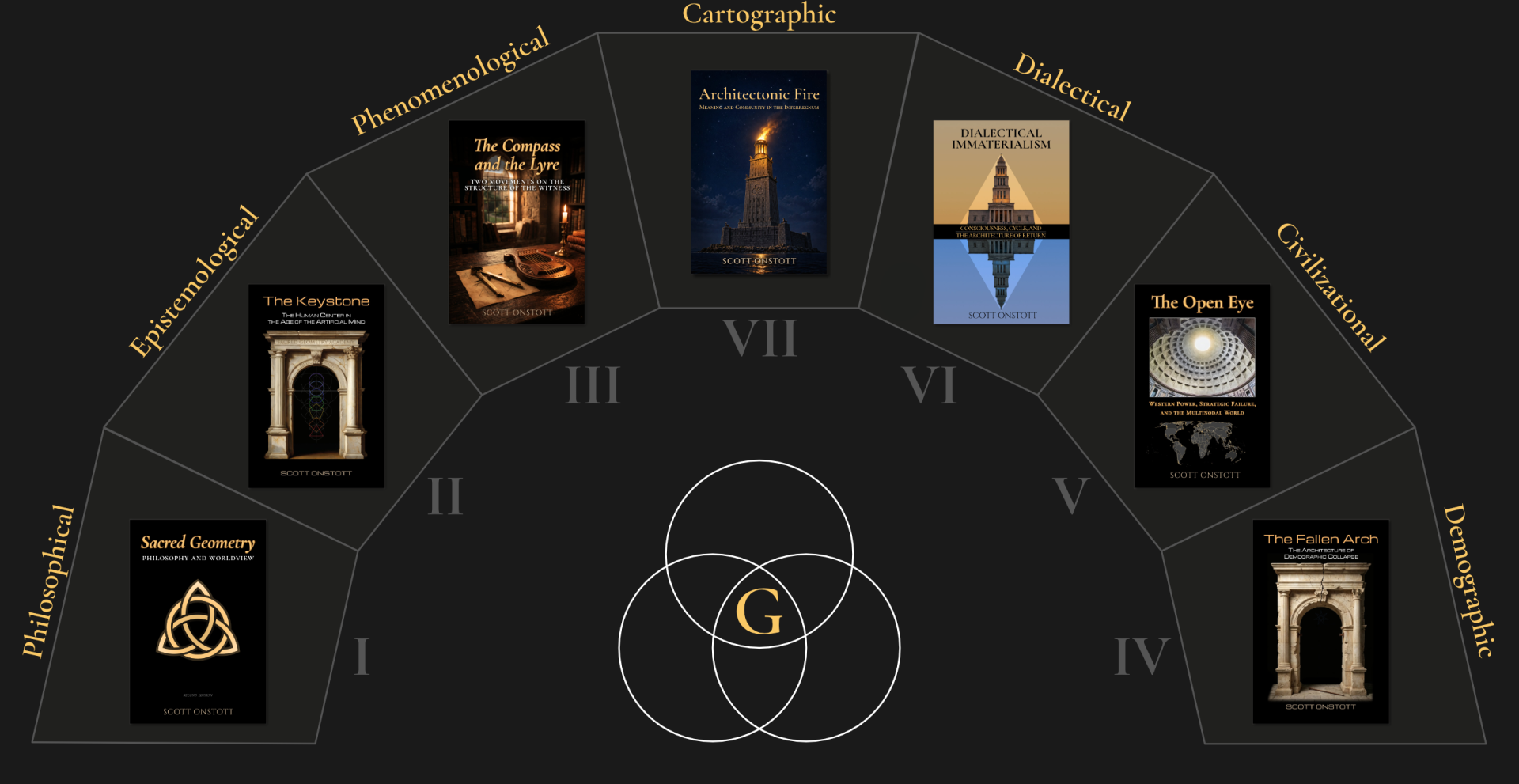
I. Foundation | II. Center | III. Witness | IV. Diagnosis | V. Reflexivity | VI. Return | VII. Transformation
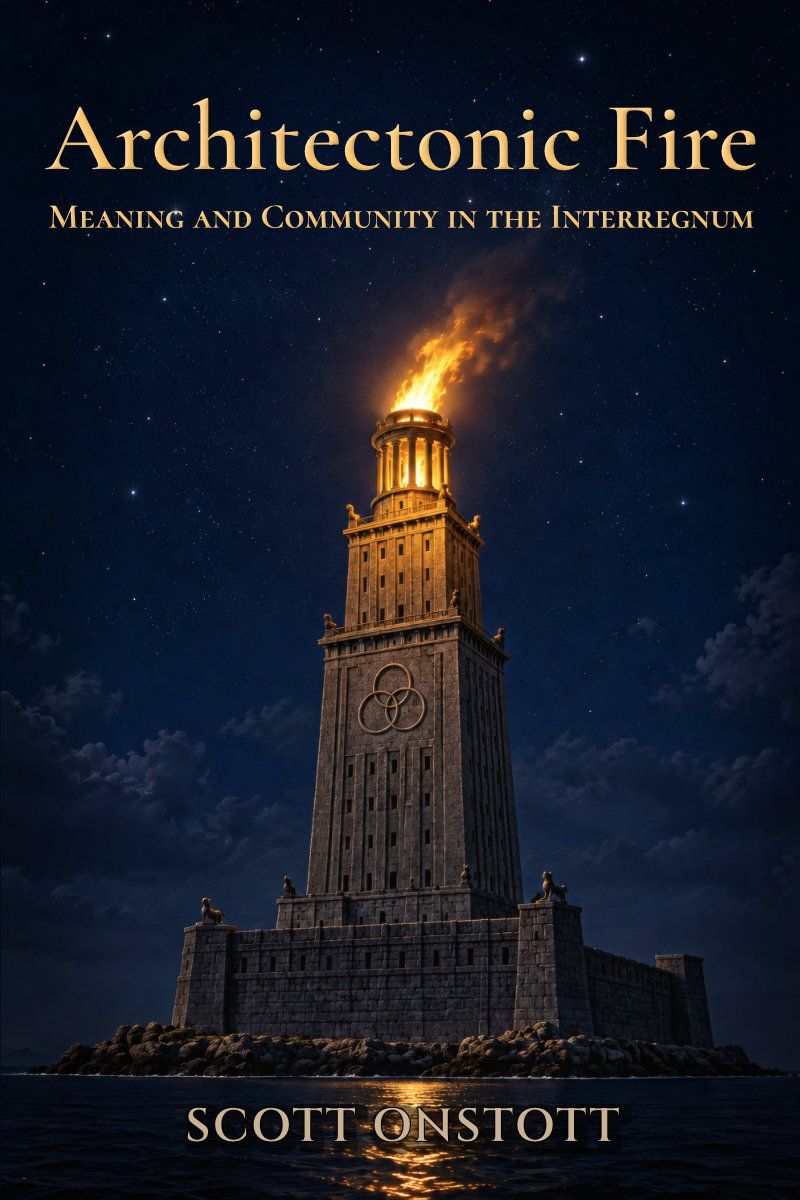
Architectonic Fire
Meaning and Community in the Interregnum
The capacity for meaning and community must be maintained. This is the map of the structural conditions under which that capacity becomes active, and the closing window in which those conditions can still be rebuilt.
The question is not whether the present moment is difficult. It is whether the difficulty is structural, whether what is happening now represents a specific combination of pressures that the available interpretive frameworks were not built to describe.
Architectonic Fire makes that argument and then asks the question it makes necessary: given the specific configuration of the present interval, what are the structural conditions under which meaning, community, and an orientation toward the future can still be developed and transmitted?
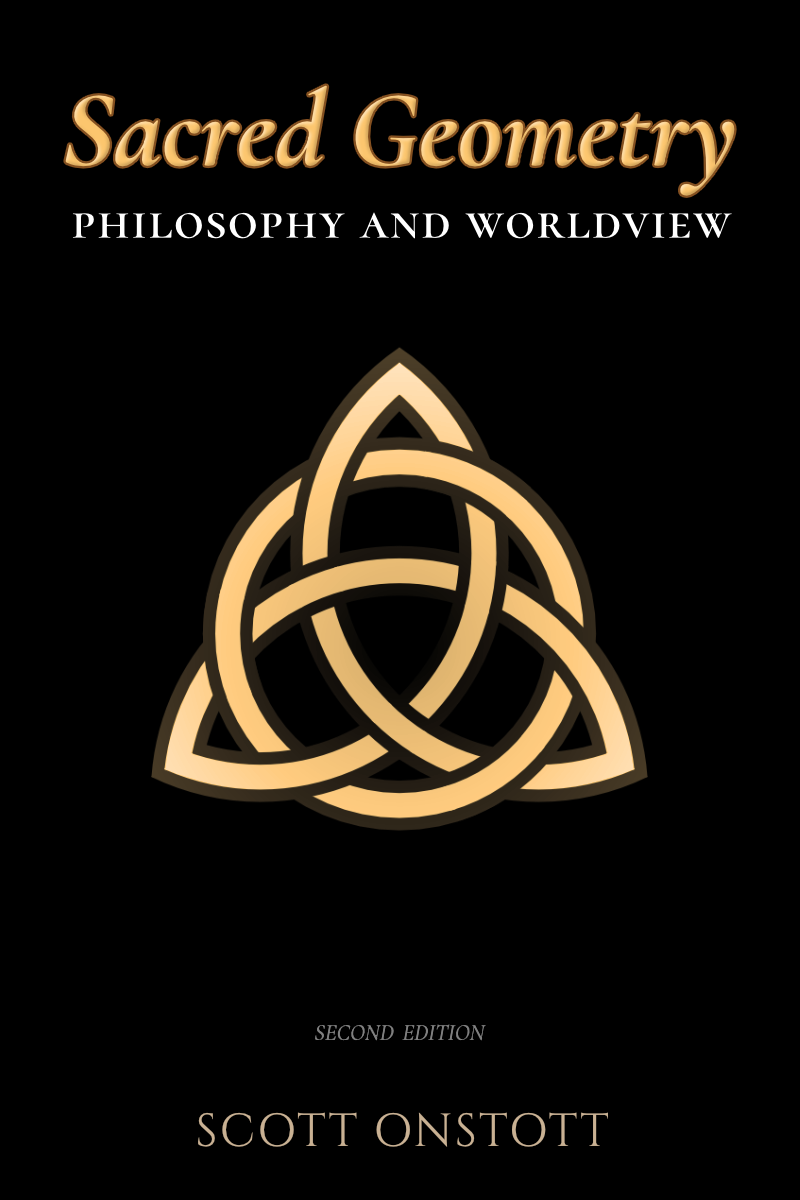
In this concise philosophical guide, Scott Onstott explores the "science of the soul," revealing how the qualitative experience of geometry provides a bridge to a deeper reality. By integrating non-dualism, transpersonal psychology, and a revolutionary theory of mind, he challenges the "standard worldview" of a purposeless universe and offers a profound alternative rooted in the Platonic tradition.
Sacred Geometry: Philosophy and Worldview provides a rational framework for understanding our place in the cosmos, inviting you to see reality not as a collection of objects, but as a symphony of meaning where consciousness is the primary foundation.
138 pages in 6"x9" paperback edition
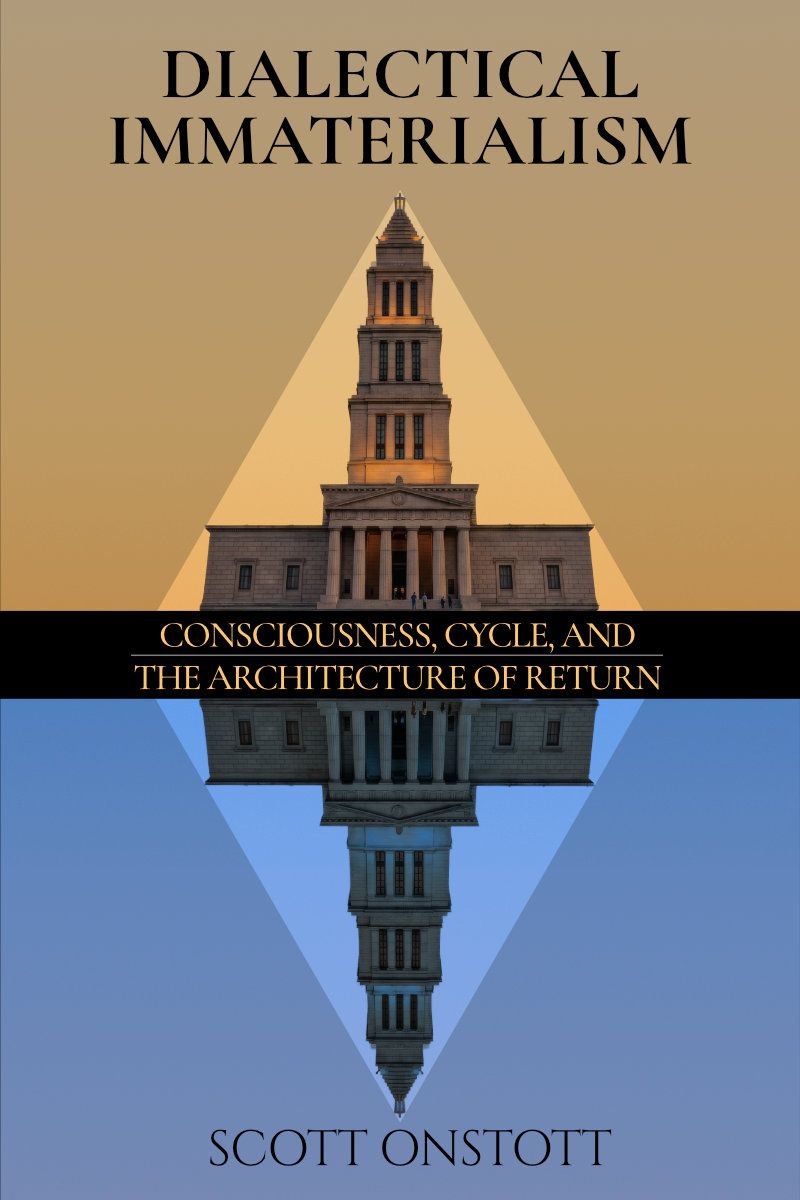
Dialectical Immaterialism
Consciousness, Cycle, and the Architecture of Return
The summit is not the destination.
It is the turning point between two movements.
What drives the transition from one stage to the next, whether in an individual, an institution, or a civilization, is not failure. It is success completed so thoroughly that the success becomes the constraint. Dialectical Immaterialism names this engine, traces its geometry across four scales, and argues that the witnessing position most traditions treat as the destination is, structurally, the halfway mark.
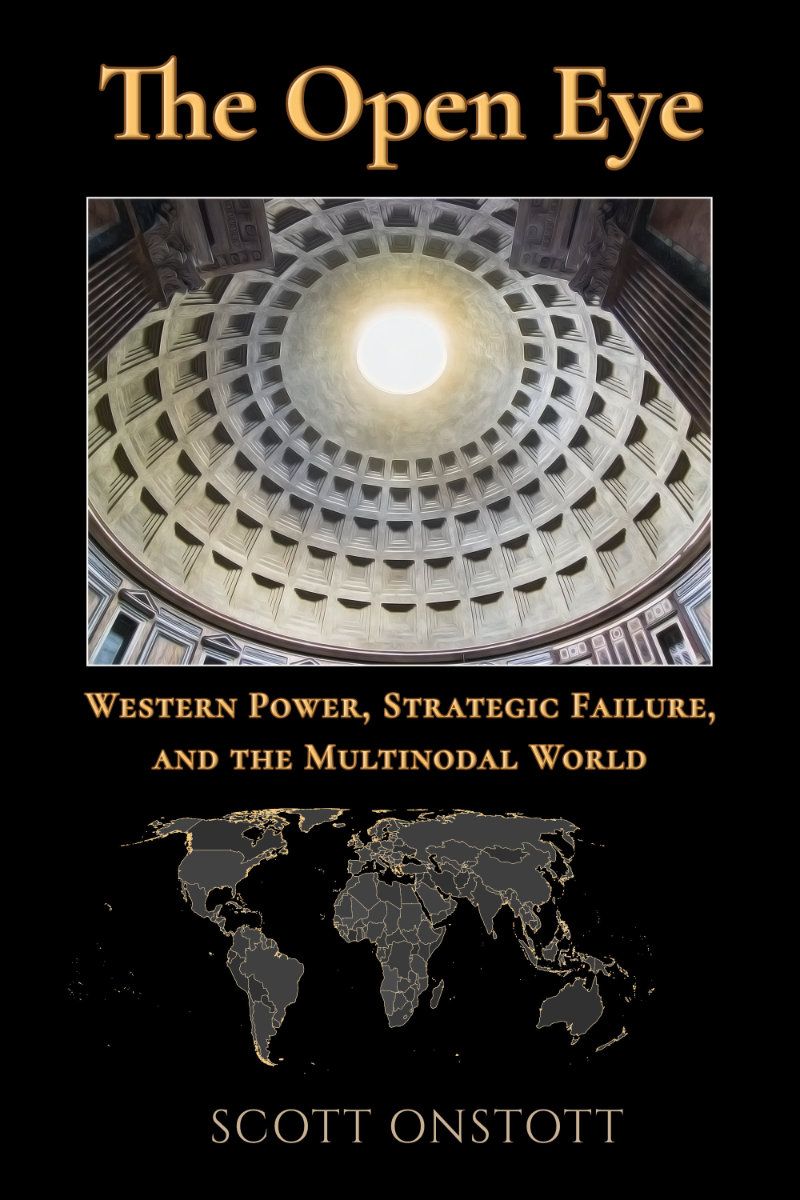
The Open Eye
Western Power, Strategic Failure, and the Multinodal World
The West has not been outgunned. It has been out-thought, by its own prior certainties more than by any adversary.
The Open Eye asks why the West is losing and finds the answer not in its adversaries but in itself. Drawing on realist geopolitics, developmental psychology, demographic analysis, and a philosophy of civilizational renewal, Scott Onstott maps the structural failures that have turned American strategic advantage into strategic drift: NATO expansion that produced the war it was designed to prevent, sanctions that strengthen the states they target, and an institutional culture that mistakes process compliance for strategic thought.
But The Open Eye goes further than diagnosis. From the postwar synthesis that built the liberal order to the multinodal world now displacing it, from the demographic cascade quietly undermining Western vitality to the AI transition poised to amplify every unexamined institutional assumption, Onstott offers a framework, and a direction for genuine civilizational renewal. Rigorous, wide-ranging, and written for readers who want more than partisan reassurance, this is a book about what the West still has worth preserving, and what it must be willing to let go.
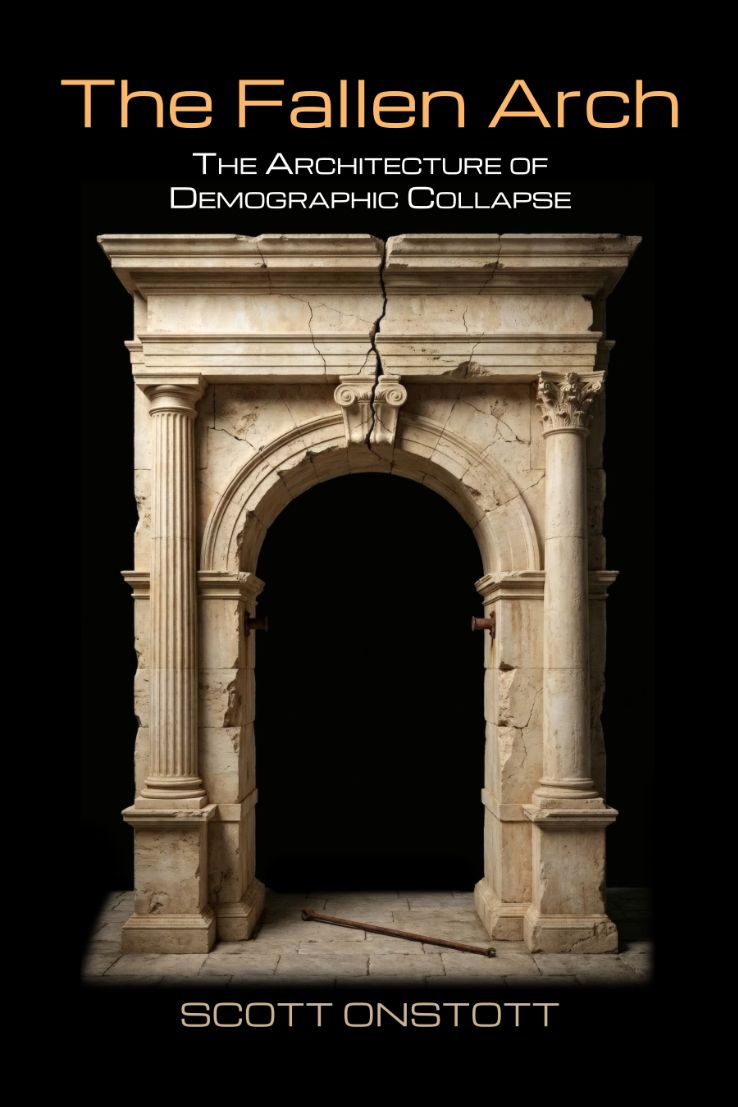
The Fallen Arch
The Architecture of Demographic Collapse
The cradle is empty because the math no longer adds up.
The arch is falling because the stones have been removed.
The future is vanishing because we have made it irrational.
None intended the void at the center.
The Fallen Arch is the diagnostic mirror to the Academy’s philosophical arc: the book that maps the external descent of the structure.
We are living through a demographic cascade that no one has correctly named. It is not a moral crisis. It is not a political crisis. It is an architectural crisis: the collapse of the seven-layer structure that has sheltered human life for millennia. The necessity of life has collapsed into choice. The structure of the household has dissolved into labor. And the security, desire, and communal fabric have been systematically traded and the existential meaning has drained out.
The result: a structural failure mode that no policy can fix. This book is the diagnostic map of the seven-fold cascade and a clear-eyed look at what happens when a civilization rationally optimizes itself into silence. Yet there is still hope and a critical path to rebuild that has never been more urgent.

Sacred Anachronisms: Drawing Geometry and Long-Form Reading
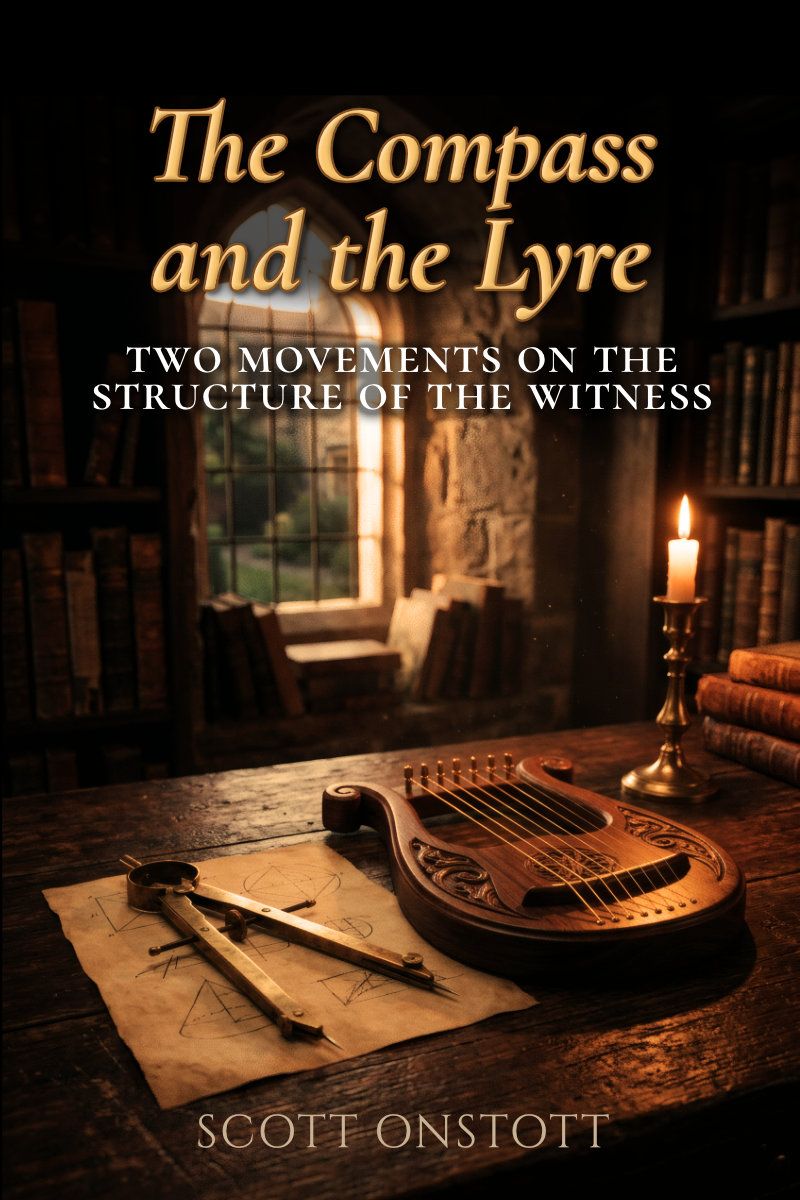
The Compass and the Lyre
Two Movements on the Structure of the Witness
Two instruments, one center that belongs to neither.
You do not need to choose between the geometer's proof and the poet's song. This slender companion volume to The Keystone builds the same discovery twice: first through the exact mathematics of a four-dimensional hypercube and the archetypes mapped onto it, then through the recovered figure of Sappho, the Tenth Muse whose lived synthesis the philosophers could only argue about. Two disciplines, two vocabularies, one structural fact: the one who watches is never among the things watched.
The Keystone
The Human Center in the Age of the Artificial Mind
Mystics claimed the ineffable.
Machines inherited the measurable.
Mathematicians mapped the intelligible.
None remembered the human at the center.
The Keystone is the capstone of the Academy's philosophical arc: the book that names what the others have been circling.
We are living through a civilizational crisis that no one has correctly diagnosed. It is not an AI crisis. It is not a political crisis. It is an architectural crisis: the collapse of the three-domain structure that has sheltered human life for millennia. The Visible has been amplified to the size of a skyscraper. The Invisible has been dismissed as woo. And the Intelligible, the Keystone, has been quietly automated away.
The result: two failure modes tearing civilization apart. The Cage (technocratic materialism) and The Evaporation (post-truth subjectivism). This book is the third option.
Perform a Sacred Anachronism: READ A BOOK.
The algorithm wants your Data. The book wants your Being.
Step off the feed and onto the Human Bridge.

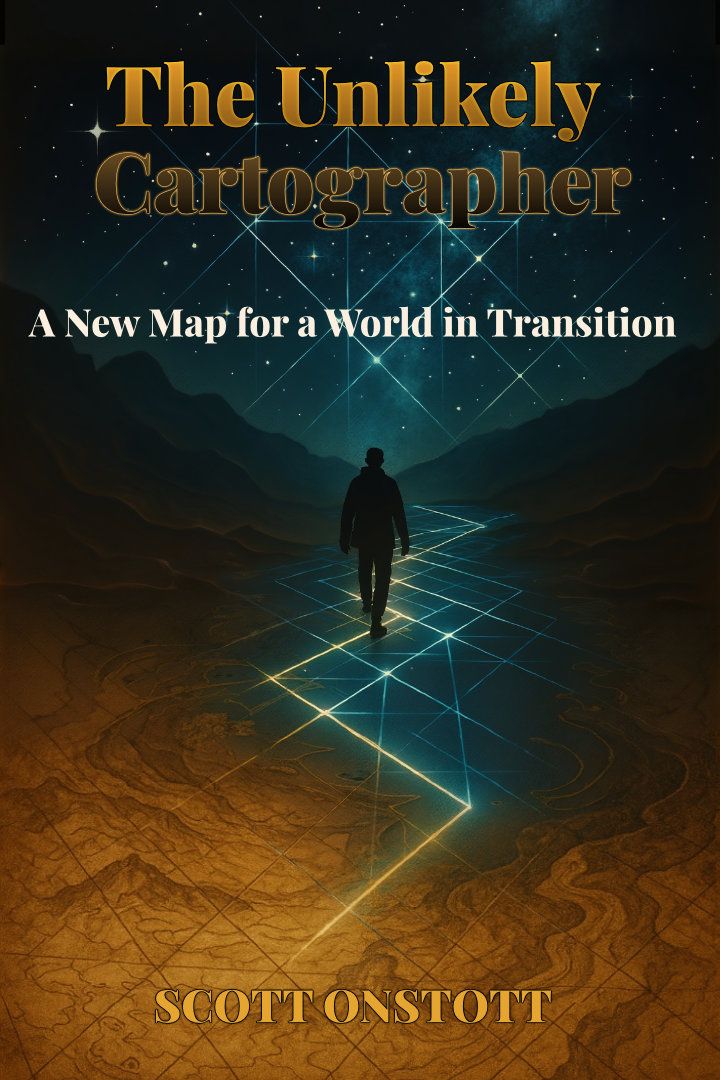
The Unlikely Cartographer
The Human Map of a Hidden World Explored through Memoir
When physical limitations become unexpected advantages.
What maps emerge from a life lived differently?
In this intimate spiritual memoir, Scott Onstott reveals how his extraordinary journey as a triple amputee became the very training that allowed him to unlock the geometric language of the cosmos. It is a profound exploration of how our perceived limitations can become our greatest strengths.
The Unlikely Cartographer offers a revolutionary new map for meaning in our age of AI, inviting you to see the universe not as a cold machine, but as a conscious, thinking entity—and ourselves as its empowered co-creators.
Quick read: 135 pages in 6"x9" paperback edition — 136 page turns on Kindle
❉ ❉ ❉
- Core Hook: The origin story of a seeker who, after a life of physical adaptation, naturally thought differently, and discovered that the world is not what it seems—and spent decades mapping the patterns others missed.
- What You’ll Learn: The personal journey behind the Secrets in Plain Sight phenomenon, tracing the path from a triple-amputee’s struggle for mobility to a craftsman’s mastery of the patterns.
- The "Aha!" Moment: Realizing that the most abstract geometric laws are actually mirrored in our most personal human struggles—and that the "Universal Patterns" are best understood when they are lived and embodied.
- Emotional Timbre: A deep sense of inspiration and intimacy, understanding that the "Universal Patterns" are most powerful when they are lived, breathed, and embodied.
Part intimate memoir of Scott’s journey as a triple amputee and part architectural detective story, this book reveals how a lifetime of physical adaptation and technical mastery led to his unique philosophy.

Secrets in Plain Sight: Leonardo da Vinci
The Master’s Hidden Cipher
Secrets in Plain Sight: Leonardo da Vinci is a deep-dive investigation into the hidden geometric structures of the world’s most iconic art. Scott Onstott demonstrates how Leonardo encoded the Divine Proportion into his masterpieces to create a palpable resonance with the human spirit. By bridging art history, sacred geometry, and biology, this book reveals that Leonardo’s "secret science" is actually the universal language of creation itself.
54 pages in 8.5"x8.5" full color paperback edition — 54 page turns on Kindle
❉ ❉ ❉
- Core Hook: Leonardo was more than an artist; he was a master geometer who encoded the "Lost Science of the Soul" into his most famous masterpieces, from the Mona Lisa to The Last Supper.
- What You’ll Learn: How to "read" Leonardo’s paintings using the tools of sacred geometry, uncovering hidden alignments and symbolic proportions that have remained invisible to the public for centuries.
- The "Aha!" Moment: Seeing the Vitruvian Man not just as a study of anatomy, but as a geometric map of the relationship between the human body, the Earth, and the Moon.
- Emotional Timbre: The thrill of a high-stakes detective story where the "clues" are centuries-old brushstrokes and the "reward" is a direct transmission of Renaissance wisdom through image and underlying geometry.
The Divine Proportion
The Universal Grammar of Beauty
From the spiral of a galaxy to the structure of your own DNA, a single mathematical constant governs the beauty and order of our world: The Divine Proportion. In this visually rich exploration, Scott Onstott reveals how the Golden Ratio (Φ) serves as the "universal grammar" of reality.
Through 33 detailed illustrations, you’ll discover the hidden geometric blueprints behind Leonardo da Vinci’s masterpieces, the Great Pyramid of Giza, and the proportions of the human form. The Divine Proportion is an essential guide for artists, seekers, and anyone who has ever felt that the universe is not a collection of accidents, but a masterpiece of design. Experience the joy of understanding the code that resonates with your very soul.
54 pages in 8.5"x8.5" full color paperback edition — 54 page turns on Kindle
❉ ❉ ❉
- Core Hook: A single mathematical ratio (ϕ) patterns everything from the structure of your DNA and the proportions of your face to the spiral arms of distant galaxies.
- What You’ll Learn: The "fractal-like" self-similarity of nature and how ancient architects used this "Divine Proportion" to create structures that resonate with the human spirit.
- The "Aha!" Moment: Seeing the "Golden Thread" that proves the universe is not a collection of parts, but a single, coherent, and beautifully orchestrated whole.
- Emotional Timbre: The quiet awe of seeing the same "signature" in a seashell and a star.
Quantification
The Architecture of Reality
From the creator of Secrets in Plain Sight comes Quantification, a visual journey into the mathematical heart of reality. Scott Onstott reveals the staggering "coincidences" that link the Great Pyramid, the human body, and the solar system through a single, unified geometric blueprint.
Explore the patterns that connect:
- Ancient wonders and modern skyscrapers.
- The speed of light and the precise location of the Great Pyramid.
- The Fibonacci sequence and the human heart.
Packed with stunning illustrations and mind-bending revelations, Quantification proves that the world is not a collection of accidents, but a consciously designed masterpiece. Discover the hidden numbers that rule your world.
54 pages in 8.5"x8.5" full color paperback edition — 54 page turns on Kindle
❉ ❉ ❉
- Core Hook: Beyond the "what" of the universe lies the "how much"—a rigorous exploration of the specific numerical constants that allow life, matter, and consciousness to exist.
- What You’ll Learn: The precise geometric and numerical "tuning" of the physical world, revealing how the macrocosm of the stars and the microcosm of the atom are governed by the same mathematical laws.
- The "Aha!" Moment: Discovering that the "constants of nature" are not random numbers, but a coherent language of proportion that suggests the universe is a deliberate composition.
- Emotional Timbre: The grounding certainty that comes from seeing the "hard science" of physics and the "soft wisdom" of spirituality finally speak the same language.
Tripartite
The Square-Format Color Trilogy
Tripartite brings together Scott Onstott’s three square-format books—Quantification, The Divine Proportion, and Secrets In Plain Sight: Leonardo da Vinci—specifically designed for readers who value aesthetically-rich illustrations alongside rigorous research. By unifying these thematically-linked works, Tripartite reveals the recurring patterns of creation with a clarity that only a full-color, oversized format can provide.
178 pages, available in 8.5"x8.5" full color paperback edition
❉ ❉ ❉
- Core Hook: A premium omnibus collecting the three square-aspect, full-color masterworks into one unified volume.
- What You’ll Learn: The "Golden Thread" of the Divine Proportion as it weaves through the Great Pyramid, the masterpieces of the Renaissance, and the very architecture of the cosmos.
- The "Aha!" Moment: Seeing the "Body:House:Cosmos" homology—represented by the Sphinx, the Great Pyramid, and the Nebula—as a single, coherent map of reality.
- Emotional Timbre: The aesthetic joy of a high-definition visual journey where art, history, and geometry finally click into place.
Reviews from History
Pythagoras
(570-495 BCE)
"Geometry is knowledge of the eternally existent."
Hypatia of Alexandria
(350-415 CE)
"Geometry unveils the eternal architecture of the spheres, where lines converge in harmony and circles whisper the soul's ascent to the One."
Leonardo da Vinci
(1452-1519 CE)
"Let no one who is not a mathematician read my works."
Johannes Kepler
(1571-1630)
“Geometry has two great treasures: one is the theorem of Pythagoras, the other the division of a line into extreme and mean ratio. The first we may compare to a measure of gold, the second we may call a precious jewel.”
Isaac Newton
(1643-1727)
"It is the glory of geometry that from so few principles, fetched from without, it is able to accomplish so much."
Benjamin Franklin
(1706-1790)
"As to the usefulness of geometry, it is as certain that no curious art or mechanic work can either be invented, improved, or performed without its assisting principles."
Auguste Rodin
(1840-1917)
"Geometry is everywhere present in nature. A woman combing her hair goes through a series of rhythmic movements that constitute a beautiful harmony. The entire rhythm of the body is governed by geometric law."
Albert Einstein
(1879-1955)
"It is marvellous enough that man is capable at all to reach such a degree of certainty and purity in pure thinking as the Greeks showed us for the first time to be possible in geometry."
Maryam Mirzakhani
(1977-2017)
"Mathematics is more than just numbers; it's shapes, structures, and patterns around us."
People love these books

The Sacred Anachronisms
Cartographer Life Hacks
Drawing Geometry: The Oldest Hack in the Book
- Zero Software: No updates, no subscriptions, and no screen time; fully offline and analog.
- The Haptic Loop: Build profound body-hand-eye coordination.
- Flow State: Tactile resistance is a natural trigger for deep focus and meditative flow.
- Sovereign Creativity: Construct your own maps; stop being a consumer of pre-packaged patterns.
- The Chromatic Forge: Flesh out the skeleton of logic with color; turn geometric precision into beauty.
- Contemplative Cartography: Pin your work to the wall; live within the sacred territory you’ve created.
- Analog Socializing: Replace "social media friends" with the shared silence of a drawing circle.
- Low-Cost Entry: No "Pro Version" to unlock; map the cosmos with basic supplies.
- The Human Signature: A hand-drawn line is a qualitative action in the intelligible domain.
Paperback Editions: The Ultimate in Resilience
- Instant On: Zero boot time.
- No Lag: High-resolution, tactile interface that moves at the speed of reflected light.
- Fully Hack-Proof: Offline by design; immune to surveillance and electromagnetic eavesdropping.
- Sovereign Ownership: No subscriptions, no "terms of service," and no fickle corporations; your "legacy" access can never be changed, revoked, or updated.
- Privacy Guaranteed: No tracking cookies, no data harvesting, and no callback telemetry once the book is in your hands.
- Kinesthetic Navigation: Locate passages through physical memory; the where on the page anchors the what in the mind.
- The Living Record: Take notes in the margins, dog-ear the corners, make the map your own. Act like it.
- Peer-to-Peer Sharing: Fully transferable; gift it, lend it, or leave it for a future generation by your own grace.
- Infinite Battery Life: No charging cables or docks.
Scott Randolph Onstott
The Academy Legend
A Map for the Human Bridge
The Architecture of Consciousness
The Sacred Geometry Map Legend
— click icons for navigation —


My Commitment to Augmented Craftsmanship
The argument, the structure, the ideas, the voice, and every editorial judgment in this book are mine. The AI contributed extraordinary execution under my direction, but it could not originate the work, and the result is not separable into its parts.

I believe humans are meant to use the tools of their day. I have walked on artificial legs for more than fifty years. Augmentation does not replace the person. It extends them. As a triple amputee, my body has always been a collaboration between biology and technology. My mind, now, is the same.
Read the book and judge it for what it is. If the worlds are richer, the research deeper, the editing sharper, the page will say so without my help. If they are not, no claim of mine will save them.
This is the work as I make it, and I am glad to tell you how it is made.
Sacred Anachronisms
When was the last time you finished a whole book?
When did you last read to expand your worldview?
If this feels too long to read, that is exactly why
you might want to read it slowly.

Like sacred geometry, painting, or playing an instrument, it is one of the last few remaining ways to engage the "slow" brain, the part of you capable of catalyzing lasting change and profound "Aha!" moments.
I remember the books that changed me decades ago;
I can’t remember what my feed showed me 5 minutes ago.
I write in the hope that you will read with that same intensity. It's not easy. A book is a slow, deliberate conversation that may change how you see the world. It is quality time well spent. Don't just scroll past another day that you won't remember.
I didn't write lengthy books to be skimmed, and you weren't born to be a consumer of summaries. This is an invitation to the depth that brevity cannot reach. Engage your mind in a deep grapple with ideas that dissolve the boundary between the observer and the observed, getting to the heart of what it means to be the conscious experiencing of life itself.