
Pathways
aka courses on our platform
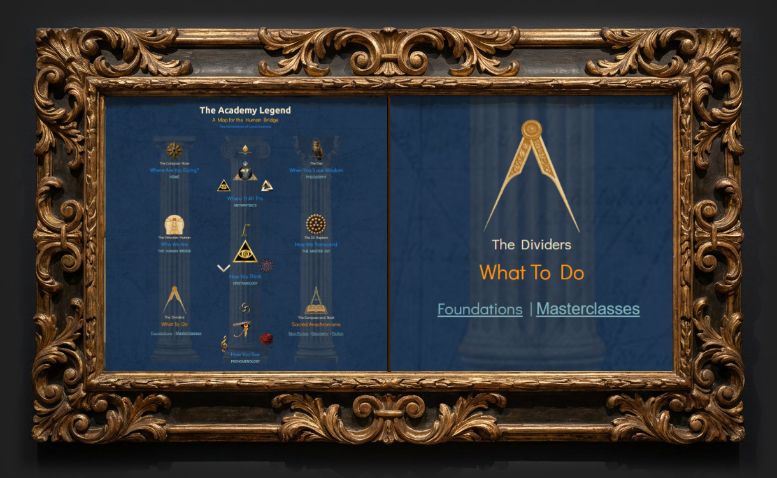
The journey from theory to direct experience is mapped through two distinct pathways. Whether you are establishing your foundations or seeking to master the deeper harmonies of sacred geometry, these courses provide the tools for personal and philosophical transformation.

Foundations
- The Goal: To establish the fundamental geometric and philosophical literacy required to decode the architecture of reality.
- Who it’s for: Those new to sacred geometry or those wishing to base their practice on practical drawing and creative skills.
- What you’ll learn: The grammar of shape, the golden ratio, and quantitative geometry know-how.
Masterclasses
- The Goal: To dive deep into specific, advanced applications of sacred geometry: from architectural mysteries to consciousness research.
- Who it’s for: Experienced practitioners and those ready to unpack complex geometric archetypes.
- What you’ll learn: Deep-dive symbolic and ontological studies, and the synthesis of ancient wisdom with modern science.
Masterclass Pathways
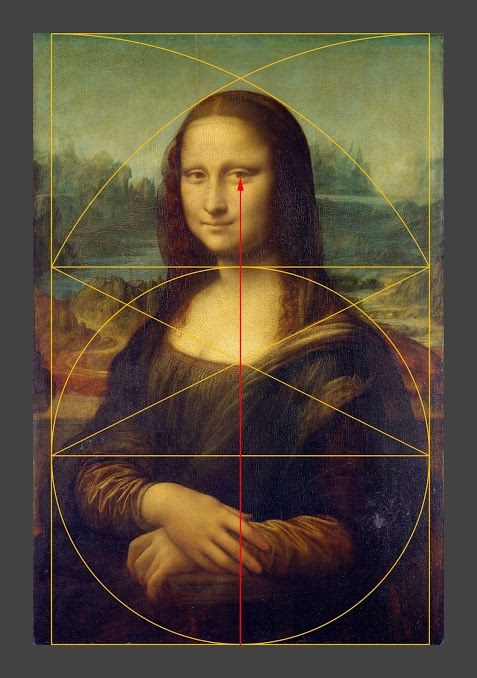
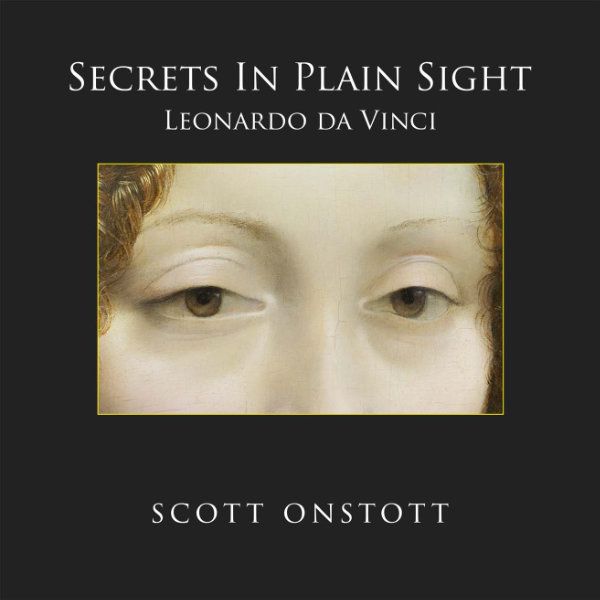
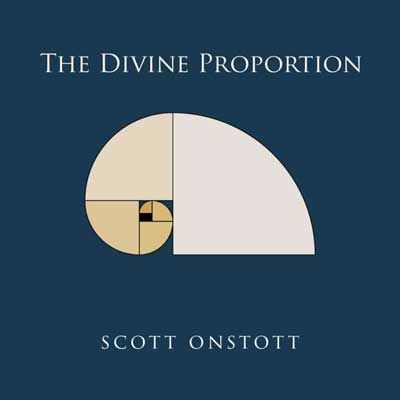
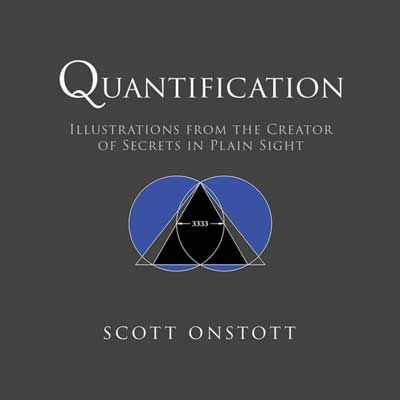
An Old Cartographer's Tip: To deepen the understanding of the advanced archetypes explored in these Masterclasses, explore the 'Square Book Trio.' These full-color visual guides include Secrets in Plain Sight: Leonardo da Vinci, The Divine Proportion, and Quantification, providing the high-definition evidence and geometry that you must see to comprehend.
The Invisible Structure of Mind
"We naturally mirror the structure of our minds in governments, which are designed to act like the minds of the body politic. For example, consider how democratic governments tend to be divided:
• Branches: executive, legislative, judicial
• USA: federal, state, local
• Canada: national, provincial, municipal
• Ancient Rome: consuls, senate, assembly
Religions also often encoded the invisible structure of mind in their traditions and most sacred protagonists:
• Ancient Egyptian: Osiris, Isis, Horus
• Hinduism: Shiva, Brahman, Vishnu
• Christianity: Father, Son, Holy Spirit
• Buddhism: Great retreat which lasts 3 years, 3 months, and 3 days.
Plato’s transcendentals of truth, beauty and goodness are an echo of the older Vedic tradition’s Sat (truth), Chit (beauty), Ananda (bliss). In discussing the intelligible domain, I used the English translation of the Vedic in characterizing the structure of universal mind’s unified trinity as: truth, beauty, and bliss."
• Branches: executive, legislative, judicial
• USA: federal, state, local
• Canada: national, provincial, municipal
• Ancient Rome: consuls, senate, assembly
Religions also often encoded the invisible structure of mind in their traditions and most sacred protagonists:
• Ancient Egyptian: Osiris, Isis, Horus
• Hinduism: Shiva, Brahman, Vishnu
• Christianity: Father, Son, Holy Spirit
• Buddhism: Great retreat which lasts 3 years, 3 months, and 3 days.
Plato’s transcendentals of truth, beauty and goodness are an echo of the older Vedic tradition’s Sat (truth), Chit (beauty), Ananda (bliss). In discussing the intelligible domain, I used the English translation of the Vedic in characterizing the structure of universal mind’s unified trinity as: truth, beauty, and bliss."
—Sacred Geometry: Philosophy & Worldview (page 71)
Geometry can be considered from at least three viewpoints. First as a technical exercise mostly serving industrialization. Secondly as a purely mathematical function. Thirdly, and most importantly, as a science of the soul. This has to be performed with the human hand and is fundamental to a deeper understanding of the Platonic wisdom tradition. Geometry is only fully understood by doing it. —Keith Critchlow (1933-2020)
Qualitative Geometry
SacredGeometryAcademy.com
Sacred Anachronisms
When was the last time you finished a whole book?
When did you last read to expand your worldview?
If this feels too long to read, that is exactly why you need to read it.
We now live in an "attention economy," a world engineered to keep you in a dopamine-seeking loop of short-form monetized noise. Sacred Geometry is the antithesis of that trend. When you pick up a pencil, a straightedge, and a compass, you aren't just drawing; you are performing a quiet act of rebellion. You are stepping out of the limbic "reactivity" of the algorithmic feed and back into the neocortex: the seat of human reason that can intelligently commune with your soul.

Deep reading is a sacred anachronism.
Like sacred geometry, painting, or playing an instrument, it is one of the last few remaining ways to engage the "slow" brain, the part of you capable of catalyzing lasting change and profound "Aha!" moments.
I remember the books that changed me decades ago;
I can’t remember what my feed showed me 5 minutes ago.
Like sacred geometry, painting, or playing an instrument, it is one of the last few remaining ways to engage the "slow" brain, the part of you capable of catalyzing lasting change and profound "Aha!" moments.
I remember the books that changed me decades ago;
I can’t remember what my feed showed me 5 minutes ago.
I write my latest books using a process I call Augmented Craftsmanship. I don't just "push a button" or let a machine do the thinking. Instead, I spend hundreds of hours actively running my ideas through advanced LLMs to sharpen the narrative and deepen the research. Using these tools today is no different than the transition from cursive to the typewriter, or from the canvas to the camera. We are on the cusp of a new age; I choose to master its tools to serve an ancient vision. I am actively using the current tools with my neocortex to shape my logos, not passively swiping through a feed engineered to monetize consciousness.
I write in the hope that you will read with that same intensity. It's not easy. A book is a slow, deliberate conversation that may change how you see the world. It is quality time well spent. Don't just scroll past another day that you won't remember.
I didn't write lengthy books to be skimmed, and you weren't born to be a consumer of summaries. This is an invitation to the depth that brevity cannot reach. Engage your mind in a deep grapple with ideas that dissolve the boundary between the observer and the observed, getting to the heart of what it means to be the conscious experiencing of life itself.
I write in the hope that you will read with that same intensity. It's not easy. A book is a slow, deliberate conversation that may change how you see the world. It is quality time well spent. Don't just scroll past another day that you won't remember.
I didn't write lengthy books to be skimmed, and you weren't born to be a consumer of summaries. This is an invitation to the depth that brevity cannot reach. Engage your mind in a deep grapple with ideas that dissolve the boundary between the observer and the observed, getting to the heart of what it means to be the conscious experiencing of life itself.