Sacred Geometry

Philosophy and Worldview

SECOND EDITION

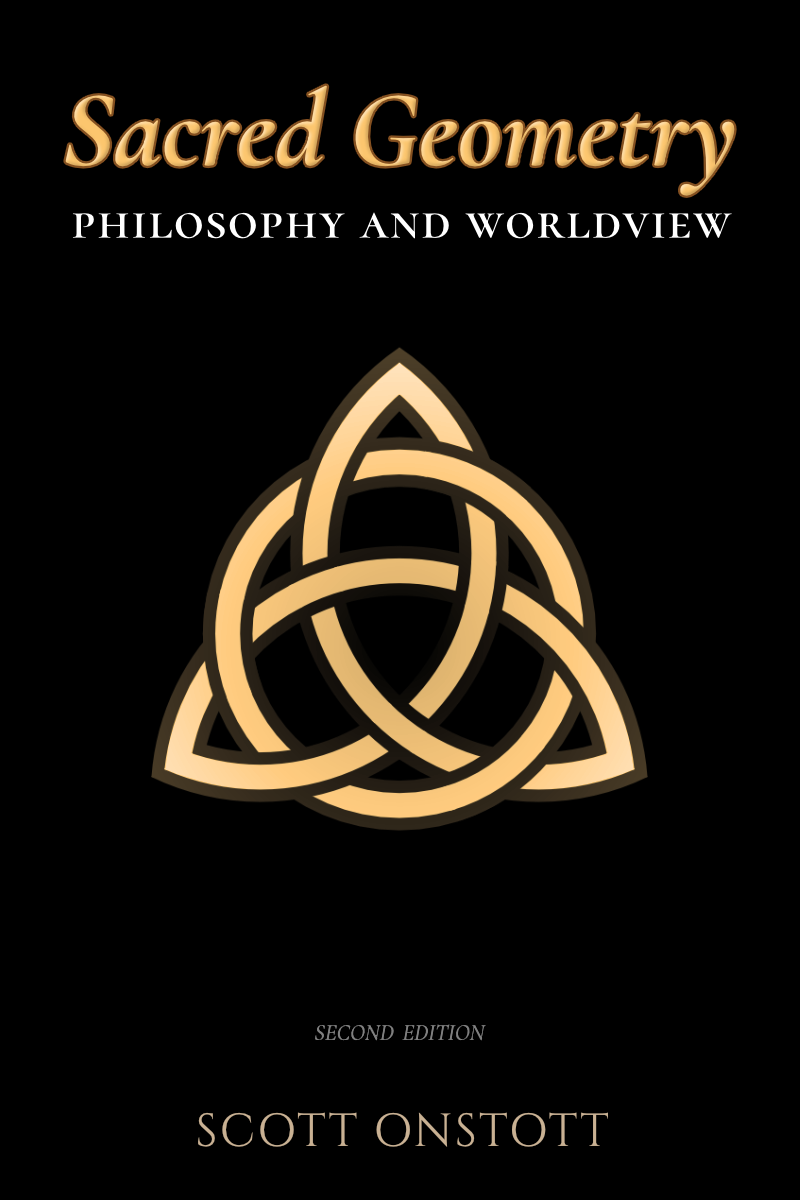
Sacred Geometry: Philosophy & Worldview book cover

the Arch's Foundation

Second edition coming soon

Literary / Cinematic Comparisons:

Combining Inception’s layered exploration of the mind’s architecture with The Alchemist’s search for universal signs and the sense of wonder found in Sagan’s Cosmos. It deconstructs the “hard problem” of consciousness to reveal a universe that is fundamentally minded, and shows how the universal language of qualitative geometry can restore human purpose to a world long obscured by modern materialism.

What if the universe is not a purposeless machine but a living, minded whole, and geometry is the one language that reveals this clearly?

Sacred Geometry: Philosophy and Worldview
is a rigorous, first-principles philosophy of mind and reality. It begins where modern science stops: at the hard problem of consciousness, where the materialist worldview quietly concedes it has no explanation for why there is something it is like to be you.

Rather than patching materialism, Onstott builds an alternative from the ground up. Drawing on Plato, Gödel, Tarski, analytical idealism, and the geometry encoded in everything from atomic orbitals to planetary orbits, he maps what he calls the Reality Atlas: a coherent account of how one infinite awareness gives rise to the full spectrum of minds, worlds, and experience.

In this book you will explore:

  • The three domains of existence: how the Intelligible, the Visible, and the Invisible interact to produce the reality you experience every day
  • Why the brain does not generate consciousness: what it actually does instead, and what the extreme cases of functional compensation reveal about the mind-body relationship
  • The Reality Atlas: a systematic map of universal mind, its dissociations, and the mechanism by which one awareness becomes many apparently separate selves
  • Geometry as the language of mind: from the modular symmetry of quark charges to the golden ratio's appearance in quasicrystals, Nobel-recognized physics, and the proportions of the human body
  • Stages of mind: how human development moves from animistic to universalistic, and why most political and cultural conflict is a collision between stages rather than a disagreement about facts


This is not a collection of mystical assertions. It is a self-consistent philosophical framework, intellectually honest about what it can and cannot prove, and written for the reader who suspects the standard worldview is incomplete but has not yet found a rigorous alternative.


Geometry is not a measuring tool. It is a doorway. This book shows you a glimpse of what is on the other side of the threshold.

A Note on the Second Edition

The first edition of this book was completed in 2021, before AI was a practical research tool. It established the philosophical framework that the Arch series depends on, and that framework has not changed. What changed was my ability to audit it.

In preparing this second edition, I used AI to review the book's citations, attributions, and supporting arguments systematically in a way that would have taken months to do manually, if I could have done it at all. That audit was the catalyst for the revision. What it surfaced was not a flawed argument but a handful of places where the supporting evidence was weaker than the argument deserved. A second edition seemed the right occasion to shore those up.

Four developments emerged from that review as worth addressing. First, the clinical research on near-death experiences has continued to strengthen. The first edition cited sources that gave a skeptical reader an easy target. The second edition replaces the most contested citations with prospective clinical studies from cardiologists and resuscitation physicians whose methodology is rigorous enough to withstand scrutiny.

Second, the philosophical debate about machine consciousness has become impossible to ignore. The first edition made the argument that algorithmic computation cannot be conscious in the relevant sense. That argument was always philosophically serious, but it was brief, and the intervening years have made the question urgent. The second edition develops the supporting references more fully, placing the book's claim in the context of Penrose, Searle, and Nagel, where it belongs.

Third, the contemporary philosophers of mind who most directly support this book's ontology have produced work that postdates the first edition. Bernardo Kastrup's analytic idealism program, Donald Hoffman's evolutionary cognitive science argument for a consciousness-first ontology, and the ongoing clinical consciousness research at the University of Virginia have all moved in the direction this book argues. The second edition acknowledges these allies.

Fourth, the perennial philosophy tradition, whose lineage this book belongs to without naming, deserves acknowledgment. Aldous Huxley named it. Huston Smith mapped it. Frithjof Schuon and Seyyed Hossein Nasr developed its metaphysical precision. The second edition places the book in that lineage, not to trade on authority, but because a reader already sympathetic to that tradition deserves to know where they are.

What has not changed: the argument, the structure, the voice, the insistence that the three-domain framework is something to evaluate rather than believe, and the personal register that, several readers have told me, made the philosophical claims accessible when they might otherwise have bounced off. If you read the first edition and found it useful, the second will be recognizable. If you are arriving for the first time, this is the edition to read.

First Edition Testimonials

5 seven pointed stars

The New Gold Standard

If anyone else has done or is doing what Scott Onstott has accomplished with Sacred Geometry in any contemporary sense, I am not aware of it. The book is an essential piece of reading for anyone interested in the subject of sacred geometry. For beginners, it's the perfect place to start as a primer; for advanced students, it's a refreshing place to rethink ideas and reevaluate preconceived notions. Several great thinkers have written about sacred geometry over the most recent decades — John Michell and Keith Critchlow being two prime examples — however, nearly all have started somewhere in the middle of it all, assuming that their readers are already versed in the subject. On the other hand, Onstott starts at square one, which is helpful for anyone looking to get started without getting lost. With more people worldwide taking interest in the subject — scholars, artists, architects, and designers (even EMD visual creators!) — it would be fitting to see this book become the classic it deserves to be.
Jim Hunter
5 seven pointed stars

A hidden gem

Definitely a book for those wanting to open their perspective about the physical world and its relation to the mental world.
Tiago
5 seven pointed stars

Highly recommended!

In my view, this is a high-value book with information that is timely and very important given the conditions and challenges that humanity is currently facing. There is a ton of merit in this book regardless of whether you are new to the study of sacred geometry, have had a casual interest, or are a long-time student of these studies. I would have valued this book decades ago had I had access to it. Scott Onstott delves into many of the key aspects of these studies, without the baggage of any particular tradition or source. He purposely avoids belief structures. There is the saying, “Follow the money,” and I would say here, “Follow the geometry!” Scott follows the geometry. His concise method works efficiently to aid other students in their individual quests for knowledge and understanding. Scott explicitly states his journey into sacred geometry “resulted in a different way of thinking about everything,” and articulates this as a compelling alternative worldview and philosophical framework. I first became acquainted with Scott through his great work Secrets in Plain Sight, Volumes I and II. My appreciation of his work, his commitment to Sacred Geometry, and his adept teaching abilities have only continued to grow over time. His new book expands this work, and once again demonstrates excellence. He combines deep knowledge and understanding, and this is clearly conveyed through his skills as a teacher and presenter of information. Scott intimately connects us with geometry’s sacred dimensions. Highly recommended!
Richard Paschal
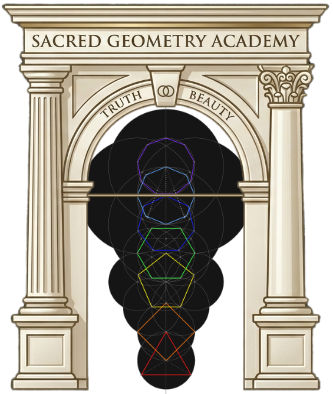
The Arch

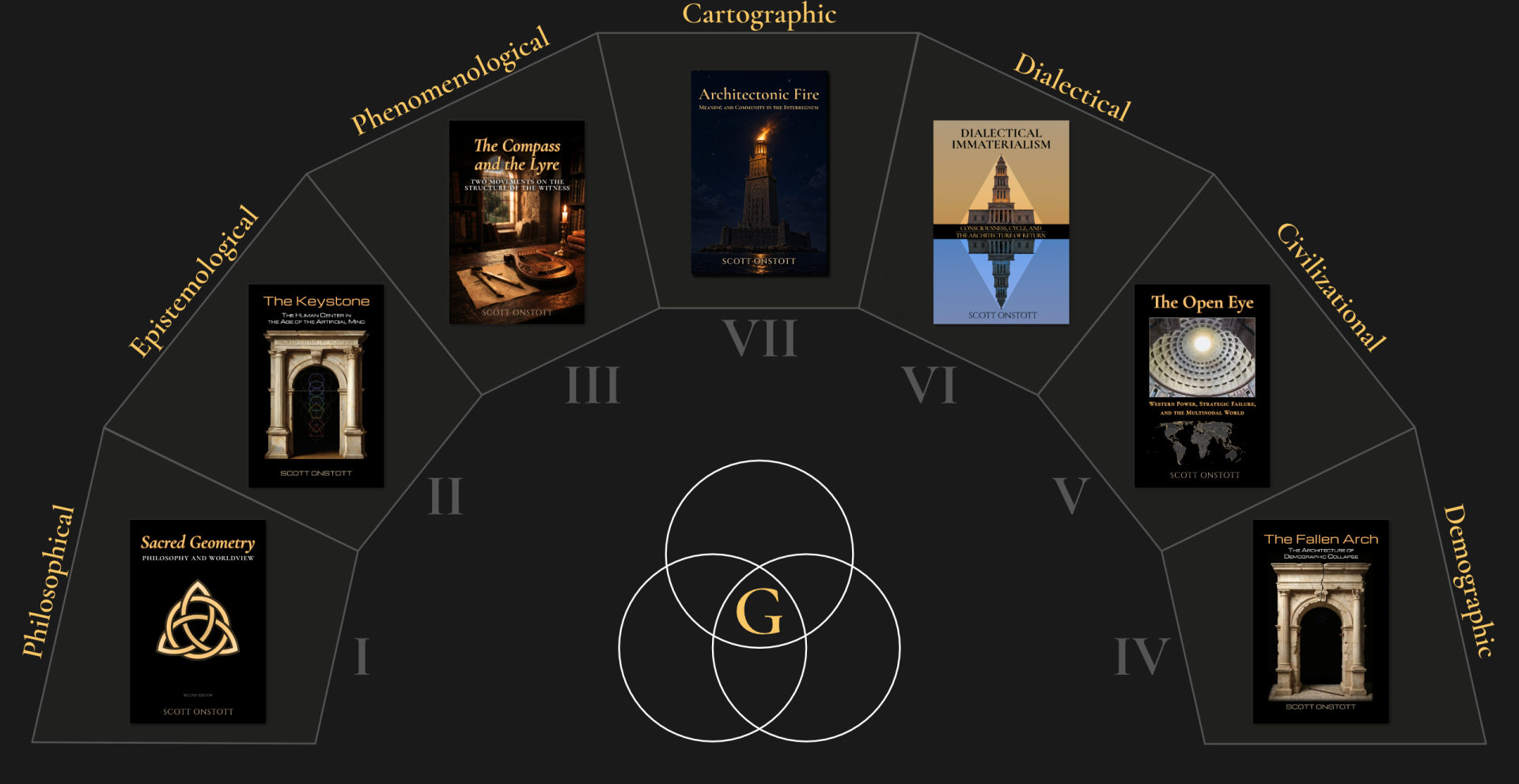
A nonfiction seven-book cycle by Scott Onstott

Seven books tracing the architecture of reality, consciousness, civilization, and the human center
from the foundations of philosophical geometry to the pressures reshaping the modern world.

Seven-book cycle diagram showing seven interconnected nonfiction books arranged around a central geometry

Click/Tap any cover to explore the cycle.

I. Foundation | II. Center | III. Witness | IV. Diagnosis | V. Reflexivity | VI. Return | VII. Transformation

Write your awesome label here.
Created with