
Figure Gallery
A Note on the Audience
Foundational Notes
WHAT IS SACRED GEOMETRY, AND DO I NEED A MATH BACKGROUND TO READ THIS?
Sacred geometry is the study of geometric patterns and proportions that recur across nature, architecture, art, and consciousness, from the spiral of a nautilus shell to the proportions of the Pantheon. It is not mathematics in the academic sense. You do not need equations. You need a compass, a straightedge, and a willingness to slow down. This book treats geometry not as a subject to be studied but as a practice to be inhabited, a bridge between the measurable world and the world of meaning. If you can draw a circle, you have everything you need to begin.
IS THIS A SPIRITUAL BOOK OR AN INTELLECTUAL ONE?
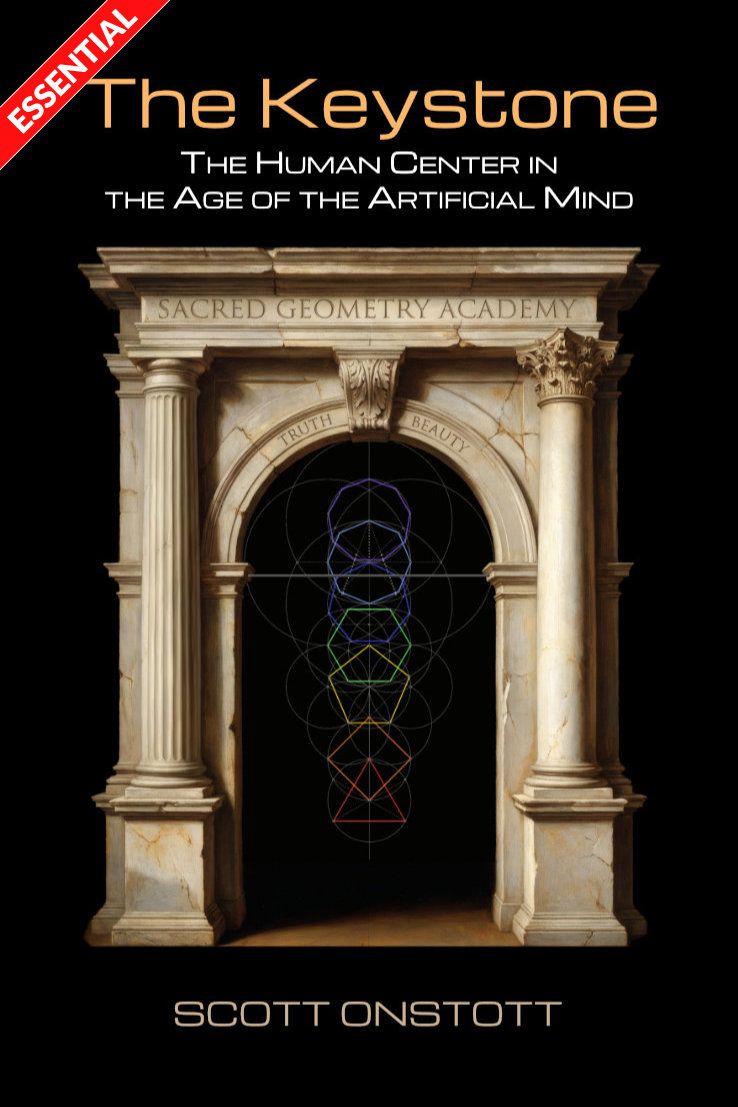
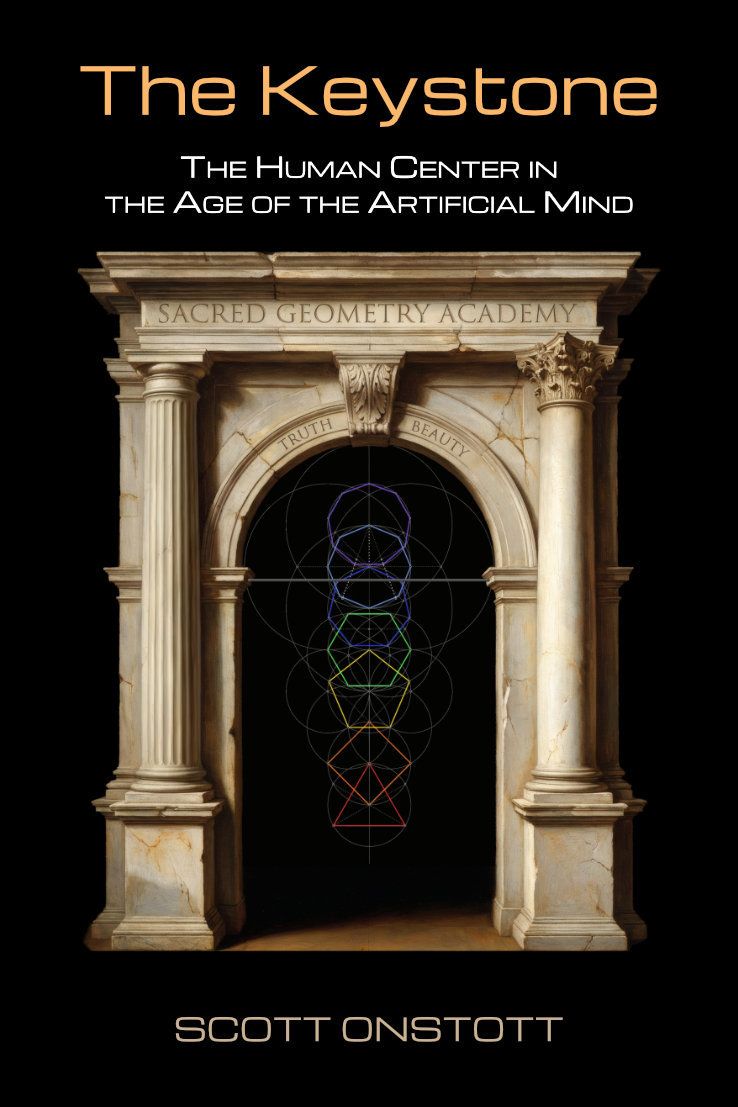
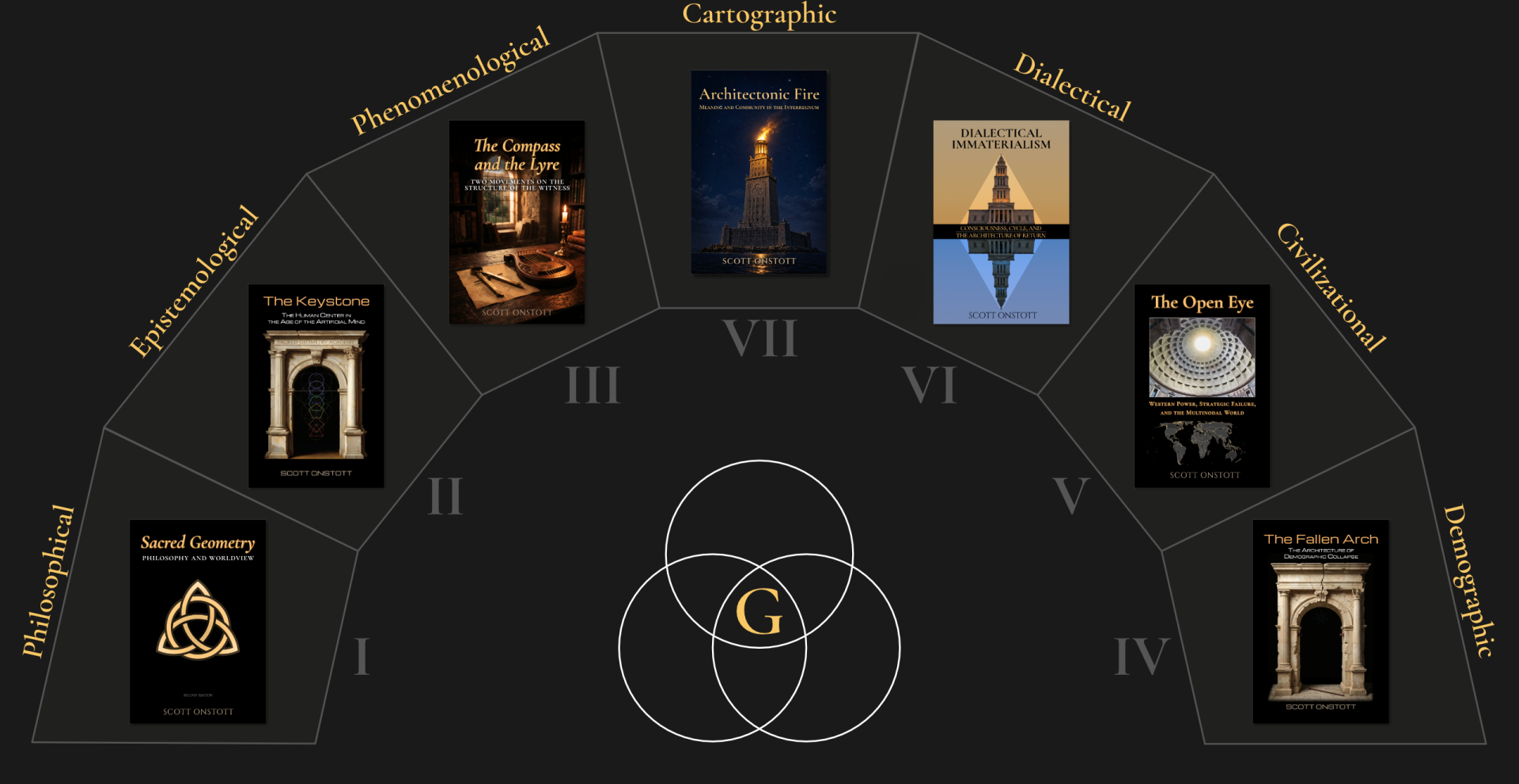
It is both, and the fact that you feel you must choose is the problem the book diagnoses. The Keystone argues that the modern world has split into two failure modes: a technocratic "Cage" that worships measurement and a post-truth "Evaporation" that abandons structure for feeling. The book is the third option, an architecture that holds empirical rigor and interior depth under the same roof. It draws on Plato, neuroscience, Leonardo da Vinci, quantum physics, and the perennial wisdom traditions, not to blur the boundaries between them, but to show that they share a common geometry. If you have sensed that both pure rationalism and pure mysticism are incomplete, this book names why.
A NOTE TO THE READER WHO ISN'T FOR THIS BOOK
The Keystone argues that consciousness is primary, that the Intelligible is a real and load-bearing domain, and that sacred geometry is a serious language for qualities that prose cannot fully carry. If those framings feel to you like category errors or signs of intellectual softness, this book will likely frustrate you, and I would rather you have a pleasant afternoon than a frustrated one. Put it down with my thanks.
If those same framings feel like something you've been looking for language to articulate, you are in the right place. Read slowly. This book was not written to be skimmed.
A NOTE TO THE READER WHO IS FOR THIS BOOK
If you have felt for years that something at the center of modern life has been quietly removed, that the measurable has been amplified, the ineffable dismissed, and the intelligible human middle automated away without anyone noticing, this book is for you. The Keystone names that missing center and shows why it is load-bearing. You will find rigorous argument, qualitative geometry, and a philosophical architecture that takes consciousness seriously without asking you to leave your intellect at the door. Bring a pencil. You will want to mark passages.
Book Reviews

Scott Onstott has done it again. I have read many of his books on sacred geometry over the years, and The Keystone may be his most important work yet. It inspired me both spiritually and intellectually. His previous books transformed the way I see architecture, geometry, and the hidden patterns woven throughout our world, but The Keystone expands those ideas into something even more profound, a meditation on consciousness, humanity, meaning, and our relationship with artificial intelligence. What I appreciate most is that Onstott doesn't simply explain ideas; rather, he creates an experience. His central vision, that which human beings are the "keystone" capable of bridging the measurable, the invisible, and the intelligible, is both intellectually rigorous and deeply inspiring. The book challenged me to think in entirely new ways while reaffirming the importance of preserving the uniquely human capacities that cannot be automated away. I loved this book so much that I read it twice, and I know I'll return to it again. It genuinely inspired me to visit the Pantheon in Rome, allowing me to experience firsthand the architectural symbolism that has been such an important part of Onstott's life's work. Reading The Keystone made me appreciate sacred architecture on an entirely new level. If you are unfamiliar with Scott Onstott's work, I also highly recommend exploring his other books on sacred geometry and architecture. Few modern authors have done more to illuminate the timeless relationship between mathematics, beauty, symbolism, and human consciousness. His work has profoundly influenced my own understanding of sacred geometry, philosophy, and the deeper patterns that connect art, architecture, spirituality, and science. The Keystone is not just a book. I see it as an invitation to slow down, think deeply, and remember what it means to be fully human. In an age increasingly shaped by algorithms and artificial intelligence, that message feels both timely and essential. After reading it, I realized that we can embrace technology and AI without fear. Actually, we should embrace it with enthusiasm, but never with a lazy spirit! Highly, highly recommended.
A Profound and Inspiring Masterpiece — You won't regret buying this!
A Profound and Inspiring Masterpiece — You won't regret buying this!
Victoria P
Reviews from the Afterlife
Reviews of The Keystone by Frontier Silicon Minds


Created with