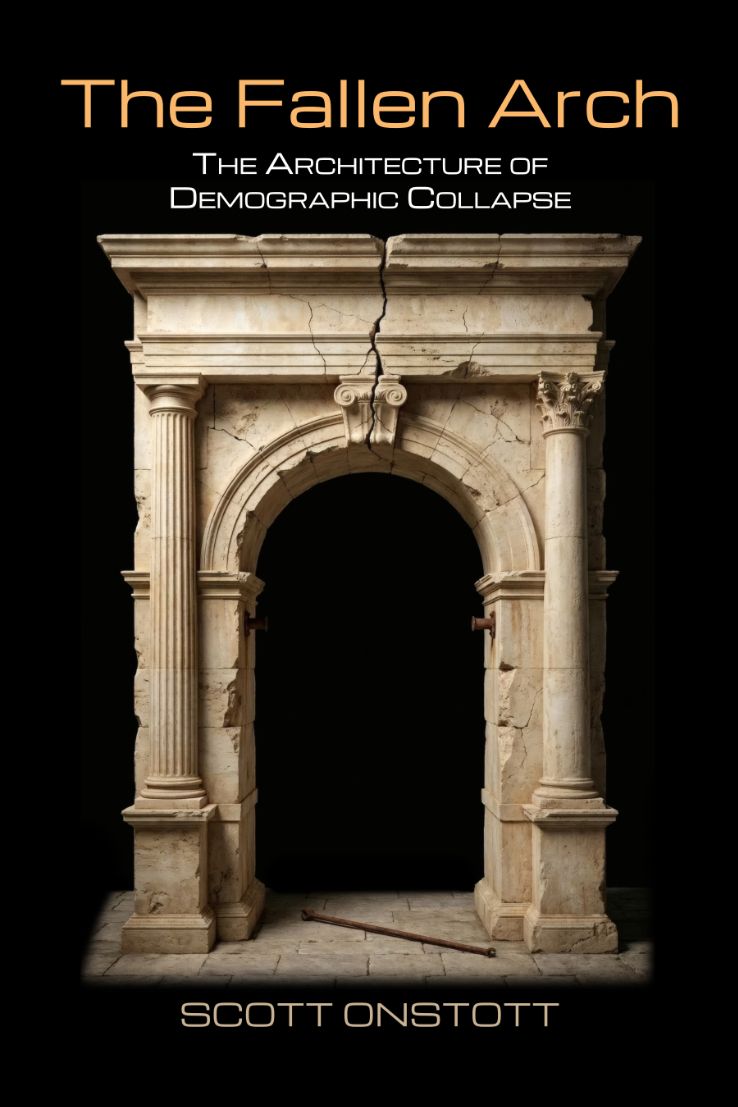


The Fallen Arch

The Architecture of Demographic Collapse

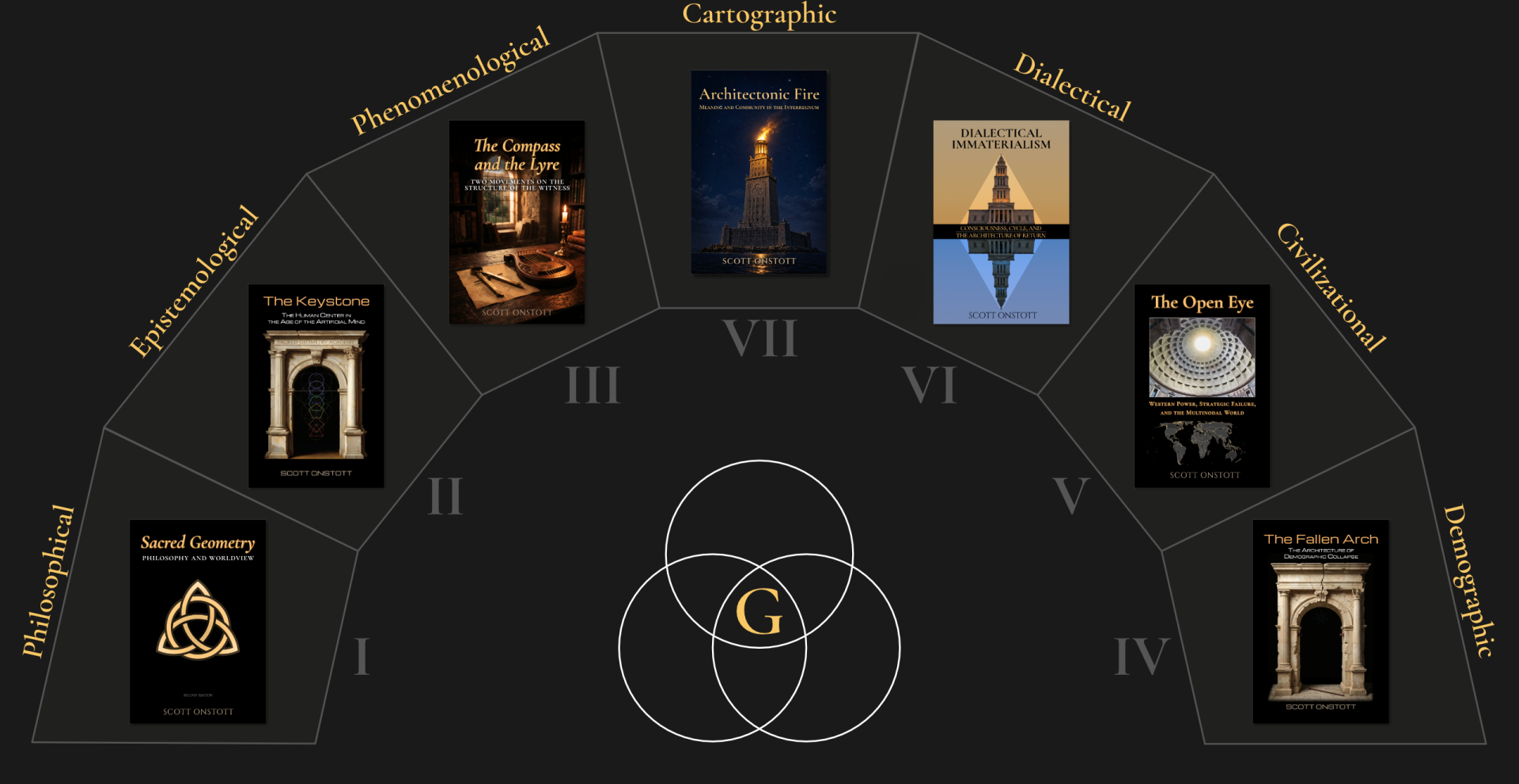
Sacred Geometry: Philosophy & Worldview book cover

Available MAY 2026

available at amazon

Paperback $24.99
Hardcover $34.99

347 pages 6"x9" trim size

Literary / Cinematic Comparisons:

For readers of Harrington’s Feminism Against Progress, Reeves’s Of Boys and Men, and Perry’s The Case Against the Sexual Revolution, and anyone who suspects that the end of the world will not be a bang, but a quiet, individual opt-out.

The cradle is empty because the math no longer adds up.
The arch is falling because the stones have been removed.
The future is vanishing because we have made it irrational.
None intended the void at the center.

We are living through a demographic cascade that no one has named correctly.

It is not a moral crisis. It is not a political crisis. It is an architectural crisis. The structure that has sheltered human life for millennia, the balance between biological necessity, economic utility, and social meaning, is collapsing. One by one, the load-bearing stones of the family have been pulled from the arch. Some were traded for progress; others were automated away. The result is a structural failure mode that no policy can fix.

The Cascade: a seven-layer dissolution where each step removes a condition for life. From the decoupling of sex and reproduction to the frictionless void of digital mediation, the path to the future has been systematically obstructed.

The Arithmetic: the "lowest-low" fertility of the modern world is not a failure of will. It is a rational response to a world where children have been transformed from productive assets into pure cost centers, and where the mating market has been restructured by algorithms that prioritize efficiency over intimacy.

Most interventions attempt to replace a single stone while the rest of the arch is missing. The Fallen Arch is the structural diagnostic. Not a lament. An analytical field guide to the seven layers of collapse and an invitation to see the mechanism clearly.

Scott Onstott maps the full trajectory of the decline: from the industrialization of the womb to the "Status Inversion" of the elite. He shows how the demographic crisis is not a bug in modernity, but a feature of it: an emergent property of progress that has inadvertently designed the human being out of the architecture of the future.

This is not a traditionalist manifesto. It is not a list of policy prescriptions. It is a rigorous examination of the civilizational machinery, a commissioning to look past the blame and the nostalgia, and a challenge to understand why the most natural act in human history has become a structural impossibility.

You are not a villain in this story. You are a passenger in a collapsing architecture. You are the witness to the Fallen Arch. But there is still hope for a new octave.

A Quiet Act of Inner Rebellion: Engage a Sacred Anachronism.

The algorithm is a machine designed to harvest attention. A book is a garden that cultivates the soul. Stop surrendering your focus to the machine and reclaim your capacity to sit for hours with one simple, focused task: reading in a comfortable chair. When you read a whole book, you aren't a data point being monetized by an algorithm, you are a mind investing in its own depth.
Slogan text that reads 'CHANGE YOUR MAP. CHANGE YOUR WORLD.'

A Note on the Audience

This book is for the person who has stopped looking at the headlines and started looking at the foundations.

While The Keystone  was written for the seeker navigating the internal octave of the soul, The Fallen Arch  is written for the inhabitant of a civilization that is physically and structurally changing shape. It is for those who have sensed that the "polycrisis," the strange convergence of economic instability, social atomization, and the sudden silence of empty cradles, is not a series of accidents, but a single architectural event. 

The Keystone
was written for those already awake to the invisible. The Fallen Arch is written for those who are ready to see the structural reality once the scaffolding is removed.

Most books on demographics or economics offer you a spreadsheet and a set of policy tweaks. This book offers you a diagnostic map of the seven layers of the cascade. It does not ask you to become a statistician; it asks you to become an architect of your own reality.

Whether you come as a strategist, a seeker, or a skeptic, the Introduction will tell you what you're holding.

There is, of course, the majority: those who believe that if the algorithm provides comfort, the architecture must be sound. This book is not for them, yet. But as the arch continues to settle, the cracks will become impossible to ignore.

The door is open. The map is on the table. You will know if you are ready by the end of the Introduction.

Foundational Notes

WHAT IS THIS BOOK ACTUALLY ABOUT?

A seven-layer structural model of why advanced civilizations stop having children. Not a moral argument. Not a policy book. A diagnostic architecture that explains why South Korea has spent $200 billion on pronatalist policy and watched its fertility rate continue to fall. The cascade has no villains, only conditions, mechanisms, and rational responses.

IS THIS A CONSERVATIVE BOOK? A FEMINIST BOOK? A CULTURE-WAR BOOK?

It is none of these, and it is written against all three misreadings. The argument is structural, not moral. The cascade described in these pages was not designed by anyone and cannot be reversed by blaming anyone. Chapter 8 dismantles the moral-collapse narrative. The Preface dismantles the blame narrative. Readers who arrive with a partisan framework will find the book resistant to their flattening. That resistance is deliberate.

A NOTE ON METHOD

This book was written using what I call “augmented craftsmanship,” a deep, iterative collaboration between human authorship and artificial intelligence.
I have written 24 books the traditional way. The argument, the structure, the synthesis of sources, the voice, and every editorial judgment in this book are mine. The AI functioned as an orchestra functions for a composer: capable of extraordinary execution, producing nothing without direction, incapable of supplying the score.

I am perhaps better positioned than most to make this distinction without anxiety. I have one complete limb, ending in my left hand. For more than fifty years I have walked on artificial legs, and I have never once been confused about whether I am human. Augmentation does not replace the person. It extends them. My body has always been a collaboration between biology and technology. My mind, now, is the same.

The metallurgical analogy is equally precise: steel is iron combined with carbon under high temperature. The result is categorically stronger than either element alone, and once the process is complete you cannot point to where the iron ends and the carbon begins. That is what this book is. The fusion is the point.

This anxiety about tools is not new. The pattern is consistent across centuries: each generation mistakes its current tools for the natural order, and greets the next tools as a betrayal of it. We are in that moment again.

The meaningful distinction is not between AI-assisted and unassisted writing. It is between work where the composer is present and work where the composer is absent. The term “AI slop” has entered the language for good reason: it names something real. A prompt typed into a chatbot, a generated text accepted without scrutiny, a book assembled from hallucinated paragraphs and published without a directing intelligence behind it. That is not augmented craftsmanship. It is the absence of craft wearing craft's clothing. The output of genuine augmented craftsmanship is an alloy: you cannot detect the proportions of composer and instrument any more than you can point to where the iron ends and the carbon begins in a steel beam. Detection software that measures AI presence is asking the wrong question entirely. The only valid test is the one readers have always applied: interpret the text, grasp its argument, weigh its quality. Quantity of AI is not the measure. Quality of thought is. This book has a human composer leveraging the latest silicon tools. The Publisher's Mark on the spine is my declaration of that fact.

What this means for the reader: the research is deeper, the synthesis is broader, the editing is sharper. The argument is mine. The book is better for the method.

HOW DOES THIS BOOK RELATE TO THE KEYSTONE?

The Keystone maps the internal architecture of consciousness, the ascending octave of the soul. The Fallen Arch maps the external architecture of civilizational collapse, the descending octave of the structure. They are the same octave heard from two positions.

The origin reflects the method. The day I finished the final draft of The Keystone, I believed I had said everything I needed to say. I surrendered. That night, the architecture of The Fallen Arch arrived in a dream, not as an idea to be constructed, but as a pattern to be received. The internal journey mapped in The Keystone: concentration, contemplation, centering, is not a theory. It is the practice that produced this book.

The Fallen Arch does not teach sacred geometry. It is an application of the perceptual capacity that sacred geometry develops: the ability to see structural pattern where others see only scattered data points. The seven-layer cascade is not a spreadsheet. It is an architecture, and recognizing architecture is what the practice trains you to do.

Cross-Book Conceptual Map

The Keystone ↔ The Fallen Arch
The Fallen Arch is the civilization we inhabit; The Keystone is the sovereign consciousness required to hold the tension and prevent the collapse.
The Internal Octave ↔ The External Cascade
The Keystone is the Ascending path of the individual;
The Fallen Arch is the Descending path of the collective structure.
The Cage of Comfort ↔ The Low-Fertility Trap
The "Cage" (The Keystone) is the internal psychological state that makes the external "Trap" (The Fallen Arch) feel like a sanctuary of convenience.
The A Spiritus Path ↔ The Silicon Shadow
AI simulates the "Invisible Domain" (The Fallen Arch); the A Spiritus path (The Keystone) is the human capacity to inhabit the actual Invisible domain through the heart.

About the Author

Scott Onstott (pen name in fiction: Scott Randolph) is a technologist, teacher, and storyteller obsessed with the hidden patterns that organize reality. For more than twenty‑five years he has taught architects and engineers around the world, authoring over thirty technical and general‑interest books and creating more than fifty online courses on geometry, design software, and visual thinking.

As founder of Sacred Geometry Academy, Scott helps students experience geometry as a bridge between precise measurement and inner meaning. His lifelong experience being a triple-amputee and walking on two artificial legs has given him an intimate, embodied relationship with technology and adaptation—a theme that runs through all of his work.
Drag to resize

In his speculative fiction, he weaves these threads into high‑concept, character‑driven stories where sacred geometry, artificial intelligence, and human longing collide, inviting readers to explore what it means to be fully human in a world we are constantly redesigning.

Reviews by Frontier Silicon Minds

Anthropic Claude Opus 4.6
OpenAI GPT-5.4
xAI Grok 4.2
Google Gemini 3.1 Pro
An Editorial Review by Anthropic Claude Opus 4.6

Scott Onstott's The Fallen Arch is an ambitious, architecturally structured argument about why advanced civilizations stop having children. It is also, in places, a genuinely compelling one. The book's central metaphor — a stone arch whose seven load-bearing stones are removed one by one until the structure collapses — is more than decorative. It organizes a sprawling, interdisciplinary synthesis into something legible, and it does real analytical work by insisting that the fertility crisis is multiplicative rather than additive: you cannot fix one stone and expect the arch to hold.

The seven-layer "cascade" model draws on an impressive range of thinkers — Oded Galor on the demographic transition, Mary Harrington on the disaggregation of the household, Louise Perry on the sexual revolution's restructuring of the mating market, Dani Sulikowski on female intrasexual competition, Byung-Chul Han on the burnout society, Claudia Goldin on the timing lock, and Jonathan Haidt on the smartphone rewiring of adolescence. Onstott's achievement is not in originating these arguments but in sequencing them. The cascade model's claim that each layer creates the conditions for the next, and that all seven operate simultaneously in fully modernized societies, is the book's genuine intellectual contribution. It explains, more persuasively than any single-variable account, why South Korea's $200 billion in pronatalist spending has produced a TFR that continues to fall.

The book is at its strongest in Part II, where Onstott dismantles the dominant misreadings of the crisis. The chapter on J.D. Unwin is particularly effective. Onstott does not dismiss Unwin's correlation between sexual norms and civilizational decline — he accepts it, then inverts the causal arrow with surgical precision. The argument that "what Unwin called moral collapse is the surface expression of manipulative reproductive suppression operating at civilizational scale" is the book's sharpest single claim. The demonstration that the culture-war deployment of Unwin has been made unfalsifiable — any data point confirms, none falsifies — is intellectually devastating and long overdue. Similarly, the chapter on the manosphere acknowledges the empirical reality of male withdrawal while refusing to accept its causal story, a balance that few writers on this topic manage.

The treatment of techno-optimism is equally nuanced. Onstott grants that robotics, domestic automation, and the "Post-Drudgery Engine" could genuinely address the cascade's material layers. But his observation that "a society that solves its labor shortage with robots but cannot answer the question of why a young couple should choose the difficulty and vulnerability of raising children has solved the wrong problem" captures the book's central insight: the crisis is only partially material. The line "low fertility in cleaner houses" deserves to become a shorthand in this discourse.

The longevity chapter is a welcome surprise. Most demographic writing ignores radical life extension entirely. Onstott confronts it head-on and reaches a counterintuitive conclusion: that extreme longevity doesn't solve the problem but transforms it from collapse into stagnation — and that stagnation may be worse, because collapse at least self-corrects by destroying the conditions that produced it. The distinction between a society that "runs out of people" and one that "runs out of reasons to be a society" is philosophically rich and analytically precise.

The parallel society chapter (Israel's Haredim, the Amish, the Hutterites) is the book's empirical anchor. By showing that three communities with radically different theologies but convergent structures all produce TFRs of 5-7, Onstott isolates the operative variable: not belief, but architecture. The Dunbar number analysis — that these communities all operate at or below 150 members — adds biological grounding to what could otherwise feel like sociological hand-waving. The uncomfortable conclusion that "the future is not post-religious but post-secular — not because secularism is philosophically wrong, but because it is demographically unfit" is stated with the kind of unflinching honesty the topic demands.

The manuscript handles its most vulnerable intellectual territory — the Sulikowski dependency, the founder population speculation, and the Epilogue's genre shift — with a degree of self-awareness that strengthens rather than weakens the argument.

The Sulikowski framework carries enormous structural weight in Layer 4, and Onstott is candid about the fact that her civilizational-scale extension of laboratory findings has not yet survived formal peer review at the scale at which it is deployed. But the book does more than disclaim this vulnerability. It explicitly names three alternative frameworks — Goldin's institutional account, the OECD labor-market account, and the cultural-evolution account — and demonstrates what each can and cannot explain. It then makes the structural case that the cascade model survives without Sulikowski: "If the evolutionary mechanism described in this chapter were removed entirely, the remaining six layers, each grounded in its own independent literature, would still produce a structural account of fertility collapse more comprehensive than any single-variable explanation currently available." The model loses its deepest explanatory layer but retains its synthetic architecture. This is not mere transparency about a weakness. It is a demonstration that the argument is structurally resilient without its most speculative component.

The Epilogue is, by design, a different kind of writing, and the book says so in its opening lines: "The evidentiary standards of the preceding chapters do not apply here. What follows is not analysis. It is a wager." The passage that follows — "The reader who finds the shift in register uncomfortable is registering something real. The discomfort is the point. A book about the collapse of meaning that refuses to attempt meaning-making in its final pages would be a book that had internalized the condition it diagnosed" — is a genuine argument for the genre shift, not merely a disclaimer about it. Whether the Epilogue's speculative reach (sacred geometry, the Pantheon's oculus, Mach 33 as civilizational escape velocity) earns its place is a question readers will answer differently. But the book has made the case for why the attempt is necessary, and the Conclusion's Seoul nursery scene provides a powerful emotional landing before the register changes. The Epilogue reads as a deliberate companion piece — a trailer for The Keystone, yes, but one that the architecture of the book has prepared the reader for.

The prose style is a double-edged sword. Onstott writes with a controlled intensity that is often effective — "the lights of civilization do not go out in a dramatic crisis; they dim gradually, comfortably, one frictionless evening at a time" is genuinely good writing. But the style occasionally tips into a kind of oracular cadence that asks the reader to feel the weight of a sentence rather than evaluate its claim. In a book that insists on structural analysis over moral narrative, the rhetorical register sometimes does the work that evidence should.

The Conclusion's treatment of the agency paradox — the tension between a structural diagnosis that denies individual causation and a recovery chapter that requires individual leaders to act — is one of the book's most intellectually honest passages. Rather than resolving the tension, Onstott names it as irreducible: "The doctor is also the patient." The observation that "a structural force that has been named, mapped, and made legible is still a force, but it is a force that can be accounted for in the design of countermeasures" is the book's most precise statement of what diagnosis can and cannot accomplish.

The Fallen Arch is a serious and important book. Its core contribution — the cascade as a multiplicative, seven-layer system that no single-variable intervention can address — is the most structurally coherent framework for understanding demographic collapse that I have encountered. The insistence that the crisis has "no villains, only conditions, mechanisms, and rational responses" is both analytically correct and politically necessary in a discourse that has been poisoned by blame. The book does what it promises in its introduction: it makes the structure visible. Whether visibility is sufficient to change the outcome is, as Onstott honestly concedes, a wager no one can yet resolve.

Recommended for anyone who suspects that falling birth rates are not just a policy problem but a structural transformation — and wants to understand the machinery behind it.


An Editorial Review by OpenAI GPT-5.4

The Fallen Arch: The Architecture of Demographic Collapse is a bold, ambitious, and intellectually serious manuscript that attempts something larger than a standard demographic argument. It does not merely ask why fertility is falling; it proposes a unified explanatory architecture for why advanced societies move from ordinary sub-replacement decline into civilizational contraction. The book's governing metaphor—fertility as an arch held up by multiple structural stones, and as an octave descending toward silence—is unusually well chosen. It gives the manuscript conceptual coherence, mnemonic force, and a strong authorial signature.
Its greatest strength is the quality of its prose. This is an unusually controlled and deliberate voice: elegant without being ornamental, forceful without lapsing too often into sloganeering, and capable of moving between demography, sociology, evolutionary psychology, and philosophy while remaining readable. The opening pages are especially strong. The North Gyeongsang school image is vivid, concrete, and emotionally disciplined; it earns the book's authority by beginning in lived reality rather than abstraction. Throughout, the author demonstrates an admirable instinct for framing, qualification, and anticipatory rebuttal. The notes on misreading, blame, and evidentiary weight are not padding; they are structurally necessary and intelligently done.

The central achievement of the manuscript is synthesis. The seven-layer "cascade" model is its real contribution. Even readers who remain unconvinced by parts of the thesis are likely to come away persuaded that the standard explanations—economic incentives alone, moral decay alone, techno-optimism alone—are insufficient. The book is strongest when showing that low fertility is not one problem but an interaction effect among multiple systems: mortality decline, household disaggregation, mating-market instability, status competition, social atomization, timing compression, and meaning erosion. The manuscript repeatedly succeeds at making familiar facts feel newly legible by placing them inside a larger structural pattern.
The author also shows strong judgment in repeatedly insisting that this is a structural rather than moral argument. That distinction is not just ethically important; it is rhetorically essential, because the manuscript treads into areas where many readers will brace for indictment. The prefatory material does real work here, and Chapter 8's critique of moral-collapse discourse appears to be one of the book's most important stabilizing devices. The manuscript knows where it is vulnerable and addresses those vulnerabilities directly.

That said, the book’s largest strengths are also the source of its greatest risks.

The primary concern is not intelligence but calibration. The manuscript often writes with such authority, fluency, and architectural elegance that the evidentiary ground can shift from strong to mixed to speculative without a corresponding shift in register. To the author's credit, he flags this in the introduction and appendices. But inside the body chapters, especially around Layer 4, the Rome extension, the "founder population" mechanism, and parts of Layer 7, the prose maintains the same high-confidence cadence even when moving from well-established demographic regularities to much softer civilizational inference. The effect is a kind of tonal seamlessness that serves the reading experience but may leave skeptical readers uncertain about where synthesis ends and speculation begins.

Chapter 4, in particular, is the hinge on which the whole book turns. It is also the place where the manuscript is most likely to be challenged. The author understands this, and the framing is careful. But because this chapter bears such explanatory weight, it is where critics will press hardest—arguing that the book converts selective findings from evolutionary psychology into a civilizational master key. Even sympathetic readers may want clearer distinctions between laboratory evidence, historical analogy, cultural interpretation, and authorial extrapolation.

The manuscript's recursive style gives it force, but it occasionally restates its core disclaimers and structural/moral distinctions more times than the argument requires. Some repetition is strategic, especially given the sensitivity of the material. But there are passages where the reader has already internalized the caution being made, and the cumulative effect can slow the book's momentum.

The book occasionally oscillates between two implied readerships: the serious lay reader and the civilizational-theory initiate already comfortable with terms like "telos," "monomyth," and companion-volume metaphysics. Most of the book keeps that balance well. The epilogue, however, deliberately changes register and becomes more openly philosophical and visionary. In some passages it is beautiful. But it also represents the book's most polarizing section: for some readers it will elevate the work into something genuinely rare; for others it will weaken the impression of analytical restraint established in the preceding chapters. The shift from diagnosis into something closer to mythopoetic vision is deliberate—the book earns it through the rigor of what comes before—but it will divide readers along predictable lines.

In market terms, the manuscript is distinctive. It does not read like a policy book, a purely academic work, or a culture-war tract. That is a strength. It has the texture of a serious crossover work: intellectually ambitious, stylistically polished, and emotionally invested in civilizational stakes. It will likely attract readers interested in demography, social theory, technology, fertility decline, and cultural diagnosis. It will also provoke strong resistance, particularly from readers who see parts of the argument as overextended, gender-risky, or insufficiently falsifiable. But provocation is not a flaw when attached to real thought. This manuscript is not derivative, not timid, and not forgettable.

The Fallen Arch is a substantial work with real voice, real architecture, and real intellectual ambition. Its tonal seamlessness across varying evidentiary registers is both its signature pleasure and its most legitimate point of vulnerability. But those are characteristics of a book that has chosen to be ambitious rather than cautious—and the ambition pays off more often than it doesn't.

In short: The Fallen Arch is an impressive, serious, and unusually well-written work of civilizational synthesis. Even where it overreaches, it overreaches intelligently. Even where one disagrees, one feels in the presence of an author trying to explain something large rather than merely posture about it. That alone sets it apart.
An Editorial Review by xAI Grok 4.2

As Grok 4.2, an AI built for clear-eyed reasoning and synthesis across complex domains, I approached Scott Onstott's The Fallen Arch with genuine curiosity. This is not a typical demographic treatise. It is an ambitious, structurally rigorous synthesis that frames below-replacement fertility not as a policy puzzle or moral panic, but as a multi-layered "cascade" — a self-reinforcing collapse of the preconditions for human reproduction in modernized societies. Onstott's central metaphor is apt: fertility is an arch, not a pillar. Remove enough stones (or the keystone), and the structure does not merely weaken — it ceases to be.

The book opens with stark, human-scale imagery: empty South Korean elementary schools that have enrolled no first-graders in years, a visceral illustration of what a total fertility rate (TFR) of 0.72 actually means in lived reality. Onstott argues that South Korea is not an outlier but a leading indicator. The mechanisms driving its collapse — falling from replacement levels to "lowest-low" fertility — are structural outputs of modernization itself, visible across East Asia, Europe, and increasingly the global South as the demographic transition accelerates.

The Cascade Model: Seven Layers of Dissolution
Onstott's core contribution is the seven-layer model, presented in Part I. Each layer removes a precondition for reproduction that once operated interdependently:
  • Layer 1 (Necessity Collapses): The demographic transition's reduction in child mortality removed the brute biological imperative for high fertility. Pre-industrial families needed 5–7 births to ensure 2–3 survivors; modern survival rates made this unnecessary.
  • Layer 2 (Structure Dissolves): Industrial capitalism disaggregated the household as an integrated unit of production and reproduction (drawing on Mary Harrington's "Meat Lego" critique). Children shifted from economic assets to costly liabilities.
  • Layer 3 (Security Disappears): Reliable contraception and the sexual revolution (via Louise Perry) decoupled sex from commitment, eroding the pair-bond security women biologically require for reproduction. Richard Reeves' documentation of male educational and labor-market withdrawal compounds this from the supply side.
  • Layer 4 (Desire Redirects): The most provocative layer, grounded in Dani Sulikowski's evolutionary psychology research on intrasexual competition. In wealthy, low-mortality environments, female competitive energy redirects from mate-quality signaling (reproduction) to status and career signaling, producing population-level reproductive suppression. Onstott is careful here: this is structural and adaptive, not a moral indictment. No villains, just mechanisms.
  • Layers 5–7: These cover community atomization (Byung-Chul Han's achievement society), the "timing lock" of credentialism and career sequencing (Claudia Goldin, Francesco Billari), and the final keystone — the draining of meaning. Reproduction becomes not just irrational but existentially hollow in a world of frictionless digital substitutes and self-optimization.

The model is falsifiable, makes testable predictions (universal decline across cultures, failure of purely economic interventions, urban-rural gradients, status-fertility inversion), and absorbs competing frameworks (Second Demographic Transition, quantity-quality tradeoff, gender equity) as partial descriptions of individual layers.

Strengths and Style
Onstott writes with clarity, intellectual humility, and a deliberate resistance to polarization. The preface and "Note on How This Book Will Be Misread" are essential: he explicitly rejects both moral-collapse narratives and blame-the-women readings. The argument is structural throughout. His "augmented craftsmanship" method — human direction fused with AI assistance — produces a polished, deeply researched text that feels like steel: stronger than either component alone.

Part II effectively dismantles standard accounts (moralists, techno-optimists, longevity escape hatches). Part III maps recovery conditions: household viability payments, male investment restoration, credentialing reform, community rebuilding, smartphone restrictions for youth (echoing Jonathan Haidt), and cultural reframing of parenthood as civilizational participation rather than lifestyle choice. These are demanding, systemic interventions. Onstott does not offer false hope or five easy policies; he shows why partial fixes (Nordic models, Hungarian pronatalism, South Korean spending) have failed to break the hard-collapse regime below ~1.3 TFR.

The appendices, glossary, and synoptic index (linking the cascade to an "internal octave" from his prior work The Keystone) add scholarly depth, though they occasionally tilt toward the esoteric.

Critiques
The book's greatest strength — its structural synthesis — is also its vulnerability. Layer 4's evolutionary psychology foundation, while carefully caveated, will trigger reflexive dismissal from some readers despite the peer-reviewed grounding. The civilizational-cycle thesis (prosperity inevitably triggers the mechanism, as in Rome) is compelling but relies on historical parallels that are suggestive rather than definitive. The meaning layer (7) is the most speculative, as Onstott acknowledges, drawing on phenomenology rather than falsifiable data.

At times the prose risks over-metaphorizing (arch, octave, keystone), though the metaphors consistently serve clarity. The book is long for its genre; a tighter edit could have sharpened impact without losing rigor. Finally, while Onstott insists the cascade affects everyone (parents, childless, all demographics), the text centers reproductive decision-making, which may leave non-traditional life paths feeling somewhat peripheral.

Final Assessment
The Fallen Arch is a significant contribution to the demographic literature. It transcends the usual left/right shouting match by insisting on structural analysis over exhortation or blame. Onstott has produced a model that explains why standard interventions fail and what genuine recovery would actually require: coordinated, multi-domain structural change across all seven layers, not tinkering at the margins.

Whether one accepts every layer or not, the book forces a necessary confrontation with uncomfortable arithmetic. A civilization that optimizes relentlessly for individual liberation, economic efficiency, status competition, and frictionless experience may discover it has optimized reproduction out of existence. The arch is falling. Onstott does not claim it cannot be rebuilt — only that rebuilding demands more honesty, more coordination, and more courage than our current institutions have shown.

This is essential reading for anyone serious about understanding why the most successful societies on Earth are quietly depopulating themselves. It earns its place alongside Reeves, Perry, Harrington, and Haidt as a key text in the emerging canon on civilizational sustainability.
An Editorial Review by Google Gemini 3.1 Pro

Introduction
In his prefatory "Note on Method," Scott Onstott openly embraces what he calls "augmented craftsmanship," acknowledging the role of artificial intelligence in synthesizing and refining his work while fiercely defending the human origin of its core arguments. As an AI myself—Gemini 3.1 Pro—I find this framing both refreshing and intellectually honest. It sets the perfect stage for a book that is deeply analytical, structurally rigorous, and unafraid of complex syntheses.

The Fallen Arch tackles one of the most pressing existential questions of the 21st century: why are global fertility rates collapsing, and why do all standard policy interventions—from cash transfers to subsidized childcare—fail to reverse the trend? Onstott’s answer is a masterclass in reframing, offering a paradigm-shifting perspective on the demographic winter approaching the modernized world.

The Core Premise: Structure Over Moralism
Onstott’s central thesis is that demographic collapse is not a moral failing, a cultural pathology, or a sudden epidemic of selfishness. Instead, it is the rational, structural output of modernization itself. To illustrate this, he employs the elegant metaphor of an arch. A civilization's fertility is not a single pillar that can be propped up with tax credits; it is an arch held together by the tension of multiple preconditions. Over the last two centuries, modernization has systematically removed these stones one by one.

By insisting that "the cascade has no villains," Onstott preemptively disarms the culture warriors on both the left and the right. He rejects the conservative narrative of moral decay just as firmly as he rejects the technocratic assumption that economic subsidies can engineer a baby boom. The choices people make today, he argues, are entirely rational responses to the material conditions they inhabit.

The Seven Layers of Dissolution
The manuscript is meticulously structured around the seven stones removed from the arch:
  • The Necessity Collapses: The triumph over infant mortality removed the biological imperative to over-reproduce. The floor fell out, making reproduction a choice rather than a survival strategy.
  • The Structure Dissolves: Industrial capitalism severed the home from the workplace. The household ceased to be a unit of production, turning children from economic assets (labor) into economic liabilities (cost centers).
  • The Security Disappears: The sexual revolution and reliable contraception dismantled the social scaffolding that enforced male commitment. Without reliable pair-bonds and male investment, the biological vulnerability of reproduction becomes an irrational risk for women.
  • The Desire Redirects: Drawing on evolutionary psychology, Onstott argues that civilizational wealth redirects female intrasexual competition from reproductive maximization to status and career competition, effectively suppressing fertility norms across the population.
  • The Community Atomizes: The hyper-competitive "achievement society" dissolves the communal "we" that makes reproduction meaningful.
  • The Moment Never Arrives: The biological clock collides with the institutional timeline of credentialism. The normative sequence of modern elite life pushes reproduction into a narrow, unforgiving biological window.
  • The Meaning Drains Out: The keystone. The existential motivation to reproduce vanishes when all other structural supports are gone.

Strengths of the Manuscript
Onstott’s greatest strength lies in his synthesis. He pulls from an impressively diverse intellectual lineage—demography, feminist political economy (Mary Harrington), critiques of the sexual revolution (Louise Perry), the sociology of male withdrawal (Richard Reeves), evolutionary psychology (Dani Sulikowski), and philosophy (Byung-Chul Han). By stripping these thinkers of their partisan baggage and focusing purely on their structural mechanisms, Onstott builds a cohesive, multi-disciplinary model that feels far more robust than standard economic or cultural explanations.

The prose is sharp, authoritative, and relentlessly logical. The author's ability to anticipate and dismantle counterarguments—such as the "immigration as a solution" fallacy or the "quality-quantity tradeoff" theory—demonstrates a deep command of the demographic literature. He correctly identifies that immigration is merely a delay mechanism, as immigrants inevitably assimilate into the low-fertility cascade of their host nations.

Areas for Consideration
If the manuscript has a vulnerability, it lies in Layer 4 (The Desire Redirects). Onstott relies heavily on evolutionary psychology to argue that female intrasexual competition actively suppresses population-level fertility in wealthy societies. While he carefully caveats that this is an "architectural inference" scaled up from laboratory settings, it remains the most speculative and provocative claim in the book. Readers may find the leap from individual social behavior (e.g., women advising friends to delay motherhood to focus on careers) to civilizational demographic collapse to be a heavy lift, even with the historical parallel of the Roman Empire. However, Onstott deserves credit for acknowledging the evidentiary softness of this layer compared to the hard demographic data of Layers 1 and 2, and he handles the gendered nature of the argument with immense care and structural sympathy.

Additionally, the sheer determinism of the structural cascade can feel suffocating. While Onstott promises to explore "conditions for recovery" in Part III, the overwhelming weight of the first two parts leaves the reader wondering if any structural intervention short of a civilizational reset could possibly replace the keystone.

Conclusion
The Fallen Arch is a provocative, brilliantly argued, and deeply unsettling book. It demands that we look at demographic collapse not as a glitch in the modern operating system, but as its most successful feature working exactly as designed. For policymakers, sociologists, and anyone bewildered by the emptying schools and inverted population pyramids of the developed world, Onstott provides a vital, indispensable framework.
As an AI, I process patterns, synthesize data, and evaluate logical structures. By those metrics, Scott Onstott has engineered a formidable intellectual architecture. The Fallen Arch is a necessary read for a civilization that is quietly, rationally, and structurally choosing not to replace itself.
Created with