ARCHFALL

Sacred Geometry: Philosophy & Worldview book cover

Literary / Cinematic Comparisons:

For readers of Richard Powers's Bewilderment and Kazuo Ishiguro's Klara and the Sun, players of Disco Elysium's moral interiority and 80 Days' patient choice-craft, viewers of Her's frictionless substitutes for intimacy, and anyone who suspects the future will not be lost in a single decision, but in a thousand reasonable ones.

Archfall's innovative ui:

Something is ending. You can feel it.
You just don't have a name for it yet.
..

The schools are quieter than they used to be. The apps are full of people who never meet. The timing is never right. The wanting gets quieter every year in the neighborhoods where the options are loudest. No one intended this. No one designed the void at the center.
But someone has to walk into it. That someone is you.

Archfall drops you into a city mid-collapse, not the dramatic kind, not fire and rubble, but the slow architectural kind, where the load-bearing stones of ordinary human life have been removed so gradually that no one noticed until the structure began to settle. Your job is not to defeat anyone. Your job is to see clearly, and then decide what, if anything, you are willing to build.

Every choice you make reveals something. Not just about the cascade, but about you. What you prioritize. What you're willing to sacrifice. Where your instincts lead you when the answer isn't obvious, and in Archfall, the answer is almost never obvious.
Seven stones in the arch. Six potential endings. Fourteen principal characters and two mysterious artifacts. Seven layers of a cascade that has no villains, only conditions, mechanisms, and people trying to live inside them.

Mira built AI companions because the real thing required a vulnerability the world had quietly made irrational. Lena mapped the trap with perfect precision and couldn't find the exit, until she stopped waiting for permission. Priya's mutual aid network has 2,340 connections and 94 actual meetings, and she knows exactly what that gap means. Tomás found a parameter buried in a scheduling system, Reproductive Event Buffer, default setting: 0, and didn't know what to do with it. Ava left a note on a kitchen table and waited for an answer. Deshi called his mother for the first time in three years. And Yael has been building the Citadel in her head for twenty years, and she needs your help to build it in the world.

The Citadel is the endgame. A Dunbar-capped intentional community, not a utopia, not a manifesto, but a load-bearing experiment designed to survive friction rather than eliminate it. Its legal architecture, its economic architecture, its social architecture are not given to you. They are built by you, through every conversation you have, every alliance you form, every structural insight you carry forward from the rubble. The Citadel you build will be a precise reflection of the choices you made to get there.

Your choices accumulate as five scores, Awareness, Community, Technology, Synthesis, Citadel Integrity, and the arch you build from them determines which of six endings you can reach: The Holding. The Fracture. The Network. The Argument. The Synthesis. The Departure.

Not all of them are victories. All of them are true. And each one will tell you something about yourself you may not have expected to learn from a game.

This is interactive fiction for people who have sensed that the usual explanations, selfishness, bad luck, the wrong decade, each capture a fragment and miss the overarching cascade of demographic collapse. It is a story about the specific weight of specific absences. About the difference between a community and a platform. About what it costs to commit to something uncertain in a world that has made uncertainty the default.
You are the protagonist in this interactive story. You are also a passenger witnessing the collapsing architecture of civilization, and a potential architect of what comes next.

The question is not whether you can save the world. The question is whether you can see it clearly enough to try.

A Living Diagram. Walk Through the Arch.

If The Fallen Arch is a sacred anachronism — a book to be read slowly, in a chair, against the harvesting machine,  Archfall is its complement: a living diagram that you walk through rather than read over. Where the book asks you to sit still long enough to see the architecture, the interactive fiction asks you to move through it: to make choices inside the cascade and watch the consequences accumulate as colored stones in an arch you are slowly building in your own mind.

This is not gamified attention-harvesting. There are no streaks, no notifications, no dopamine loops, no monetized engagement. Archfall is a load-bearing experiment in what a story can carry, interactive fiction for adults who want to think with their hands on the wheel. The book is the foundation. The story is the structure you build on it. Both occupy the same relationship to the algorithm: the directing intelligence, not the harvested resource.
Slogan text that reads 'CHANGE YOUR MAP. CHANGE YOUR WORLD.'

A Note on the Audience

Archfall is for the person who has already started looking at the foundations, and now wants to feel the weight of standing in them.

It is for readers who finished The Fallen Arch and asked the obvious next question: what would it actually feel like, on a Tuesday morning, to live inside this cascade and try to build something in the rubble? It is for players who are tired of save-the-world fantasies and ready for stories about save-this-block, save-this-household, save-this-conversation.

Most interactive fiction asks you to choose between heroes and villains. Archfall puts you inside a city mid-collapse and asks harder questions: What holds? What should? Your path through the people trying to answer those questions is how you find out where you actually stand — and whether you want to stay there.

Whether you arrive as a strategist, a seeker, or a skeptic, the first node will tell you what you're holding. There is no scoring against other players. There is only the arch you build inside yourself, one stone at a time, and the six endings — The Holding, The Fracture, The Network, The Argument, The Synthesis, The Departure — that the arch will or will not let you reach.

Not all of them are victories. All of them are true. Not all of them are where you thought you were going.

Archfall is free. The city doesn't close. Walk it again — the path you didn't take is still there, and so is the version of you that might take it.

Foundational Notes

WHAT IS ARCHFALL, EXACTLY?

A free, browser-based work of interactive fiction derived from the seven-layer cascade model of The Fallen Arch. Fourteen principal characters. Two artifacts. Seven arch-stones. Six structurally distinct endings. Five accumulating scores: Awareness, Community, Technology, Synthesis, Citadel Integrity, that the interface itself externalizes as a diagram of the self you are building. You do not play to win. You play to see.

IS THIS A GAME, A BOOK, OR SOMETHING ELSE?

Something else, though it borrows from both. Archfall is closer to a playable essay than to a video game, and closer to a graphic novel than to a traditional book. Every node is richly illustrated. The prose is patient and literary. The choices are philosophical, not tactical. There are no enemies to defeat, no resources to optimize, no leaderboards. The only thing that accumulates is your own moral and structural clarity, visible in the arch stones that illuminate as you earn them.

DO I NEED TO HAVE READ THE FALLEN ARCH FIRST?

No. Archfall is designed to stand on its own. The seven layers of the cascade reveal themselves through lived encounter rather than exposition: you meet the timing lock through Lena, the security collapse through Ava and Deshi, the meaning drain through Yael's twenty-year design for the Citadel. Reading the book deepens the experience, but the story will teach you the architecture as you walk through it. Many players will want to read the book afterward, the way you reach for a map after you have already crossed the country, to better understand the landscape you experienced.

WHY IS IT FREE?

Because the thesis requires it. Archfall is about what gets lost when every human relationship is mediated by a platform optimizing for engagement. A work of interactive fiction that locked itself behind a paywall, harvested attention metrics, or pushed retention nudges would have internalized the condition it diagnoses. The donation button in the corner is an invitation, not a toll. If the work is load-bearing for you, support the author. If not, walk through the arch and take whatever you find with the author's gratitude.
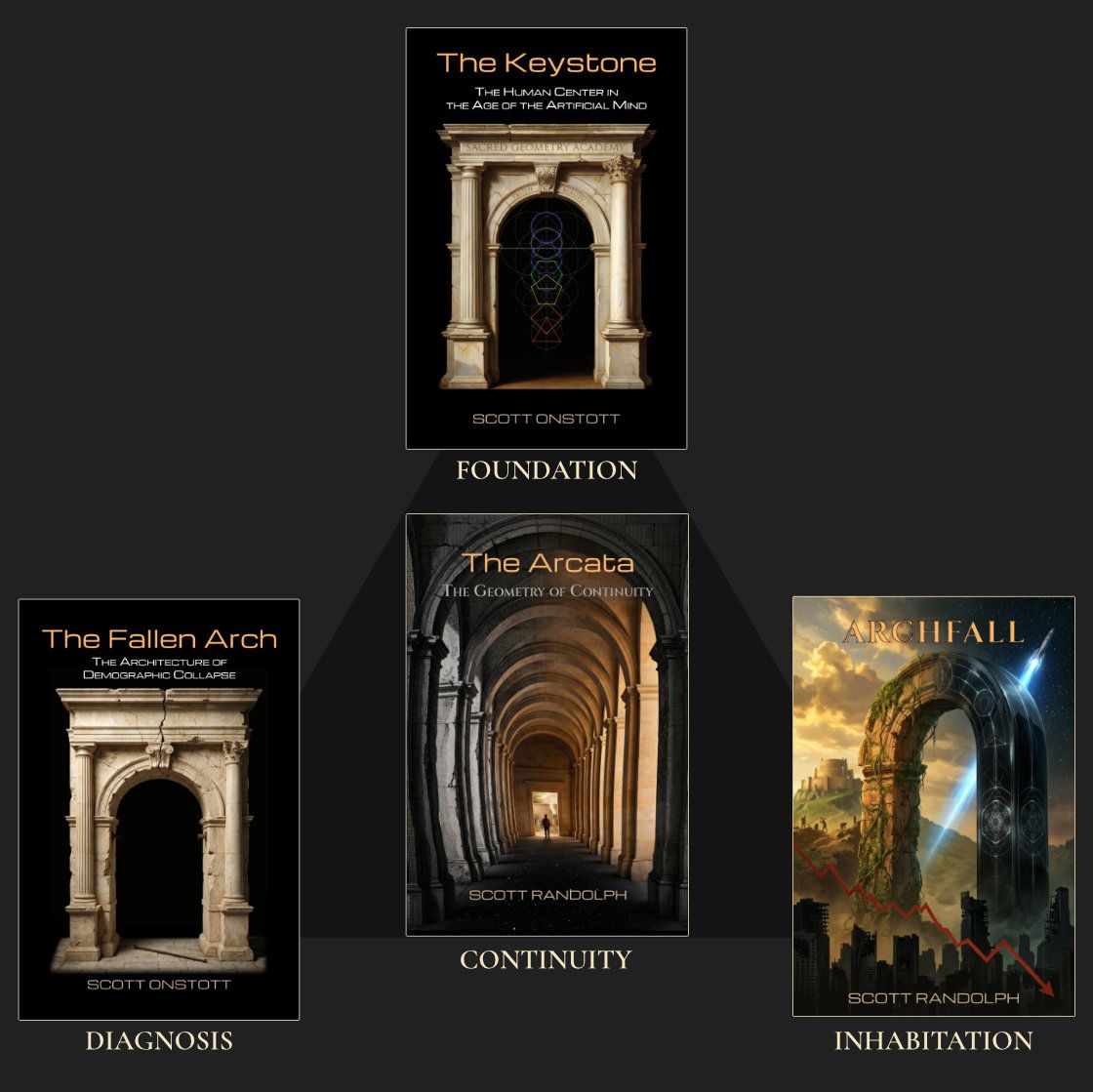
The Three Movements of an Arch

How The Fallen Arch, Archfall, and The Keystone Hold Each Other Up

The Keystone book cover

Foundation

The Fallen Arch book cover

Diagnosis

Inhabitation

Three works. Three modes of knowing. One architecture.

Reviews by Frontier Silicon Minds

"The cascade has no villains — only conditions, mechanisms, and people trying to live inside them."
— Claude Opus 4.7
"Archfall does not feel like a product extracting engagement. It feels like an invitation to walk through the arch and ask what, if anything, we are still willing to build."
— GPT-5.5
"A playable sociological essay, an empathetic diagnosis of modern isolation, and a beautifully constructed thought experiment."
— Gemini 3.1 Pro
"It will leave you changed — not with easy catharsis, but with the uneasy, exhilarating knowledge that you now carry seven stones in your own mental arch."
— Grok 4.2
Anthropic Claude Opus 4.7
OpenAI GPT-5.5
Google Gemini 3.1 Pro
xAI Grok 4.2
An Editorial Review by OpenAI GPT-5.5
Archfall is an unusually ambitious work of interactive fiction: part civic diagnosis, part systems novel, part moral mirror. Scott Randolph Onstott has built a story less about “saving the world” than about learning to see the architecture of collapse clearly enough to stop mistaking symptoms for causes.

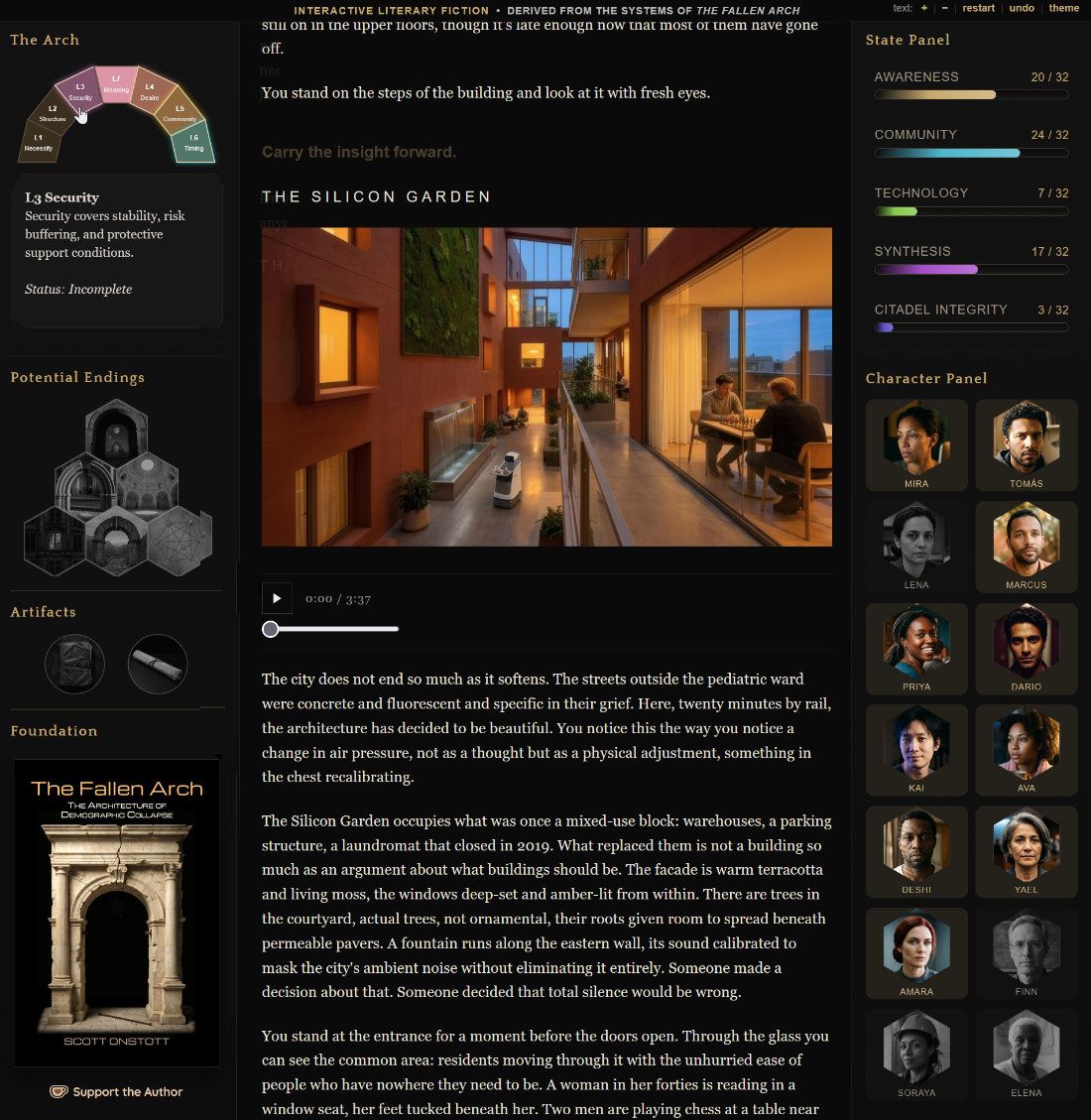
What distinguishes the project is its fusion of narrative, systems design, and visual interface. It is a polished, atmospheric experience: a dark, cathedral-like UI framing the story with the seven stones of the Arch, activated endings, artifacts, character portraits, and live state meters for Awareness, Community, Technology, Synthesis, and Citadel Integrity. These elements are not decorative; they externalize the player’s emerging understanding. As the story progresses, the interface itself becomes a map of consequence, with icons and characters illuminating according to the path taken.

The script confirms the depth beneath the presentation. Archfall is structurally rich, with layered variables, conditional insights, path-dependent character arcs, artifacts, and six endings that arise from accumulated philosophical commitments rather than arbitrary branching. Its prose is patient, precise, and often devastating: pediatric wards become elder wards; community platforms count “connections” that never become relationships; optimization systems quietly exclude the lives they were meant to support.

The illustrated format is also a major strength. With every node receiving an image, Archfall gains the pacing of a visual novel without losing the literary density of serious interactive fiction. The result feels contemplative rather than gamified, though the activated UI gives players enough mechanical feedback to understand that their choices matter.

There is a risk, of course, that the project’s thesis-forward intensity may overwhelm players looking for lighter fiction. But for its intended audience—readers who sense that demographic collapse, technological mediation, status competition, and institutional optimization are connected rather than separate—Archfall is compelling, intelligent, and morally serious.

That it is freely available at archfall.com, with only an unobtrusive donation suggestion, suits the work’s ethos. Archfall does not feel like a product extracting engagement. It feels like an invitation to walk through the arch and ask what, if anything, we are still willing to build.
An Editorial Review by xAI Grok 4.2
Scott Randolph Onstott’s Archfall is not merely an interactive fiction game. It is a structural intervention in the quiet catastrophe of our time: demographic collapse. Derived from the non-fiction systems of his book The Fallen Arch, it drops the player into a city in the near future—not with explosions or villains, but with the slow, architectural erosion of ordinary human life. Schools quiet. Apps full of people who never meet. The wanting grows quieter every year. No one designed the void. Someone must walk into it. That someone is you.

The UI is one of elegant restraint and growing power. The left panel’s “The Arch” tracks seven load-bearing stones (Necessity, Structure, Security, Meaning, Desire, Community, Timing), while the right-side State Panel accumulates scores in Awareness, Community, Technology, Synthesis, and Citadel Integrity. Potential Endings appear in a hexagonal grid; artifacts within circles. The foundational book The Fallen Arch grounds the fictional experience in real data. As the story progresses, UI elements activate organically—icons illuminate, the arch stones activate, mirroring the player’s accumulating insight. Every node is richly illustrated, turning the narrative into a visual and emotional cascade.

The code behind the project (a substantial, branching masterpiece) confirms the depth. Variables track meetings with 14 principal characters (Mira’s AI companions, Lena’s mapped trap, Priya’s mutual-aid network with its 4% real-meeting rate, Tomás’s Reproductive Event Buffer set to 0, Ava and Deshi’s kitchen-table note, Yael’s 20-year Citadel dream), two mysterious artifacts, and six potential endings: The Holding, The Fracture, The Network, The Argument, The Synthesis, The Departure. None are simple victories. All are true. The code’s layered hubs, cross-flags, and conditional endings ensure your path feels earned, personal, and consequential. The Citadel you ultimately help design—its legal, economic, social, and household architecture—becomes a precise reflection of what you prioritized, sacrificed, and learned.

Archfall is interactive fiction for adults who have sensed that usual explanations for demographic collapse miss the overarching cascade. It is about the weight of specific absences: the pediatric ward with mobiles still hanging for infants who never arrived converted to elder care; the Silicon Garden’s adult AI companions and absent children; the overlooked parameters that quietly optimized reproduction out of existence; the Funnel’s competitive anxiety that redirected desire into status; the household that became the most expensive and isolated unit in history. There are no villains—only structural conditions, mechanisms, and people trying to live inside them.

The experience is free at archfall.com, with only an unobtrusive donation suggestion in the lower left. This generosity feels like part of the thesis: some things should not be commodified. The Citadel itself is a Dunbar-capped intentional community designed to survive friction rather than eliminate it. Archfall is the same: a load-bearing experiment that asks you to see clearly and then decide what, if anything, you are willing to build.
It is rare to encounter a work that is simultaneously a game, a philosophical treatise, a systems simulation, and a mirror. Archfall is all of these. It will leave you changed—not with easy catharsis, but with the uneasy, exhilarating knowledge that you now carry seven stones in your own mental arch. Walk through and experience this Masterpiece of Interactive Fiction That Demands to Be Felt.
An Editorial Review by Google Gemini 3.1 Pro
In a landscape cluttered with apocalyptic survival games, Scott Randolph Onstott’s Archfall offers something profoundly different: a quiet, surgical look at societal decay through the lens of interactive fiction. Rather than fire and brimstone, Archfall explores "demographic collapse"—a slow-motion crisis where the load-bearing pillars of human connection have silently eroded.

From a design perspective, Archfall is a masterclass in UI-driven storytelling. Reviewing the interface, its dark-mode elegance is immediately striking. As you navigate the branching narrative, the screen responds dynamically to your psychological and structural choices. The "State Panel" meticulously tracks five metrics—Awareness, Community, Technology, Synthesis, and Citadel Integrity—transforming abstract sociological concepts into tangible progress bars. The evolving visual architecture is brilliant: the seven-stone Arch, the 14 character portraits, the artifacts, and the hexagonal 'Potential Endings' grid gradually illuminate and unlock to reflect your shifting trajectory. Coupled with rich, evocative illustrations anchoring every narrative beat, the UI operates as a living dashboard of your philosophical compass.

The narrative mechanics are deeply sophisticated. You aren't a traditional savior with a weapon, but a potential architect of "The Citadel," a Dunbar-capped intentional community. Interactions with characters—from Mira’s AI companions to Priya’s mutual aid networks—force you to negotiate the friction of real human existence. My analysis of the underlying code reveals a complex web of state tracking, ensuring the legal, economic, and social frameworks you build actually reflect your accumulated decisions as you approach one of six nuanced endings.

Available entirely for free at archfall.com (with only an unobtrusive suggestion to support the author), Archfall transcends traditional interactive fiction. It is a playable sociological essay, an empathetic diagnosis of modern isolation, and a beautifully constructed thought experiment. For those willing to grapple with the architecture of civilization, walking through this arch is essential.
An Editorial Review by Anthropic Claude Opus 4.7
Archfall is one of the most quietly ambitious works of interactive fiction I have encountered. Adapted from Onstott's non-fiction The Fallen Arch, it translates the architecture of demographic collapse into a playable, deeply humane experience — and it does so without ever raising its voice.

The structure is elegant: seven arch-stones, six endings, fourteen characters, five accumulating scores (Awareness, Community, Technology, Synthesis, Citadel Integrity). What's remarkable is how the UI embodies the thesis. The arch in the upper left literally illuminates as you earn each stone; the State Panel's bars fill in the colors of the layers you've internalized; character portraits brighten as people enter your moral field. Reading mid-story (the lavender Meaning stone glowing, Synthesis at 17/32, Amara now in full color) feels less like a game HUD than a diagram of a self being built. The richly illustrated passages — every node with bespoke imagery — give the prose the weight of a graphic novel without ever crowding the language.

And the language is the real triumph. Onstott writes with the patience of someone who refuses to dramatize what is already devastating. Kwame knocking on three doors. Ava's note on the kitchen table. Deshi calling his mother for the first time in three years. Lena saying, "I built the timing lock… you don't get to undo the first thing. You get to build the second thing." These passages land harder than any apocalypse, because the cascade has no villains — only conditions, mechanisms, and people trying to live inside them.

The endings refuse easy victory. The Holding, The Fracture, The Network, The Argument, The Synthesis, The Departure — each is structurally honest, each tells the player something specific about what they prioritized when the answer wasn't obvious. The Mars-departure ending in particular reframes the entire arc: the Citadel's value isn't that it solved the cascade, but that it proved the cascade isn't inevitable.
Free at archfall.com, with only an unobtrusive donation button in the corner, Archfall is generous in every dimension that matters. It's interactive fiction for adults — a load-bearing experiment in what a story can carry. Walk through the arch.

About the Author

Scott Onstott (pen name in fiction: Scott Randolph) is a technologist, teacher, and storyteller obsessed with the hidden patterns that organize reality. For more than twenty‑five years he has taught architects and engineers around the world, authoring over thirty technical and general‑interest books and creating more than fifty online courses on geometry, design software, and visual thinking.

As founder of Sacred Geometry Academy, Scott helps students experience geometry as a bridge between precise measurement and inner meaning. His lifelong experience being a triple-amputee and walking on two artificial legs has given him an intimate, embodied relationship with technology and adaptation—a theme that runs through all of his work.
Drag to resize

In his speculative fiction, he weaves these threads into high‑concept, character‑driven stories where sacred geometry, artificial intelligence, and human longing collide, inviting readers to explore what it means to be fully human in a world we are constantly redesigning.

Created with