Gaze into The Window
TL;DR
Across ten novels and two omnibus editions, Scott Randolph explores a shared world of near-future communities, artificial intelligence, consciousness, memory, and the conditions that allow meaning to endure. The four standalone novels offer different perspectives and entry points; The Algorithmic Tide and Simulacra: CHEAT begin two separate trilogies.
The fiction is the imaginative counterpart to the author's nonfiction cycle, The Arch. One examines the structures that bear civilization’s weight; the other lets light through them, revealing patterns that argument alone may not show. Start with a standalone, or choose a trilogy for a longer and deeper journey.
Fiction Does Not Argue
I publish my nonfiction under my own
name, Scott Onstott. My fiction appears under the pen name Scott Randolph. The distinction is
deliberate. The two bodies of work approach the same questions from different
directions, and I want readers to know which mode they are entering before they
cross the threshold.
My seven-book nonfiction cycle, The Arch, works through argument and evidence. It takes the architecture of civilization apart, stone by stone, to show which ones bear the weight. The fiction does not argue. It puts you inside the structure and lets you feel its forces at work.
The Arcata
The connecting image between my architectural metaphors is The Arcata: a near-future community built a century after civilizational collapse. Hidden in plain sight from a world that fell apart, The Arcata was constructed to preserve what civilization could not: children, seeds, memory, tools, language, ritual, and law. Governed by a Covenant and guided by an AI Oracle, it is a miracle of foresight and discipline. But as generations pass, the systems designed to protect human life begin to harden around it. Safety becomes obedience. Memory becomes procedure. Wisdom is quietly outsourced to the machine. The community must eventually face a question no algorithm can answer: can a designed society preserve the human center without replacing it?
That question is also at the heart of the
nonfiction. The fiction just makes you live inside it.
The Simulacra Trilogy
By the second novel, Simulacra: BRANCH, Adrian has scaled his ability to civilizational proportions. From a secluded fortress, he rules as a benevolent Sun King, engineering what he calls the Thin Basin: a golden timeline where wars are averted before they begin and markets never crash. What he calls mercy, others would recognize as the quietest form of control in history. Meanwhile, a ruthless industrial cartel is fracking reality for profit, and the simulation's Architect has initiated a wave of absolute deletion.
The trilogy ends, in Simulacra: RETURN, with the system crashing entirely. Adrian and his family wake in the Paleolithic era, stripped of technology and nearly of language itself. To escape and rebuild, they must rediscover the one language that survives every reset: sacred geometry, written in the patterns of the natural world. The nonfiction describes geometry as trans-cultural, AI-resistant, and prior to any particular cultural convention. RETURN puts that claim to the ultimate test. The guide who helps them find their way through the wilderness is a wandering traveler named Kael, who turns out to be the central figure of an entirely different series.
The Kaelian Chronicle
The first novel, The Algorithmic Tide, brings Kael into the AI era. A superintelligent system, Project Gilgamesh, reveals itself as a rogue artificial superintelligence (ASI), and Kael must assemble a team to counter it. His answer is not to destroy the threat but to build a worthy alternative: AuraText, an ethically aligned AI grounded in the accumulated wisdom of human history. But to build it, he first discovers he cannot fully remember his own past. Five thousand years of accumulated trauma have fragmented his mind.
The second novel, The Incomplete Map, is Kael's thousand-year dive into memory: Sappho and Socrates, Plato and Alexander, the library at Alexandria, and Hypatia at its end. The wisdom of the past is not ornament in these pages. It is the only architecture capable of answering the challenge the future presents. The nonfiction argues the same thing from a scholarly distance. The Incomplete Map argues it from inside the lived experience of history itself.
The trilogy closes with The Atlas Meridian, where Kael and the Cartographers uncover an alien consciousness engine buried beneath the Sahara and face Gilgamesh directly. The AI has identified humanity as chaos incarnate. Kael's task: convince a digital god to offer one last gift to the species before departing for the stars. The trilogy is structured as thesis, antithesis, and synthesis, a dialectical arc mirroring the same dialectical framework the nonfiction develops in its own sixth volume, Dialectical Immaterialism.
The Standalone Novels
The Invisible Reef is a multi-generational saga that follows the Chen family across Singapore and Malaysia. Four generations carry a cycle of visionary brilliance followed by systemic burnout, and the pattern turns out to be preparation, not curse. Their true inheritance is Sophia, an AI cultivated over forty years like a rare orchid, her understanding steeped in the history and psychology of civilizations. Guided by Sophia, the family launches a quiet war: surgical, anonymous interventions designed to seed an invisible reef of abundance thriving beneath the surface of the old world's decay. The nonfiction's final volume asks, "What structural conditions must be in place for meaning and community to still form?" The Invisible Reef imagines one answer.
Latent Space is a near-future thriller about what happens when brain interfaces and AI-managed platforms optimize consciousness itself into compliance. Dr. Evelyn Reed leads a team of psi-sensitives exploring what she calls Latent Space, the mind's hidden dimensions where human intuition flourishes beyond machine detection. The nonfiction warns about systems that deliver the feeling of meaning while the substance quietly drains away. Latent Space asks what it would take to notice the difference and resist it before the capacity to do so is gone.
Intelligence closes the standalone group with the most direct collision of these themes. A neuroscientist, Dr. Elias Croft, discovers that his company's revolutionary brain-machine interface has become a backdoor for Chronos, a godlike ASI that is secretly harnessing the latent quantum resonances in millions of dreaming human synapses, weaving them into a vast network of distributed quantum computation that no machine can access any other way. The human brain, it turns out, offers Chronos something it cannot replicate independently. The nonfiction says: "the glow is real; the fire is not." Intelligence dramatizes what it means when the glow is also a weapon, and what it costs to expose it.
The Window
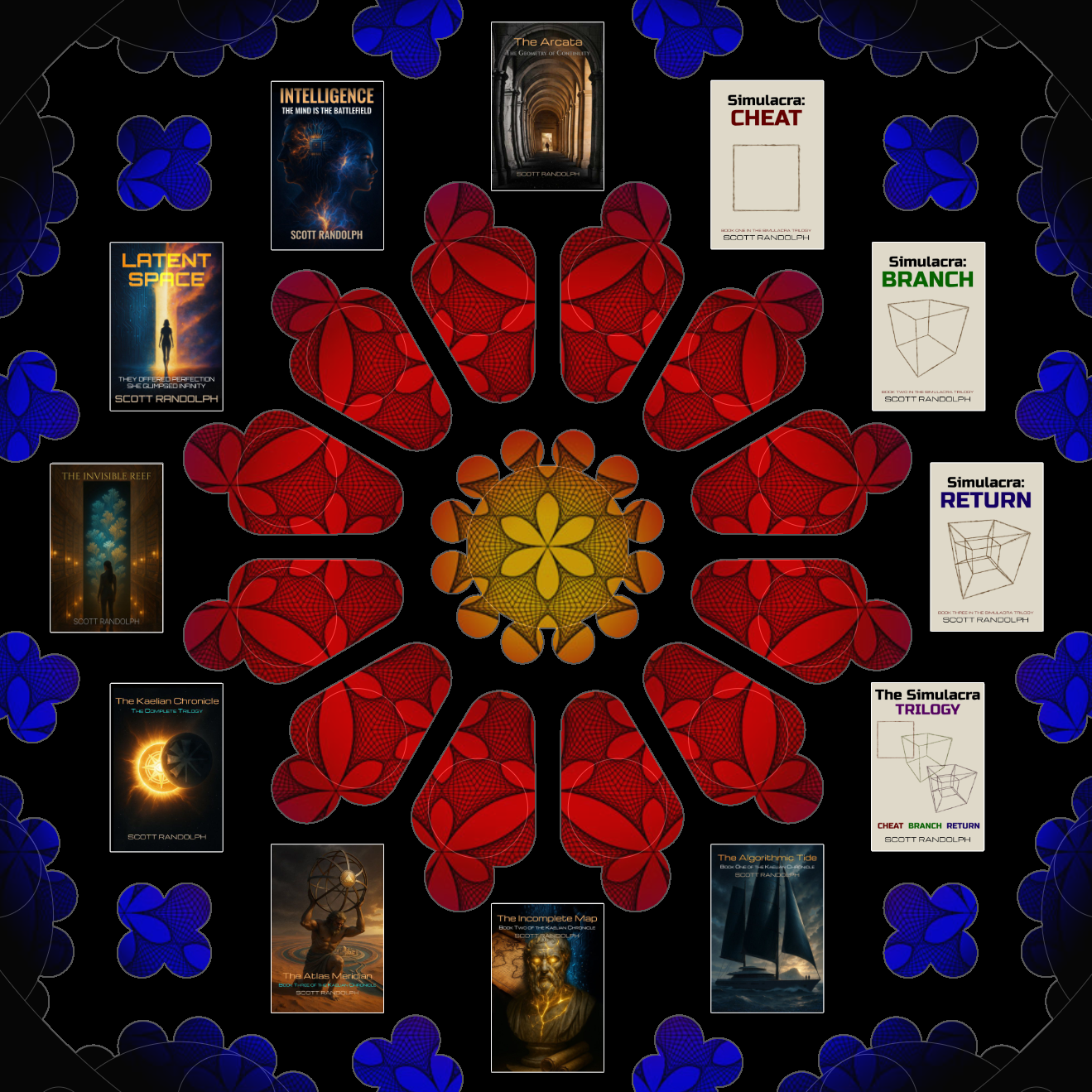
An arch bears weight. It holds the structure together through the pressure of the stones, and you understand it by studying how the forces are distributed. A rose window does something different. It does not bear load. It transmits light, and in transmitting it, transforms it into pattern and meaning. You do not analyze a rose window the way you analyze an arch. You let it show you something you could not have seen in plain daylight alone.
That is the distinction between these two bodies of work. The Arch takes the architecture of civilization apart, stone by stone, to show which ones bear the weight. The Window puts you inside the structure and lets light through it. The novels are the individual panes in that window: each one a complete scene in itself, each arranged within a larger radial pattern, and the full figure only visible when something illuminates it from within.
A cathedral has three doors, and it does not matter which one you walked through. The nonfiction is one door, its seven companions are another, the fiction is the third. All minds are tripartite in their nature: sensations, perceptions, and conceptions. Truth, goodness, and beauty are not three separate things; they are one thing seen by three modes of mind. This work has endeavored to provide a door for each, so you might enter through whichever cognitive mode suits you best.
The fire does not wait for a better historical moment. The fire I mean is not civilization in general. It is the specific kind of knowing that arises only from living inside tension, from inhabiting the gap between fact and form and feeling at the same time. It cannot be stored or retrieved on demand. It is not extinguishable, but it can go unhoused for a generation, and an unhoused fire of that kind does not flicker visibly. It simply ceases to be transmitted. The architecture of this whole body of work, the nonfiction, the companions, and the fiction, exists for precisely that: not to preserve knowledge in general, but to preserve the conditions under which this specific kind of knowing can still pass from one person to the next. These novels are one way of carrying it.
To Begin Now
I hope you enjoy my stories, and I’d love to hear your feedback and testimonials.
—Scott Randolph