The Arch
A nonfiction seven-book cycle by Scott Onstott
Seven books tracing the architecture of reality, consciousness, civilization, and the human center
from the foundations of philosophical geometry to the pressures reshaping the modern world.
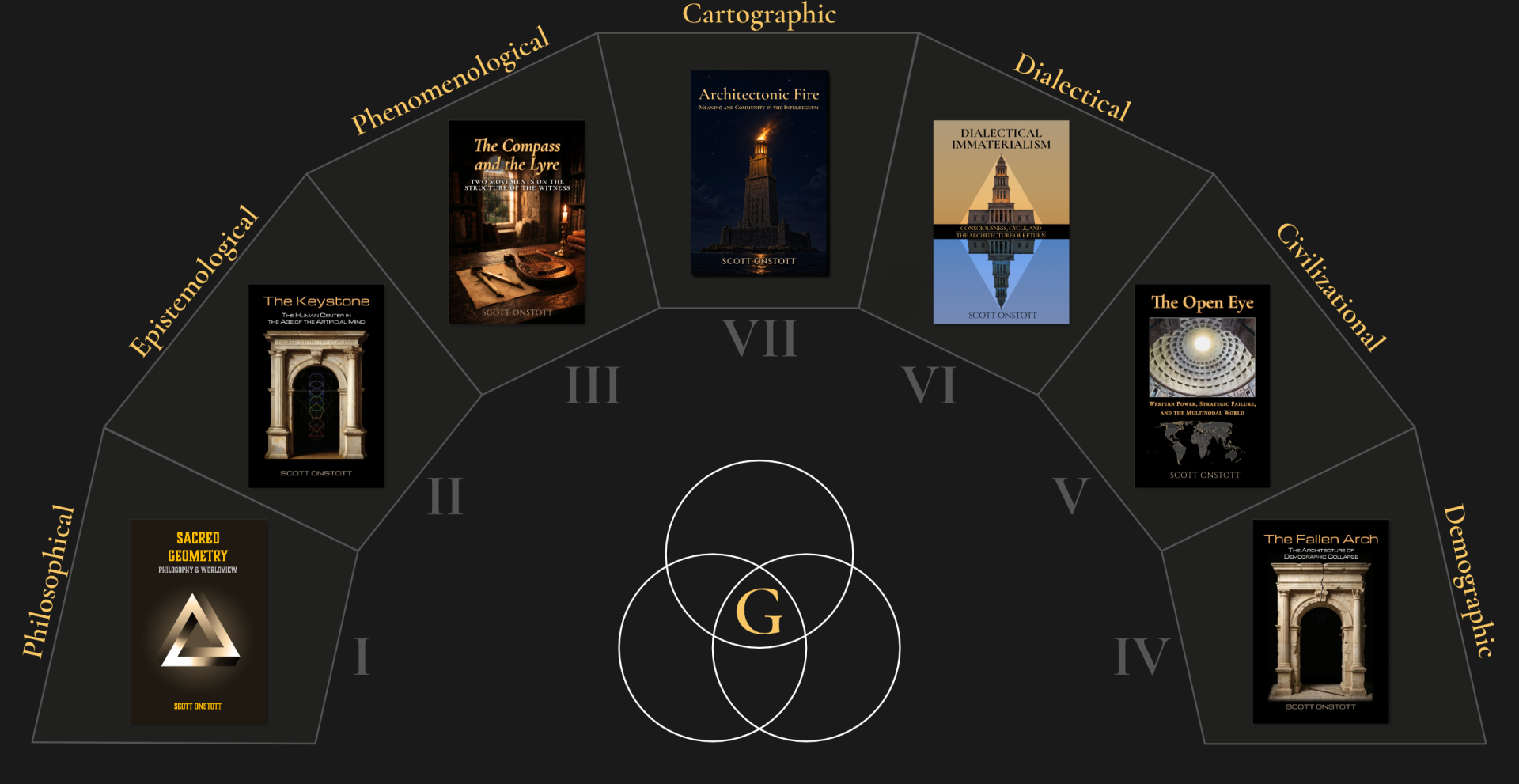
Click/Tap any book to explore the cycle.
I. Foundation | II. Center | III. Witness | IV. Diagnosis | V. Reflexivity | VI. Return | VII. Transformation
Enter The Arch
TL;DR
Across seven books, each paired with a companion game, app, fiction or essay, Scott Onstott traces that structure from the foundations of meaning, through the human center and an unflinching diagnosis, to a map of what must be rebuilt, and in what order.
The series was not planned. It unfolded, book by book, from the founder of Sacred Geometry Academy's lived experience of geometry. He names mechanisms, not villains. He shows his work and flags his own constructions. He doesn't tell you what to do; he helps you see.
What is The Arch?
Seven books. One structure. One
question: What must hold for human life to
remain not merely survivable, but worth living and capable of continuing?
An arch isn't decoration. It solves the
problem of weight. Each stone presses against its neighbors, the pressure meets
at the top, and the structure gets its strength from the forces that would
otherwise destroy it. Take out one stone and the arch starts to fail. Take out
the crown and it collapses.
A civilization holds together the same
way. It isn't made of stone. It's made of people, practices, meanings and
institutions. When enough of those relationships weaken, the load shifts
catastrophically.
Most of us can feel the strain: empty cradles, institutions that can't correct course, and an AI transition that amplifies every unexamined assumption. Many of us also see a growing prospect that advancing AI, humanoid robots and autonomous software agents will take over much of the work by which people have long defined themselves. The usual explanations treat these as separate crises, each with its own villain. The Arch argues that “strategic decline, demographic contraction, and cultural exhaustion are not separate crises.” They are one architectural event. It can only be seen from a position that doesn't belong to any tribe.
Where the Arch Came From
The Arch was not planned as a seven-book
series. It grew out of Scott Onstott’s own experience of sacred geometry, the discipline at the heart of Sacred Geometry Academy.
Geometry has three aspects, and each became one of the three domains the series works across:
- Quantitative, the Visible: what can be measured.
- Qualitative, the Invisible: what form means and how it is felt.
-
Mathematical, the Intelligible:
universal forms that must be as they are.
Geometry’s three aspects opened a different picture of reality. Sacred Geometry: Philosophy & Worldview set out that picture as an alternative worldview and became the philosophical foundation of The Arch. Its abstract, philosophical register may make it a more demanding place to begin.
The Keystone offers a more immediate entry point. It brings the framework to the human being as the Bridge-Being, living across the Visible, Invisible and Intelligible domains. It is also where the series’ fourth dimension first takes shape: the lived experience of those domains unfolding over a human lifetime. The series names this way of knowing a viviori. The quadripartite framework developed in The Keystone became the ground from which the rest of the series grew.
Then the next book came, and the next. No blueprint came first. Each book grew out of the ground the previous one had laid. The three aspects of geometry were the seed of Sacred Geometry: Philosophy & Worldview; the framework completed in The Keystone gave the unfolding series its shape. The Arch does not just describe this framework. It emerged from it.
The Three Domains Under the Arch
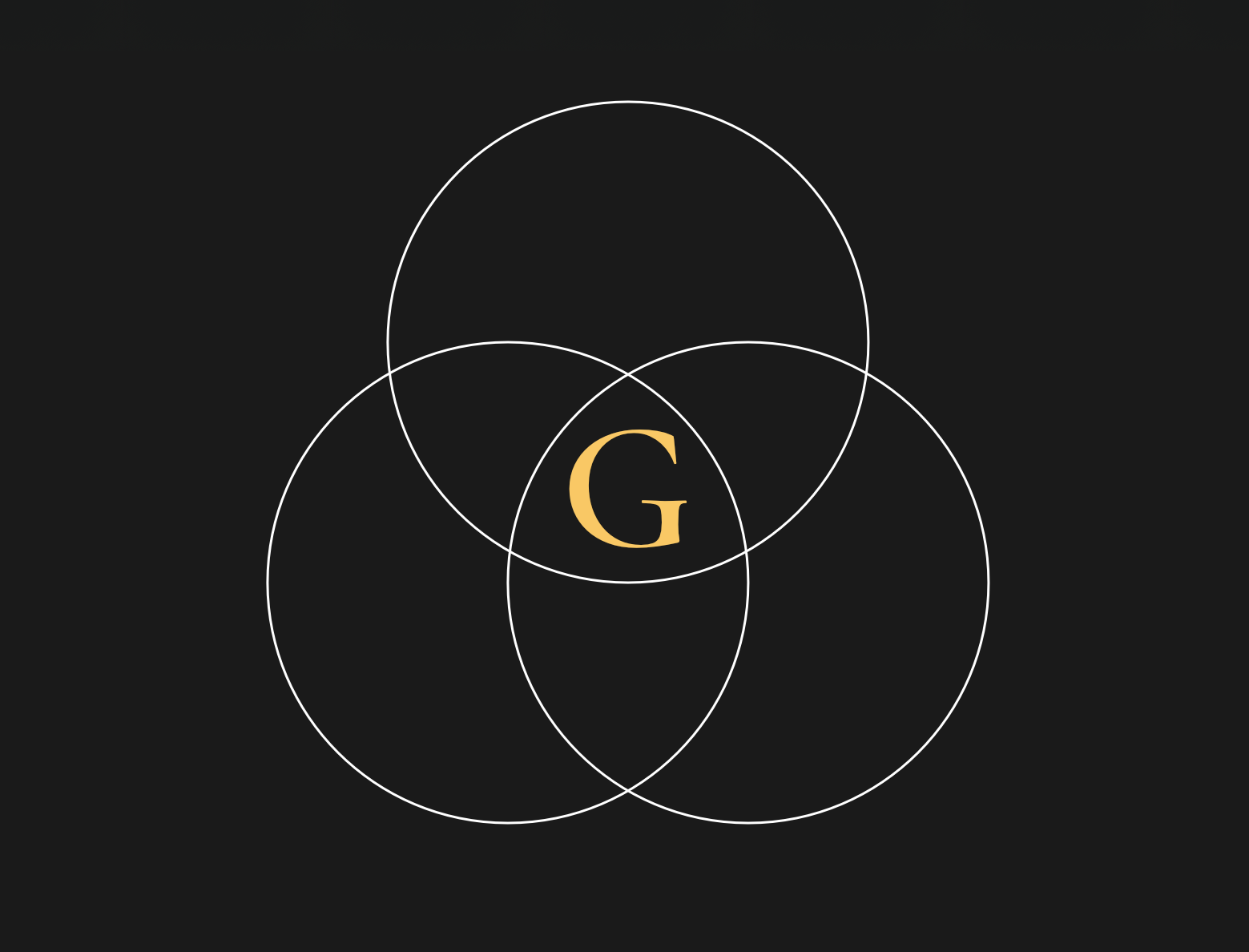
The three circles also carry the older inheritance of the three transcendentals: truth, goodness, and beauty, named in their geometric rather than their rhetorical form. The Keystone introduced this grammar. The rest of the books in The Arch take it as an established instrument and build from it.
What Makes This Series Different
It names mechanisms, not villains. The Fallen Arch describes a cascade with “no villains, only
conditions, mechanisms, and rational responses.” The Open Eye traces the
West's strategic failures to its own institutional habits, not to the malice of
its adversaries. None of the books will confirm what your side already
believes, and each one says outright that it rejects the partisan misreadings.
It shows its work. The series keeps an explicit “Invariant Ledger.” It separates what
is mathematically forced from what is empirically observed and from what is
constructed interpretation. It refuses to pass off “a coincidence dressed up as
a revelation.” Several books state exactly what evidence would count against
their own conclusions.
It takes AI seriously without panic or
worship. The first book lays its foundation before
the arrival of artificial minds. From the second book on, the series tests that
foundation against them. It argues that fluency is not witnessing and that AI
must stay “non-sovereign,” a powerful instrument whose integrating judgment
remains human. It also names a subtler danger. Systems that deliver the feeling
of meaning can keep its loss from registering. “The glow is real. The fire is
not.”
It doesn't tell you what to do. These books map structures. They are not self-help, not policy programs and not a spiritual path to follow. As one volume puts it, “The map is offered without itinerary.” What the map means for your life depends on what you bring to it.
Who It's For
The Arch is for people living in what the series calls the Interregnum:
“the window between the arch that is falling and the arch that has not yet been
raised.” It's for readers who suspect that the Cage (technocratic materialism)
and the Evaporation (post-truth subjectivism) are both wrong, but haven't been
able to say why.
It's also for anyone facing a question
that increasingly capable machines are putting to all of us: if my work no
longer defines me, what does? When a job disappears, the loss is not only
income. For many people it is also role, rhythm, standing and purpose. The Arch
offers no retraining plan and no income policy. It goes to the question
underneath them: where human meaning comes from, and why a human being is not
reducible to a function a machine can perform. The Keystone places the
human at the center as the Bridge-Being. Architectonic Fire maps the
conditions under which meaning and community can still form and be passed on.
It's for people who have stopped reading the headlines and started looking at the foundations.
Who It Isn't For
These books ask for slow reading. As The Open Eye puts it, “The medium is the message's own test.”
A Quiet Act of Rebellion: READ A BOOK.
Deep reading can steady the mind and help sustain attention. It cultivates patience, attunes you to nuance, and teaches you to hold complexity without reducing it. In books, you meet other minds, living and dead, whose voices widen the horizon of your own.
Reading is more than a pastime. It is a garden of attention, where insight takes root and what you nurture in thought becomes part of your cognitive architecture. Practice the sacred anachronism of deep reading and enjoy more clarity.

Seven Stones, One Arch
The series isn't a ladder of answers. Each
book prepares the organ required to receive the next:
I. Foundation (Philosophical): Sacred Geometry: Philosophy & Worldview. The ground everything stands on, drawn from the author's own experience of sacred geometry and written before the age of the artificial mind. Reality has three domains: the Visible (matter), the Invisible (meaning and value) and the Intelligible (universal form). Your brain doesn't produce consciousness; it tunes in to it. For anyone who suspects the universe is less a machine than a mind. “You are not a drop in the ocean, but the entire ocean in a drop.” Companion: The Unlikely Cartographer: A New Map for a World in Transition (memoir)
II. Center (Epistemological): The
Keystone: The Human Center in the Age of the Artificial Mind. Mystics claimed the ineffable. Machines inherited the measurable.
Mathematicians mapped the intelligible. None of them remembered the human at
the center. This book names the human being as the Bridge-Being, the
only creature able to live in all three domains at once. It calls that fourth
way of knowing a viviori: knowledge earned by living inside the
tension between fact, form and feeling. “Not a blueprint. An architecture
you already inhabit, and an invitation to remember it.” Companion: Wiltshire
(strategy game)
III. Witness (Phenomenological): The
Compass and the Lyre: Two Movements on the Structure of the Witness. In just over 100 pages, the book arrives at the same discovery twice: first through the geometry of the tesseract, whose 32 edges surround a center that is not a 33rd edge, and then through Sappho and the open Oculus of the Pantheon. The book also offers a falsifiable
criterion for whether an AI could ever occupy the integrating position. The
witness is not among the witnessed. “The compass proves it. The lyre sings
it. Neither could have said it alone.” Companion: Thirty-Two Winds
(interactive web app)
IV. Diagnosis (Demographic): The
Fallen Arch: The Architecture of Demographic Collapse. Why advanced civilizations stop having children, and why
pronatalist spending keeps failing. A seven-layer cascade removes, one by one,
the necessity, structure, security, desire, community, timing and finally the meaning
of continuity. Meaning is the load-bearing stone on which the other layers depend. The layers compound each other
rather than simply adding up. The book is not a lament or a manifesto. It is a
field guide, and at its end it points to “the narrow path that remains.” “You
are not a villain in this story. You are a passenger in a collapsing
architecture.” Companion: Archfall (interactive literary fiction)
V. Reflexivity (Civilizational): The
Open Eye: Western Power, Strategic Failure, and the Multinodal World.“The West has not been outgunned. It has been out-thought, by its
own prior certainties more than by any adversary.” The book examines four failures it argues were warned against: NATO expansion, sanctions, the weaponization of the dollar, and the dismantling of diplomatic capacity. Each follows the same institutional
logic: the instruments of power become the point of power. The book defends
what is worth keeping in the Western inheritance. It asks: Can a
civilization recover the integrative capacity it has fragmented before the
limits of power impose their own answer? Companion: The Other Eye
(mythic vignettes)
VI. Return (Dialectical): Dialectical
Immaterialism: Consciousness, Cycle, and the Architecture of Return. The engine behind every case in the series. Structures don't fall
because they fail. They generate their own antithesis because they succeed
so completely. The witnessing position that most traditions treat as the
destination is only the halfway mark. The “Ethics of Remaining” calls the
witness back to participation. “The summit is not the destination. It is the
turning point between two movements.” “The breath that only exhales is not a
breath at all.” Companion: The Pharaoh Clock (interactive literary
fiction)
VII. Transformation (Cartographic): Architectonic Fire: Meaning and Community in the Interregnum. The crown of the arch and the closing map. It asks what structural conditions must be in place for meaning, community and a real orientation toward the future to still develop and be passed on, and in what order. The order is a critical path, not a wish list. Meaning must come before community, and community must come before institutional reform. The sequence can't be reversed. The book aims to preserve the capacity for a viviori, and “no algorithmic system produces it by delivering the experience of it.” Companion: The Oculus (a 33-page closing essay on the gap between holding an accurate map and standing inside the territory)
How The Arch Holds Together
- The left side of the arch moves through the philosophical, epistemological and phenomenological: from what reality is, to how we know it, to the witness who knows. Its movement leans toward a spiritus: the Platonic orientation toward form and the Intelligible. The Fallen Arch is the pivotal stone. With it, the series shifts register: from foundational inquiry toward a posteriori diagnosis, grounded in historical and demographic evidence and written in a more Aristotelian, scholarly mode. That empirical register carries through the civilizational analysis of The Open Eye and the dialectical account of Dialectical Immaterialism. At the crown, Architectonic Fire brings the two movements together: the Intelligible and the lived, the spiritual and the empirical, held within one map.
- The Keystone introduces a viviori, and Architectonic Fire is written to preserve it.
- The Fallen Arch diagnoses the loss of the seventh stone, meaning, and Architectonic Fire asks how it can be rebuilt.
- The Keystone, The Fallen Arch, and The Open Eye show the same mechanism at three scales: the person, the civilization and geopolitics. Dialectical Immaterialism names that mechanism.
- The first movement of the series, the outbreath, develops the ability to see the structures that shape experience instead of being carried by them. The second, the inbreath, returns to full participation with those structures now in view.
Each book stands on its own. The strongest approach is to read them in order. The final volume says that without the earlier books, you'll be taking the diagnosis “on trust rather than on tested evidence.”
Seven Books, Seven Companions
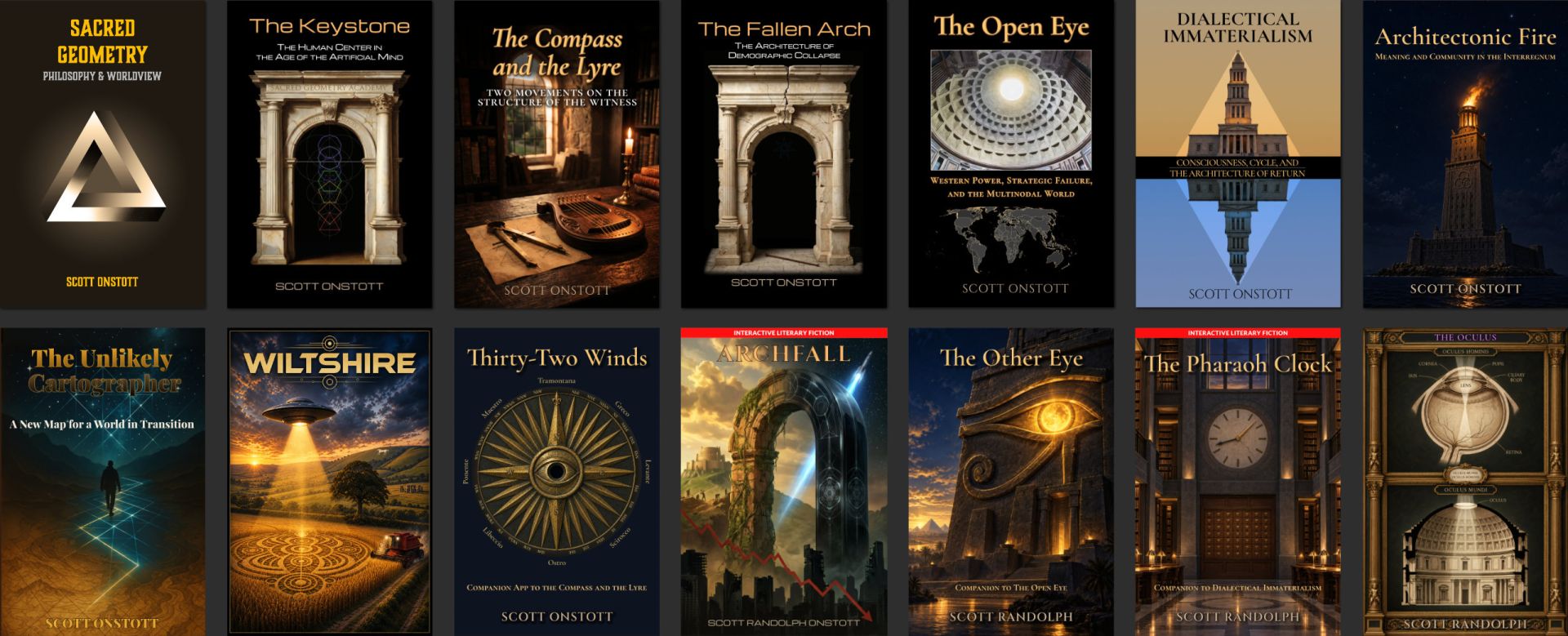
Each companion takes a different form: memoir, strategy game, web app, interactive fiction, mythic vignette or essay. A book can show that meaning is load-bearing. A story or a game lets you feel the load shift. The companions let you test the books' ideas against your own experience instead of taking them on the page alone. That is a viviori in practice. Read together, the fourteen works invite a fuller engagement than argument alone can provide.
Scott Onstott publishes nonfiction under his own name and fiction under the pen name Scott Randolph. The seven books and their companions are two expressions of the same arch, created by one author and grounded in one body of experience.
To Begin Now
Start with The Keystone, or sample other books in The Arch before you commit. Free downloadable
PDF previews are available for most of the books on their product pages.
You'll know quickly whether these are the
maps you've been looking for.
“The fire does not wait for a better historical moment. It burns in this one.”