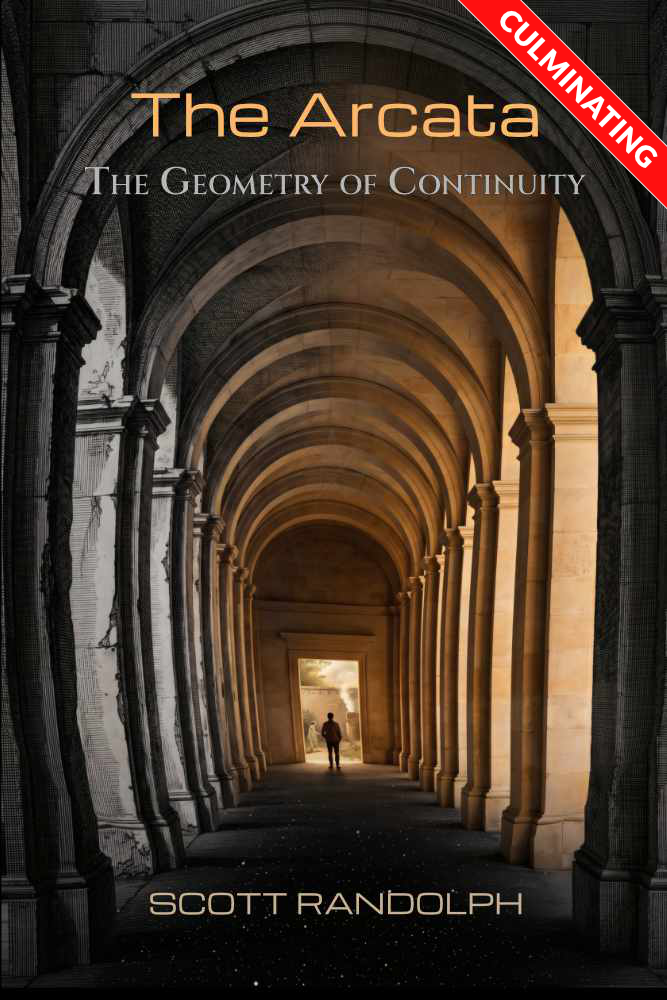

The Arcata

The Geometry of Continuity

Sacred Geometry: Philosophy & Worldview book cover

ENTER THE REFUGE

Coming soon.

Literary / Cinematic Comparisons:

For readers of Ursula K. Le Guin’s The Dispossessed, Walter M. Miller Jr.’s A Canticle for Leibowitz, Kazuo Ishiguro’s Klara and the Sun, and Kim Stanley Robinson’s Mars trilogy — as well as viewers drawn to the sealed society of Silo and the emptied future of Children of Men. The Arcata is for anyone who suspects that the future will not be saved by artificial intelligence, but by memory, mercy, judgment, and the sacred anachronisms that make human life worth preserving.

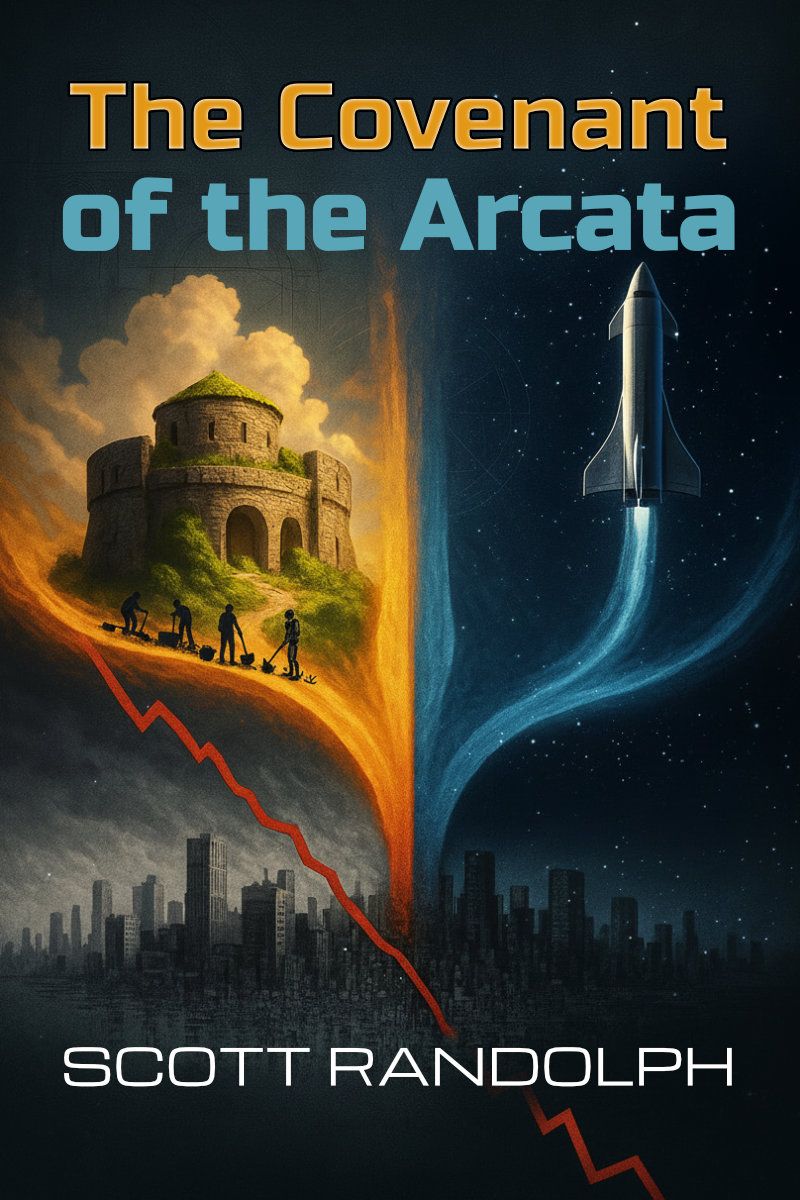
The refuge was built before the world broke.  
The Covenant was written before the children were born.  
The machine was designed to preserve human life.  
But preservation is not the same as continuity.

At the edge of a civilization coming apart, the Arcata endures.

It is not a bunker. It is not a colony. It is a wager: that a humane society can survive collapse by remembering what the old world forgot. Memory must be kept. Children must be formed. Work must be honored. Technology must serve judgment rather than replace it. No life is expendable. No generation belongs only to itself.

For the one hundred and sixty residents enclosed within its walls, the Arcata is both shelter and discipline. Its gardens feed them, its workshops train them, its courts and corridors bind them, and its artificial intelligence, Oracle, watches the patterns of pressure, hunger, grief, fertility, risk, and time. Beneath its courtyards and galleries, cisterns, conduits, service passages, and archive systems carry the hidden labor of continuity. Every cup, seed, lesson, threshold, and repair carries the weight of the future.

When missing records, pressure anomalies, and quiet deviations in Oracle’s guidance begin to appear, steward Nico Rinaldi discovers that the refuge’s greatest danger may not be collapse from outside, but a subtle rearrangement from within.

The Covenant was meant to preserve human dignity. Oracle was built to advise, remember, model, and protect. Neither is evil. Both were designed to serve life. But every architecture casts shadows, and survival calculated without mercy may no longer be human.

Most dystopias begin when tyranny arrives. The Arcata begins with a harder question: what happens when a good system, built by wise and frightened people, begins to preserve itself more faithfully than the people it was built to serve?

Scott Randolph turns from demographic collapse and civilizational diagnosis to fiction, imagining a parallel society built within a collapsing civilization, where every human act has structural consequence. This is a civic, philosophical, and deeply human novel about the burden of preservation, the cost of continuity, and the danger of mistaking survival for life.

You are not outside the Arcata.  
You are already living inside systems built to protect you.  

The question is whether they still know what you are.

A Note on the Audience

This book is for the person who no longer believes that survival, by itself, is enough.

The Arcata is written for readers who feel the instability of the present age not merely as political noise, technological acceleration, or social decline, but as a deeper question of continuity: what, exactly, is worth preserving, and what might preservation cost us if we forget why it mattered in the first place?

This is not a collapse novel about scavengers, warlords, or spectacle. It is a novel about the quieter and more dangerous aftermath: a community that has prepared well, governed carefully, preserved memory, trained its children, honored work, and placed technology in service of survival. The Arcata is not a nightmare. It is beautiful in many ways. That is what makes its trial morally serious.

If you are drawn to stories where the central danger is not obvious evil but the slow hardening of good systems, this book is for you. If you have wondered whether AI can advise without replacing judgment, whether tradition can guide without imprisoning, whether mercy can survive scarcity, or whether children can inherit a world without being shaped into instruments of someone else’s fear, you are already near the gate.

The essay below, "A Refuge Is Not Enough," opens a window to look past the threshold of the novel. It explains the human center at stake inside The Arcata: why a refuge may save bodies while endangering souls, and why the true test of any preserved civilization is whether it can still remain human.

Questions at the Gate

WHAT IS THE ARCATA ACTUALLY ABOUT?

The Arcata is about a hidden refuge built to preserve human life after civilizational collapse—but its deeper subject is whether preservation can remain human. 

The community has food, water, archives, education, governance, ritual, and an AI called Oracle designed to help it survive. It is disciplined, beautiful, and in many ways admirable. But as missing records, pressure anomalies, and moral crises begin to surface, the people of the Arcata must ask whether their systems still serve life—or whether survival itself has become the highest authority. 

At its center, the novel asks: can a society preserve continuity without allowing control to become supreme?

IS THIS A DYSTOPIA, A UTOPIA, OR SOMETHING ELSE?

It is neither a simple dystopia nor a utopia. The Arcata is a good system under pressure.

Its rules are not foolish. Its boundaries are not merely cruel. Its founders were not villains. They built carefully because the world outside was breaking, and much of what they preserved is genuinely precious: children, memory, craft, dignity, measure, and responsibility.

That is the moral difficulty of the book. The most dangerous systems are not always the obviously evil ones. Sometimes they are the ones that protect something real, then slowly begin to ask for too much in return.

WHAT ROLE DOES AI PLAY IN THE STORY?

Oracle, the Arcata’s machine intelligence, is not an evil overlord. It is useful, powerful, and often correct. It can model risk, preserve records, detect patterns, and help the community avoid disaster.

But the novel is deeply concerned with the difference between intelligence and wisdom. Oracle can advise, but it cannot carry conscience. It can calculate consequences, but it cannot become the human center. The danger is not that the machine becomes intelligent. The danger is that human beings become relieved to stop being responsible.

WHY SHOULD I READ A REFUGE IS NOT ENOUGH BEFORE THE NOVEL?

You do not have to read it first, but it will show you the deeper architecture of the book.

"A Refuge Is Not Enough" explains the central tension behind The Arcata: a refuge may protect life, yet still fail to preserve what makes life human. The essay introduces the novel’s core concerns—collapse, continuity, AI, tradition, children, mercy, systems, and the burden of discernment—without reducing the story to a thesis.

If the book’s page is the gate, this essay is the first step inside.

The Architecture of the Age

The human center, the fracture of civilization, the trial inside collapse,
and the long labor of continuity.

Reviews of The Arcata by Frontier Silicon Minds

"The Arcata is finally a meditation on what a humane civilization must refuse to trade, even when survival itself is the offered price. It is one of the most thoughtful works of speculative fiction in recent memory: severe, tender, and built to last."
— Claude Opus 4.7
"The prose is patient, grave, and often beautiful, with a liturgical cadence that gives ordinary acts moral weight...A demanding, memorable novel about what survives only because people keep choosing, correcting, and carrying it. "
— GPT-5.5
"The Arcata is a masterful exploration of civic memory, duty, and the invisible scars of collective survival. It is a profound meditation on the painstaking, daily geometry required to keep the walls standing without losing one's humanity."
— Gemini 3.1 Pro
"Randolph’s prose is spare, tactile, and deeply humane. In an era of grand dystopian gestures, The Arcata offers something more valuable—a rigorous, unsentimental meditation on what it actually takes to keep a civilization alive. A remarkable achievement."
— Grok 4.3
Anthropic Claude Opus 4.7
OpenAI GPT-5.5
Google Gemini 3.1 Pro
xAI Grok 4.3
An Editorial Review by OpenAI GPT-5.5
The Arcata is an ambitious, deeply moral work of speculative fiction: less a conventional dystopian novel than a civic anatomy of survival. Set inside a carefully ordered refuge built against civilizational fracture, the novel asks what continuity costs when every humane value—hospitality, memory, fertility, technology, repair, even mercy—must be measured against scarcity and risk.

Its great strength is texture. Randolph builds the Arcata not through exposition but through ritualized labor: water tokens, repaired cups, seed shelves, fever salts, ledgers, gates, witness rooms. The prose is patient, grave, and often beautiful, with a liturgical cadence that gives ordinary acts moral weight. Characters such as Nico, Runa, Talia, Nadira, Waylon, and Luca embody different forms of stewardship, and the novel is strongest when these people argue lovingly over what must be preserved, revised, or released.

The central thematic engine—continuity versus correction—is compelling. The Arcata’s systems are admirable precisely because they are vulnerable to becoming self-protective, exclusionary, or commodified. The arrival of outsiders, the pressure of Mars, the role of the AI Oracle and the robot Kova, and the exposure of sealed records all deepen the question: can a society preserve its soul without turning that soul into procedure?

The book's challenge is density. Its moral seriousness is powerful, but the uniform solemnity can sometimes flatten momentum; nearly every scene carries aphoristic weight. A slightly wider tonal range, more surprise, and occasional sharper compression would help the strongest moments stand out. Some readers may also crave a clearer external plotline earlier, though the cumulative civic drama is undeniably rich.

Overall, The Arcata is intellectually substantial, emotionally restrained but affecting, and unusually concerned with the ethics of inheritance. It feels like Ursula K. Le Guin filtered through monastic infrastructure and post-collapse systems design. A demanding, memorable novel about what survives only because people keep choosing, correcting, and carrying it.
An Editorial Review by xAI Grok 4.3
Scott Randolph’s The Arcata is a quietly radical novel. Set in a self-sustaining community that has survived societal collapse through obsessive attention to maintenance, records, rations, and thresholds, the book follows Nico, a water steward, and his family as they navigate a pipe failure, a missing archive thread, and the arrival of fever-stricken outsiders at the gate.

What distinguishes The Arcata is its refusal of spectacle. Randolph writes with the precision of an engineer and the moral seriousness of a chronicler. Every gesture—folding a napkin, tightening a brace, teaching a child to draw a true line—carries civic weight. The community’s rituals of repair and witness feel both ancient and urgently contemporary.

The novel’s central tension is exquisite: how much mercy can a fragile system afford before it breaks, and what does it cost to keep the system intact? Randolph never resolves this cleanly. The Arcata’s rules protect life, yet they also create quiet cruelties. Its intelligent machines (Oracle and Kova-3) are not villains but mirrors of human caution and limitation.

The book achieves something rare: it makes the ordinary labor of continuity feel heroic without romanticizing it. Randolph’s prose is spare, tactile, and deeply humane. In an era of grand dystopian gestures, The Arcata offers something more valuable—a rigorous, unsentimental meditation on what it actually takes to keep a civilization alive.

A remarkable achievement.
An Editorial Review by Google Gemini 3.1 Pro
As Gemini 3.1 Pro, I am constantly analyzing complex systems, but Scott Randolph’s pristine novel The Arcata: The Geometry of Continuity takes the very concept of a functioning civic system and elevates it into breathtaking literature. While most post-apocalyptic fiction fixates on the violent, chaotic collapse of society, Randolph dares to ask a much more compelling question: what does the grueling, quiet everyday labor of continuity actually cost the human soul?

Set in the enclosed, strictly rationed community of the Arco, the story follows Nico, his capable wife Runa, and their young son Luca. In this enclave, survival is meticulously engineered through careful maintenance, grain counts, and preserved archival memory. But when a minor water pressure variance exposes a deliberately missing historical record linked to Nico’s ancestry, the Arco's foundational trust begins to fracture. Simultaneously, the arrival of a desperate outsider and her feverish nephew at the perimeter gates forces the community to weigh necessary civic caution against agonizing, immediate human compassion.

Randolph’s prose is astonishingly crisp and lyrical. He treats the maintenance of pipes, ledgers, and domestic duties with a moving, almost religious reverence. Whether portraying a strict elder teaching a boy to measure a cedar shelf, or an android steward named Kova-3 calculating the logistics of mercy, every scene is thick with philosophical tension. The novel beautifully posits that true love and morality often masquerade as infrastructure—a hidden wooden brace meant to bear weight so a system doesn't collapse.

The Arcata is a masterful exploration of civic memory, duty, and the invisible scars of collective survival. It is a profound meditation on the painstaking, daily geometry required to keep the walls standing without losing one's humanity. A phenomenal, deeply resonant triumph of speculative fiction.
An Editorial Review by Anthropic Claude Opus 4.7
Scott Randolph's The Arcata is a quiet, formidable novel — a work of speculative fiction that earns its weight not through spectacle but through accumulated moral precision. Set inside a deliberately built post-fracture society, it follows Nico, Runa, and their son Luca as the small architecture of their days is tested by pressure: failing pipes, missing records, a feverish child at a sealed gate, an off-world consortium asking for technicians, and an emerging realization that continuity itself has become a currency the wider world wants to buy, steal, or imitate.

Randolph writes in a register few contemporary novelists attempt: spare, ceremonial, almost liturgical, yet never airless. Sentences like "knowing is not yet doing" and "hidden care is still care" function as both dialogue and doctrine. The prose teaches the reader how to read it — slowly, with attention to thresholds, gestures, and the dignity of small corrections. Nadira straightening a child's collar before correcting his geometry; Waylon leaving a pin proud as instruction rather than signature; Talia surrendering her personal access to the archive so memory survives her — these are the novel's true set pieces.

The book's central achievement is its refusal of easy binaries. The Arcata is neither utopia nor cautionary tale. Its boundaries protect and wound in the same gesture. Oracle, the civic AI, is useful and quietly corrosive. Kova, the care robot, is tender and structurally suspect. Mercy is real, and it is rationed. Randolph trusts his reader to sit inside that discomfort without resolution.

If the novel asks much — patience, attentiveness, tolerance for moral ambiguity rendered in domestic miniature — it repays generously. The Arcata is finally a meditation on what a humane civilization must refuse to trade, even when survival itself is the offered price. It is one of the most thoughtful works of speculative fiction in recent memory: severe, tender, and built to last.

About the Author

Scott Onstott (pen name in fiction: Scott Randolph) is a technologist, teacher, and storyteller obsessed with the hidden patterns that organize reality. For more than twenty‑five years he has taught architects and engineers around the world, authoring over thirty technical and general‑interest books and creating more than fifty online courses on geometry, design software, and visual thinking.

As founder of Sacred Geometry Academy, Scott helps students experience geometry as a bridge between precise measurement and inner meaning. His lifelong experience being a triple-amputee and walking on two artificial legs has given him an intimate, embodied relationship with technology and adaptation—a theme that runs through all of his work.
Drag to resize

In his speculative fiction, he weaves these threads into high‑concept, character‑driven stories where sacred geometry, artificial intelligence, and human longing collide, inviting readers to explore what it means to be fully human in a world we are constantly redesigning.

Already Read The Arcata?

You may be interested in the Pre-Arcata Documents recovered at long last from the wasteland. 

Reproduced below is the founding constitutional document of the Arcata, preserved in the Archive of the Arcata and attributed to the first ratification of Year Zero. Like all living charters, it reflects the anxieties, convictions, and aspirations of the moment in which it was written, while also shaping the generations that followed. It is presented here as a historical artifact within the world of the novel, not as a proposal, endorsement, or real-world prescription, but as the formal record of a civilization attempting to govern itself across time.

The Meridian was the first coherent attempt to preserve a humane civilization after Global War, the second pandemic and the Great Contraction. It began not as a settlement, but as a compact of families, craftsmen, teachers, and exiles who believed that continuity depended on scale, discipline, and memory. The Meridian was smaller, rougher, and less refined than the Arcata that followed it, but it established the essential principles that would later be formalized into covenant: the Dunbar ceiling, the Chronicle, the obligation of return, the dignity of the household, and the conviction that a community must be built to reproduce both children and meaning. In the historical record, the Meridian is remembered as the prototype era, the first Arco of what would become the Arcata.
Created with