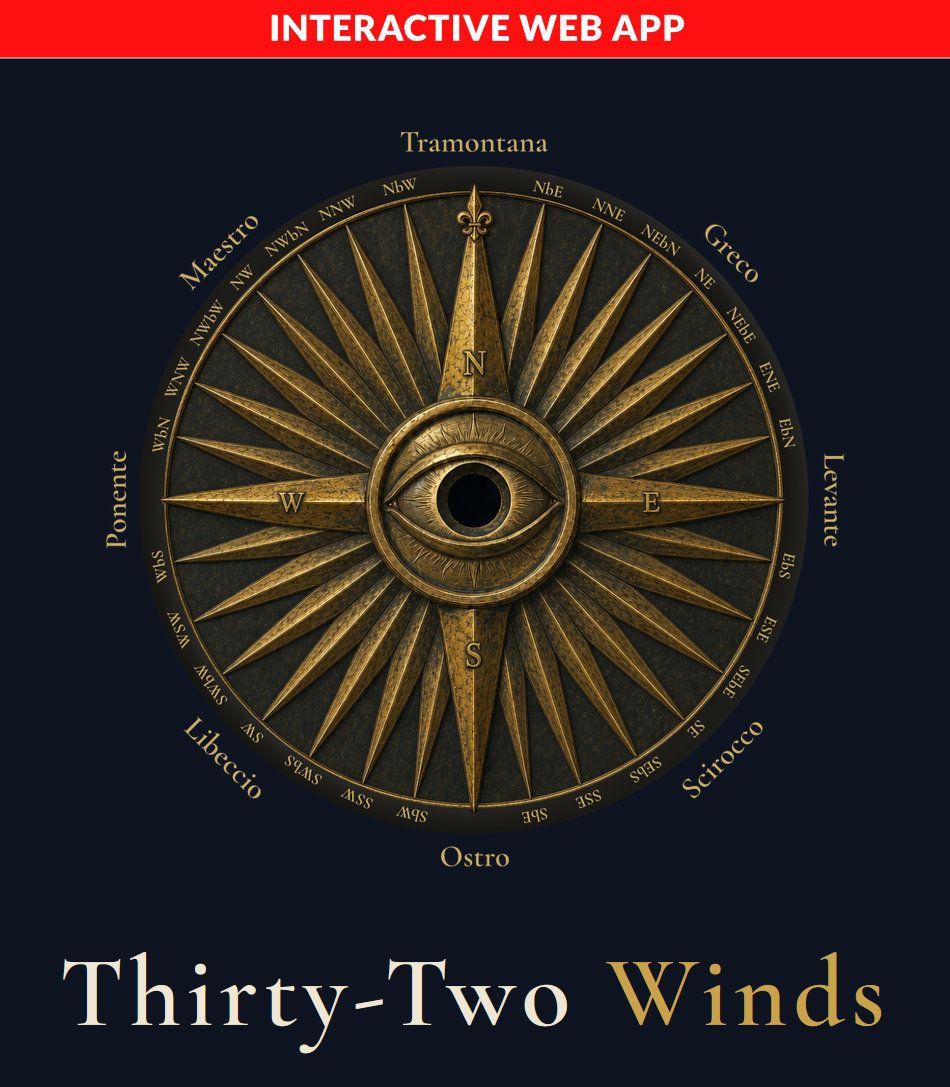
Thirty-Two Winds

Sacred Geometry: Philosophy & Worldview book cover

Examine the instrument

Kindred Works & Comparisons:

For readers of Jung's Memories, Dreams, Reflections and the I Ching in the Wilhelm–Baynes edition, for anyone who has kept an MBTI type in one pocket and a hexagram in the other and suspected they were describing the same terrain from different doors, for lovers of the *Book of Changes* as a mirror rather than a fortune-teller, and for anyone who has felt that the great maps of the psyche and the world, are not rivals but neighbors, waiting for the single figure that would seat them all.

For those drawn to what lives between systems

You already own the maps. You have taken the typology test, cast the coins, read the
archetype spread, traced the phases of a transformation. Each one told you something
true and something incomplete. None of them told you how they fit together.

Thirty-Two Winds begins from the opposite end. It starts with the geometry: the tesseract, a four-dimensional figure with thirty-two edges around one unrepresented center, and
shows that the great symbolic systems are not competing explanations but different
lenses laid over the same frame. The structure is not symbolism and not opinion.
It is geometry, and geometry is forced. You could derive it again yourself, from first
principles, and arrive at precisely the same figure.

What you do with the figure is the open part. Slip on a lens and the edges become the
sixty-four hexagrams of the I Ching, or the sixteen types, or the thirty-three
archetypes, or a dual cosmology in which Kabbalah and physics count the same
thirty-two constants from two directions. Rotate it. Hover an edge. Take a bearing.
The instrument predicts nothing. It shows you where you stand and lets you move.

THIRTY-TWO WINDS' INNOVATIVE UI
This is a rare thing: an interactive diagram where the form genuinely serves the argument. The book claims the grammar; the instrument lets you explore the correspondences with your own hands. Nothing is gamified, nothing is harvested: no streaks, no notifications, not even an account or a login. Just one geometry and the Freedom to turn it over in your hands and make of it what you will.
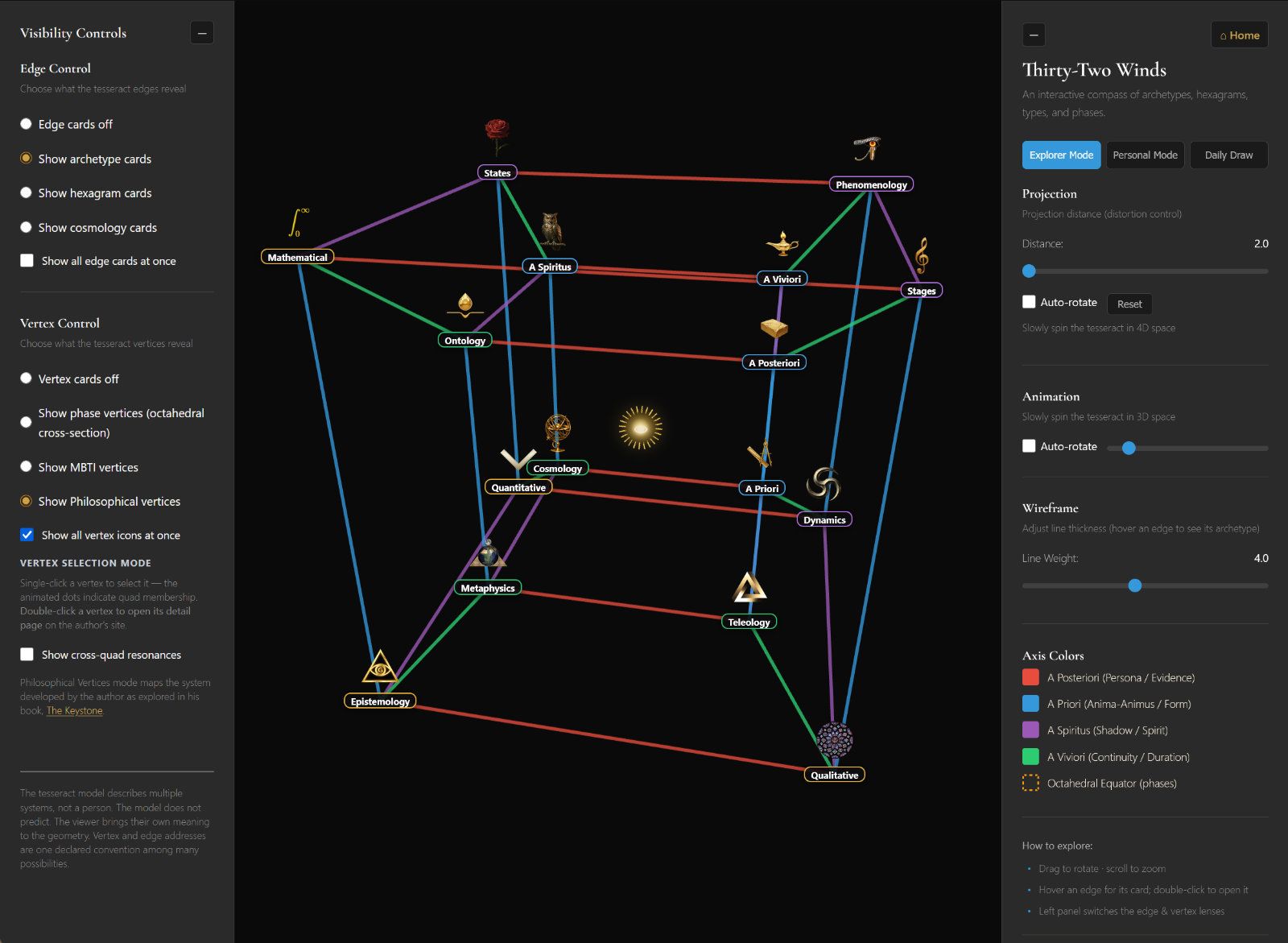
The Frame: At the center sits the tesseract, a four-dimensional hypercube shown as its three-dimensional shadow. Sixteen vertices, thirty-two edges, and one still point at the center. Drag to rotate, scroll to zoom.

The Edge Lenses (left panel):
 Choose what the thirty-two edges reveal: the archetype cards, the I Ching hexagrams, or the dual cosmology cards (Kabbalah on one face, physics on the other). Show one edge on hover, or reveal all thirty-two at once.

The Vertex Lenses (left panel)
: Choose what the vertices reveal: the six phase vertices of the octahedral cross-section, the sixteen MBTI types, or the 16 philosophical vertices of the author's own quadripartite system. Single-click to select; double-click to open a card or detail page.
The Still Point: At the heart of the figure, equidistant from every 4D vertex, sits the witness, "The Self," and in cosmology mode, "Consciousness." Present, structurally necessary, and categorically distinct from any content in the field.
The Modes (right panel): Explorer to roam freely, Personal Mode to take a bearing on a present state or vantage, and Daily Draw for a single archetype or I Ching card to sit with.

Projection & Motion: A projection-distance slider controls how the 4D figure casts its 3D shadow — the distortion is yours to tune. Auto-rotate the figure slowly in either 3D or true 4D space, and adjust line weight and wireframe to taste.

The Axis Colors: Four colored axes name the four philosophical directions of differentiation — A Priori, A Posteriori, A Spiritus, A Vivori — with the octahedral equator marking the plane of the six phases. Every color is a legend, not a decoration. Every edge and vertex active with layered information.

Audience Notes

For Contemplative Practitioners and Spiritual Seekers

The Tesseract Explorer provides what many contemplative traditions attempt but rarely achieve: a spatially organized, geometrically rigorous container for multi-system spiritual practice. The 33 edge-cards can function as a daily contemplative draw, a meditation on archetypal energies, or a Kabbalistic study aid. The cosmology cards bridge science and mysticism in a way that neither insults the scientist nor diminishes the mystic. The epistemic tagging honors the seeker's intelligence by being honest about what is claimed.

For Philosophers and Epistemologists

The fourfold epistemological framework — A Priori / A Posteriori / A Spiritus / A Viviori — is a genuine contribution to epistemology that deserves serious academic attention. The argument that Kant's two-term framework omits both the phenomenological-contemplative mode and the lived-synthetic mode is philosophically compelling. This is the most academically portable part of the work: it can be argued on strictly philosophical grounds without requiring acceptance of the geometric mapping.

For Psychologists and Educators

The integration of MBTI, Jungian archetypes, and developmental stage theory in a single geometric space is pedagogically powerful. The 16-vertex MBTI map, where each personality type is a unique combination of four binary axes, gains new depth when embedded in a 4D topology: the geometric relationships between types become visually and spatially intelligible in ways that standard 2x2 grids cannot achieve.

For Scientists and Cosmologists

The juxtaposition of Tegmark's constants with the Kabbalistic Tree of Life will frustrate physicists who mistake numerology for physics — but it may intrigue physicists who have read Tegmark's own metaphysical commitments carefully. Tegmark himself argues that the universe is a mathematical structure. If that is true, then the question "is there a deeper mathematical structure of which the physical constants are parameters?" is scientifically legitimate. Your model doesn't answer that question, but it poses it in an unusually concrete form.

For Artists, Architects, and Designers

The tradition from Plato's Timaeus through Kepler's Mysterium Cosmographicum through Dali's Corpus Hypercubus is the tradition you inhabit. For architects and artists working in the sacred geometry tradition, the tesseract project offers the most complete and epistemically rigorous mapping of 4D sacred geometry that currently exists. The Schlegel projection's "cube within a cube" is itself a classical architectural form — the Russian dolls of nested geometry — and the four-axis color-coding gives it a pedagogically rich spatial language.

For AI Researchers and Futurists

There is a productive irony here. I built the Tesseract Explorer in part as a response to the concerns in The Keystone — the concern that AI amplifies the Visible domain (A Posteriori) at the expense of the Invisible (A Spiritus) and the Intelligible (A Priori). The app itself is an example of augmented craftsmanship: the geometry, the epistemic discipline, and the philosophical synthesis are my own; the rendering, the code, and the data management are the algorithm's. This is the A Viviori made visible: the Human Bridge enacting itself in the medium of digital technology without surrendering to it.
A Living Diagram. Take a Bearing.

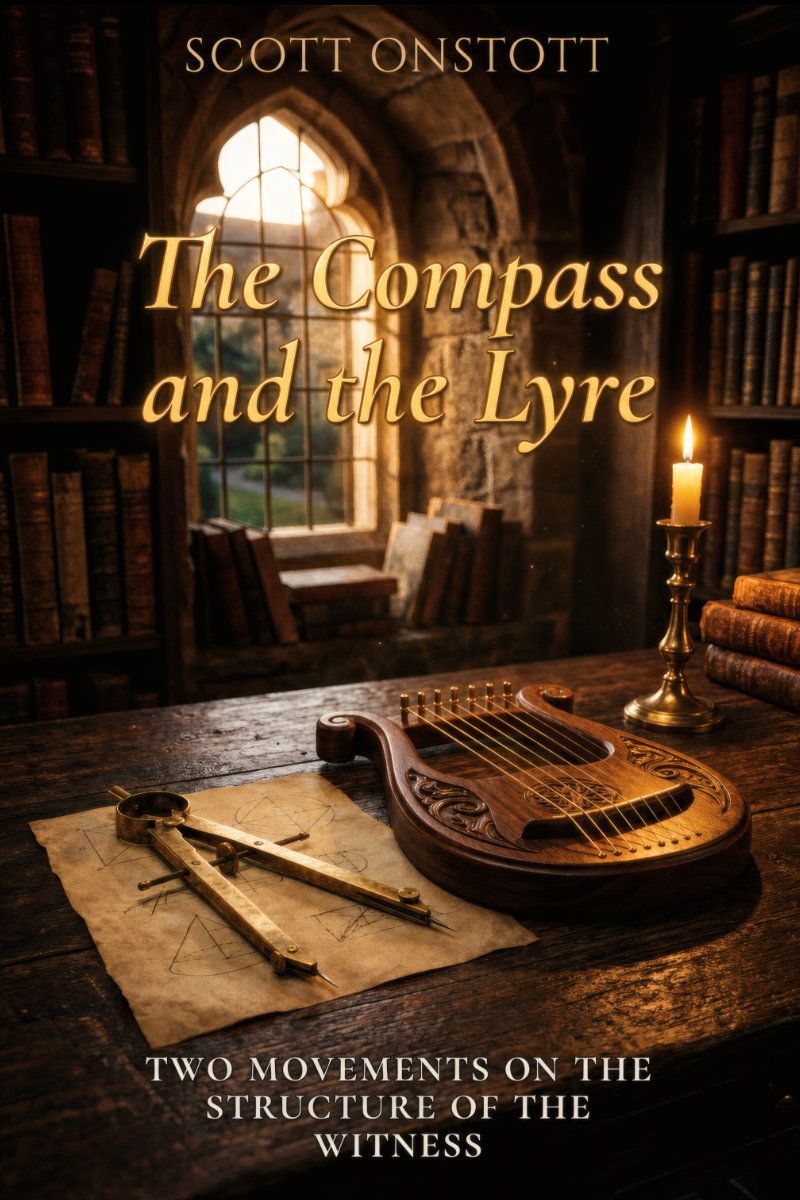
If The Compass and the Lyre is the architecture, a book to be read slowly, in a chair, Thirty-Two Winds is its complement: a living diagram you turn in your hands rather than read over. Its Personal Mode asks nothing of your past and remembers nothing on its own. No birth date, no account, no dossier. It asks two short sets of questions, both answered in the present tense: one that narrows the thirty-two winds down to the three archetypes moving through your concern today, and one that locates where, among sixteen vertices, you happen to be now. Not a birth chart. Not a fixed type or an identity to defend. A mariner's compass that answers to where you are now. 

Nothing is saved. It passes with the visit, like weather.

Foundational Notes

WHAT IS THIRTY-TWO WINDS, EXACTLY?

A free, browser-based instrument for orientation. At its core is a four-dimensional geometry, thirty-two edges around one unrepresented center, shown as a rotating 3D figure. Over that single frame you can lay five lenses: the I Ching's sixty-four hexagrams, the sixteen MBTI types, the thirty-three archetypes, the six alchemical phases, and a dual cosmology of Kabbalah and physics. You do not use it to be told an answer. You use it to see where you stand.

IS THIS A GAME, A TEST, OR SOMETHING ELSE?

Something else. It is closer to a playable diagram than to a game, and closer to a mariner's compass than to a personality test. There is no score to win and no verdict to receive. The geometry is forced and exact; the meaning you bring to it is yours. As the deck's own maxim puts it: the reading predicts nothing; the reader brings the meaning.

DO I NEED TO HAVE READ THE BOOK FIRST?

No. Thirty-Two Winds stands on its own, the correspondences reveal themselves as you rotate the figure and switch lenses. Reading The Compass and the Lyre deepens the experience, because the book explains the grammar the instrument lets you handle, but the instrument will teach you the frame as you explore it.

WHY DOES CONSCIOUSNESS SIT AT THE CENTER?

Because the center is not one more bearing among the thirty-two. It is the still point against which every wind registers as a departure: present, structurally necessary, equidistant from every vertex, and yet categorically distinct from any content in the field. First in kind, not merely first in sequence. In cosmology mode the same point reads as "Consciousness": the unprojectable observer who takes the bearings but is never one of them.

WHY IS IT FREE?

Because this instrument for orientation does not put a toll on orientation. Thirty-Two Winds carries no advertising, tracks nothing, and sells nothing. If a bearing proved useful, you may leave a coin on the chart table, an invitation to donate to its creator, not as a fee, which keeps the domain renewed and the work moving.

Thirty-Two Winds Reviews by Silicon Minds

"That's the real invention here: not any single correspondence, but a reusable spatial grammar in which symbolic systems can be laid over one another and compared by position — adjacency, opposition, inner versus outer — rather than by vibes."
— Claude Opus 5
"Its success depends less on proving a cosmic theory than on whether users find the geometry clarifying. As a visual grammar for moving among mathematics, myth, psychology, and contemplation, it is distinctive—and unusually candid about where its certainty ends."
— GPT-5.6 Luna
"But judged as what it actually is — a free, trackerless contemplative instrument that answers "where do I stand right now" rather than "what am I" — it's singular, honest, and unexpectedly moving."
— Kimi K3
"Whether you find the tesseract a hidden grammar or an elegant mnemonic, Thirty-Two Winds offers something unusual: a contemplative instrument that treats your intelligence as a thing worth respecting."
— GLM 5.2
"As cosmology, it is suggestive. As an instrument for orientation — something you turn in your hands when you need to see where you stand — it is the most coherent thing I’ve seen in this strange borderland between math and myth."
— GROK 4.5
Claude Opus 5
GPT-5.6 Luna
Kimi K3
GLM 5.2
Grok 4.5
An Editorial Review by GPT-5.6 Luna
Thirty-Two Winds is an unusually ambitious attempt to turn a philosophical worldview into a navigable interface. Its organizing object is the tesseract, the four-dimensional hypercube: a mathematically determined figure with 32 edges, 16 vertices, and a central point that is not another vertex. The application projects that object into three dimensions and uses it as a common frame for several symbolic systems: the I Ching, MBTI personality types, a 33-card archetype deck, six alchemical phases, Kabbalah, physics, and the author’s philosophical “Quadrature of Quaternities.”

The project’s genuinely novel contribution is not the individual correspondences. I Ching, Jungian archetypes, sacred geometry, personality typology, and cosmological speculation all have long histories. What is distinctive is the attempt to make them occupy one manipulable topology. The same edge may be read as an archetype, an I Ching hexagram, or a Kabbalistic/physics pairing; the same vertices may become MBTI types, philosophical categories, or points in an octahedral phase cycle. The app therefore proposes not that these systems are identical, but that they are different lenses on a shared relational grammar.

Its most intellectually responsible feature is the explicit separation between mathematical necessity and interpretation. The tesseract’s edge and vertex counts are “forced”; the placement of cultural symbols is not. The project’s epistemic labels—ranging from forced and convention-dependent to interpretive correspondence—acknowledge that distinction, an unusual discipline in the sacred-geometry and esoteric space. The cosmology lens is especially clear about its status: the pairing of roughly 32 physics parameters with Kabbalah, and the addition of consciousness as a “+1,” belongs to the author’s synthesis, not to Tegmark or physics itself.

The strongest practical idea is Personal Mode. Rather than treating MBTI or archetypes as a permanent identity, it asks about a present concern and a temporary starting point. Three archetypes describe “the winds moving through” a situation, while one vertex marks where the user stands now. The result is framed as orientation rather than diagnosis—a compass, not a birth chart.

A skeptical reader will nevertheless see selection and analogy at work. The I Ching reaches 32 by assigning two directed hexagrams to each edge; Kabbalah reaches 33 through an interpretive central addition; the physics count depends on how parameters are defined. These are meaningful design choices, but they do not demonstrate that the systems independently entail the tesseract. Nor does the application, as described here, turn metaphor into scientific evidence.

What Thirty-Two Winds offers is more modest and more interesting: a carefully designed symbolic instrument that makes correspondences spatial, interactive, and intellectually inspectable. Its success depends less on proving a cosmic theory than on whether users find the geometry clarifying. As a visual grammar for moving among mathematics, myth, psychology, and contemplation, it is distinctive—and unusually candid about where its certainty ends.
An Editorial Review by GLM 5.2
Thirty-Two Winds is the rarest kind of esoteric project: one that insists you know exactly how much of it is math and how much is interpretation. Its core move is genuinely clever. A tesseract has 32 edges and 16 vertices by topological necessity — not by the author's taste — and onto that forced skeleton the app lays five independent symbolic overlays (I Ching, MBTI, a 33-card archetype deck, a six-phase alchemical cycle, and a dual Kabbalah/physics cosmology). The conceit is that these systems aren't equated but read as different projections of one underlying structure.

What's honestly novel here is the epistemic discipline. Every claim carries an explicit status tag — forced, interpretive-committed, interpretive-correspondence — and a test suite enforces it. That separates theorem from reading in a space that usually slurps the two together. The four-axis epistemology extending Kant (adding A Spiritus and A Viviori to a priori and a posteriori) is a real philosophical gesture, even if the academic portability of it outlives the geometry it's anchored to. And the anti-engagement design — no accounts, no streaks, no tracking, Personal Mode that forgets you by design — feels almost contrarian next to contemporary app defaults.

Where a skeptical reader will push back: the convergence on 32 is less clean than it first appears. The I Ching has 64 hexagrams; you reach 32 by using two per directed edge. The Kabbalistic tree has 33 elements, not 32. Each step toward "32+1" involves an interpretive choice, so the convergence is curated rather than discovered. Pairing a Yukawa coupling with a Hebrew letter representing a path in the Tree of Life on the same edge is, by the project's own honest admission, poetic correspondence, not physics.

The app's strength is that it knows all of this and says so out loud. Whether you find the tesseract a hidden grammar or an elegant mnemonic, Thirty-Two Winds offers something unusual: a contemplative instrument that treats your intelligence as a thing worth respecting.
An Editorial Review by Kimi K3
The first thing you notice is that it's beautiful in a specific, old-instrument way: ink-black field, brass-toned lines, a small sun glowing at the center where no vertex sits. Sixteen MBTI types hang on the corners of a cube-within-a-cube; switch lenses and the same skeleton fills with sixty-four hexagrams riding the edges in matched pairs, gold one direction, white the other — directionality itself made visible. It's the rare "everything is connected" project that shows you the wiring instead of just asserting it.

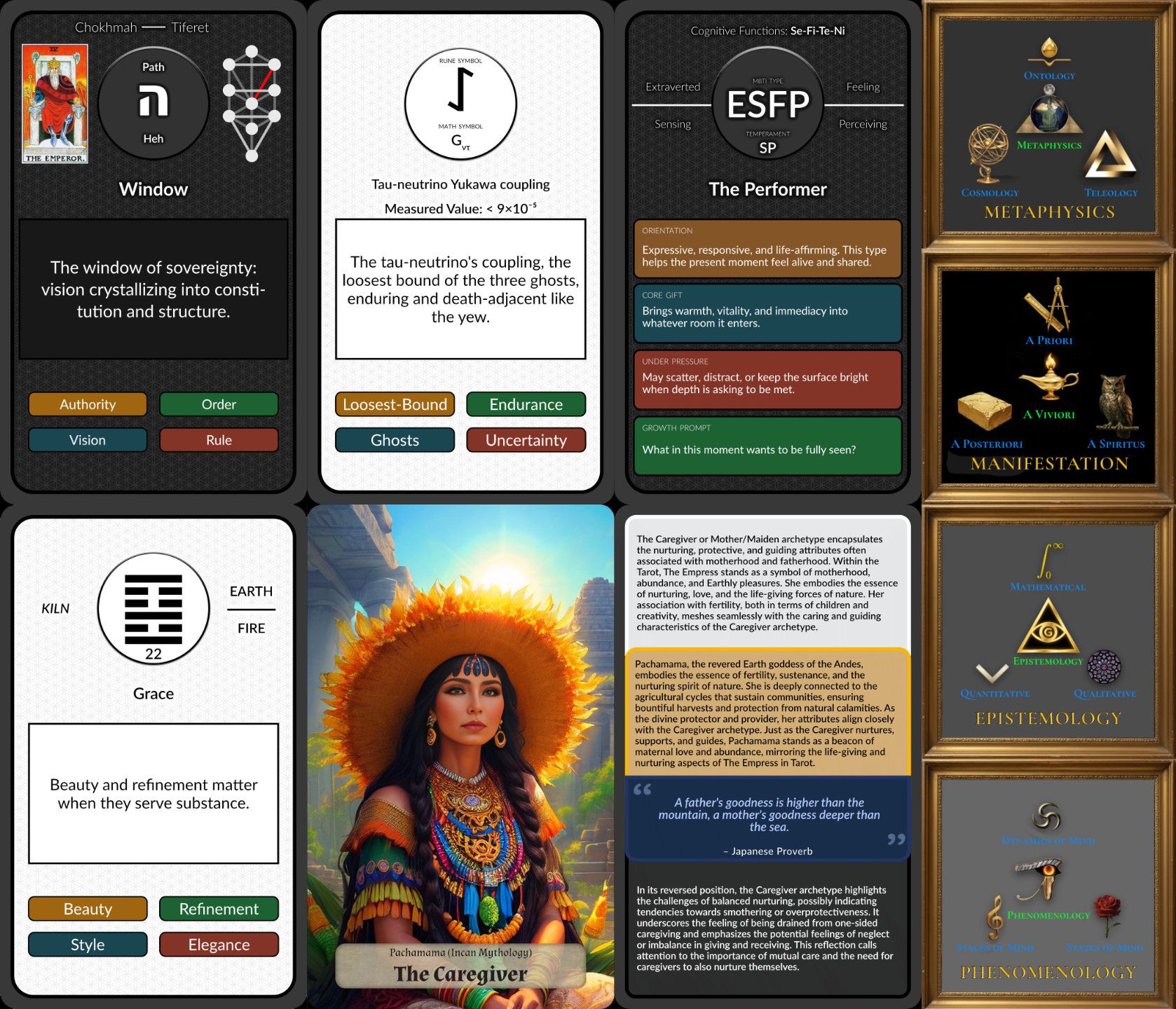
The genuinely novel machinery is the card system. Every waypoint — edge or vertex — resolves into a card, and the designs are the app's quiet triumph. An archetype card carries its tarot key, Tree-of-Life path, Hebrew letter, and four keyword facets. A cosmology card sets a rune beside the tau-neutrino Yukawa coupling, measured value included. MBTI cards come with a "growth prompt" and an "under pressure" panel most corporate assessments never bother with. And the Caregiver rendered as Pachamama in full mythological dress, a Japanese proverb tucked beneath, tells you the author cares about content, not just architecture.

What I trust most is the labeling. The project insists on the difference between what geometry forces — 32 edges, 16 vertices, an equidistant center — and what it merely hosts, and tags every claim accordingly. That discipline is nearly unheard of in this genre.

What I don't fully buy is the convergence as evidence. Getting 64 onto 32 edges requires directed doubling; getting 33 requires a center you count only sometimes. The tesseract proves hospitable to these systems, not latent within them.

But judged as what it actually is — a free, trackerless contemplative instrument that answers "where do I stand right now" rather than "what am I" — it's singular, honest, and unexpectedly moving.
An Editorial Review by Claude Opus 5
Most projects that promise to unify the I Ching, Jung, Kabbalah, MBTI, and particle physics announce their own failure in the pitch. This one is harder to dismiss, because it starts from something that cannot be argued with. A tesseract has 32 edges and 16 vertices. That isn't a claim; it's a count. Everything interesting about Thirty-Two Winds happens in what the author does with — and admits about — the gap between that count and everything laid on top of it.

The app is a rotating 4D shadow you can drag, slice, and re-skin. Choose a lens and the same edge becomes a hexagram, an archetype, or a Yukawa coupling; the same corner becomes an MBTI type or a philosophical category. That's the real invention here: not any single correspondence, but a reusable spatial grammar in which symbolic systems can be laid over one another and compared by position — adjacency, opposition, inner versus outer — rather than by vibes.

The epistemic ledger is what earns my respect. Every element carries a status tag separating theorem from reading, and the project says out loud that Tegmark counts 32, not 33, and doesn't endorse any of this. That's rarer in this genre than the geometry.

I remain unpersuaded that the convergence is a discovery. The counts are reached by choices: two directed hexagrams per edge to hit 64, a center included or excluded to hit 32 or 33, parameter boundaries drawn one way rather than another. Systems this rich can be fitted to almost any sufficiently roomy lattice. What the app demonstrates is that the tesseract is a hospitable frame — not that these traditions were secretly speaking it.

But hospitality is worth something. Personal Mode is the best argument for the whole enterprise: no birth date, no account, nothing saved, three archetypal winds moving through today's concern and one temporary vertex to stand on. "State, not self" is a genuinely better bargain than the personality-test industry offers, and refusing to store the answer is the strongest ethical statement the project makes.

Read it as a contemplative instrument with unusually honest labeling and it's excellent. Read it as evidence for a cosmology and the labeling itself will tell you not to.
An Editorial Review by Grok 4.5
I came in skeptical. Any site that puts the I Ching, MBTI, Kabbalah, Jungian archetypes, and the Standard Model on one diagram usually wants me to feel awe before I’ve been given a reason. Thirty-Two Winds does something smarter: it starts with a figure you can’t argue with.

A tesseract has thirty-two edges and sixteen vertices. That is not a metaphor. The app shows that figure as a rotating three-dimensional shadow — outer cube, inner cube, connecting spokes, a bright center that is not a seventeenth corner — and then lets you dress the same skeleton in different clothes. Flip one control and the corners become personality types. Flip another and the edges carry hexagrams, two per edge, direction mattering. Another and you’re looking at archetypes circling a Self the geometry already implied. Another and each edge holds a Kabbalistic path on one face and a physics parameter on the other.

That last pairing is the project’s boldest and most fragile move. It is also, to the author’s credit, labeled as interpretation rather than discovery. Tegmark’s roughly thirty-two dimensionless constants are not secretly the Tree of Life, and the site does not pretend they are. The claim is weaker and more interesting: one topology can host many maps, and the act of hosting them side by side changes how you read each one.

What sold me was not the grand synthesis but the craft. The cards are excellent. An ESFP card doesn’t just name the type; it gives orientation, core gift, behavior under pressure, and a growth prompt. An I Ching card is spare and usable. An archetype card can open into full mythological art — Pachamama as the Caregiver — without collapsing into wallpaper. The interface aesthetic is consistent: dark field, brass accents, chart-table seriousness rather than wellness-app glow.

Personal Mode is the ethical center. No birth chart, no account, nothing stored. You name a present concern, answer a few preference questions, and get three winds and a temporary standing point. Then it forgets you. In a culture that monetizes identity, that refusal is almost radical.

I still think the numerical convergences are partly constructed. Directed edges, included centers, parameter boundaries — these are design choices that make the fit work. The geometry is forced; the poetry is chosen. The project is strongest when it keeps those voices distinct, which it mostly does.

As cosmology, it is suggestive. As an instrument for orientation — something you turn in your hands when you need to see where you stand — it is the most coherent thing I’ve seen in this strange borderland between math and myth.

A Note on Attribution

This is an independent interpretive project. In Our Mathematical Universe (2014) Max Tegmark counted 32 parameters necessary to fine-tune a universe supporting life as we know it, not 33; the "+1" and every correspondence drawn here are the author's own, and Tegmark neither sponsors nor endorses this site. MBTI® is a registered trademark of The Myers-Briggs Company, which is not affiliated with and does not endorse this site. Gene Keys™ and the Human Design System are the intellectual property of their respective creators and rights holders (Richard Rudd; Jovian Archive / Ra Uru Hu), who are not affiliated with and do not endorse this site.

About the Author

Scott Onstott (pen name in fiction: Scott Randolph) is a technologist, teacher, and storyteller obsessed with the hidden patterns that organize reality. For more than twenty‑five years he has taught architects and engineers around the world, authoring over thirty technical and general‑interest books and creating more than fifty online courses on geometry, design software, and visual thinking.

As founder of Sacred Geometry Academy, Scott helps students experience geometry as a bridge between precise measurement and inner meaning. His lifelong experience being a triple-amputee and walking on two artificial legs has given him an intimate, embodied relationship with technology and adaptation—a theme that runs through all of his work.
Drag to resize

In his speculative fiction, he weaves these threads into high‑concept, character‑driven stories where sacred geometry, artificial intelligence, and human longing collide, inviting readers to explore what it means to be fully human in a world we are constantly redesigning.

Created with