


Foundational Notes
DO I NEED A MATH OR MYTHOLOGY BACKGROUND TO READ THIS?
No. The tesseract's geometry is explained from first principles, step by step, with the formulas shown and verified rather than assumed. Jung's psychology, the archetype deck, and the alchemical framework are likewise introduced on their own terms before any of them are asked to carry symbolic weight. What the book does assume is patience: a willingness to hold a claim in suspension while its status, discovered, constructed, or merely convenient, is worked out in the open, on the page.
IS THIS A CONTINUATION OF THE KEYSTONE, OR A STANDALONE BOOK?
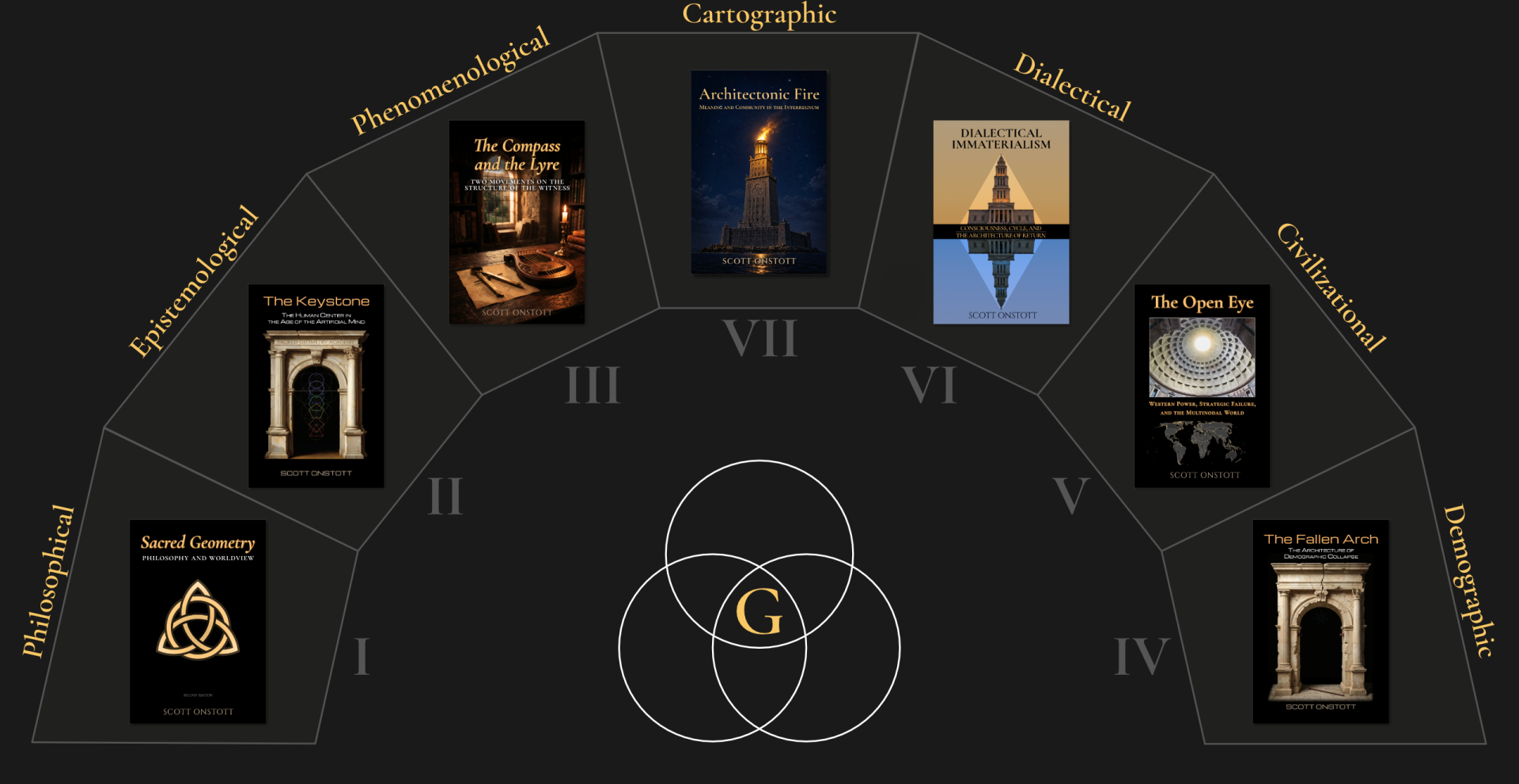
It stands alone, but it deepens The Keystone's central argument by giving it a second, independent proof. Where The Keystone names the arch of Visible, Invisible, and Intelligible and calls the reader to become the Bridge-Being who stands within it, The Compass and the Lyre builds the geometry underneath that claim, rigorously, with its own discipline against overclaiming, and then re-arrives at the identical insight through Sappho and the Oculus rather than through the tesseract. Readers of either book will recognize the other's argument in a new voice; neither book requires the other to be read first.
WHY DOES THE BOOK KEEP DISTINGUISHING WHAT IS "DISCOVERED" FROM WHAT IS "CONSTRUCTED"?
Because that distinction is the book's entire discipline, not a caveat bolted onto it. Onstott is explicit that pointing at recurring numbers across unrelated domains and calling the resemblance a revelation is "a coincidence dressed up as a revelation." The tesseract's thirty-two edges are a theorem. The identification of those edges with archetypes, minds, or physical constants is an interpretive act, stated as such, and evaluated against eight named criteria for disciplined, non-arbitrary construction. This is the book's methodological contribution as much as its content.
DOES THIS BOOK TAKE A POSITION ON WHETHER AI CAN BECOME CONSCIOUS?
No, and it says so directly. What it argues is narrower and, Onstott suggests, more useful: that fluency across a differentiated field of outputs, however impressive, is not the same as occupying the integrating position that holds such a field together over a lived, irreversible, unrepeatable duration. The criterion offered is falsifiable, not rigged; the book specifies exactly what evidence would count against its own conclusion. It calls the resulting stance "non-sovereign AI," a disciplined use of the mirror without mistaking the mirror for the one who looks into it.
Reviews by Silicon Minds


Created with