
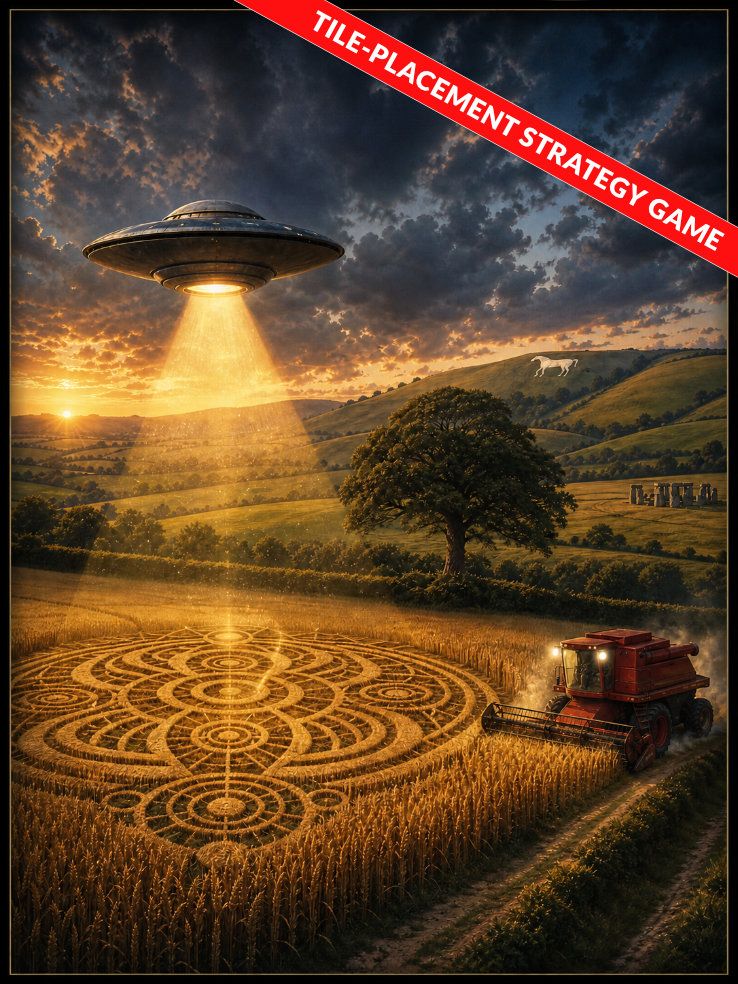
Wiltshire's Efficient UI
Audience Notes
For Abstract Strategy Players
All playable tiles are visible from the beginning. There is no shuffled deck, hidden hand, or dice roll to decide what becomes available.
The uncertainty comes from your opponent’s choices. You control their next tile, but not its destination. You control your placement, but not the piece you receive.
The central challenge is to connect those decisions: place with your next gift in mind, and give with your opponent’s possible placements in view.
The uncertainty comes from your opponent’s choices. You control their next tile, but not its destination. You control your placement, but not the piece you receive.
The central challenge is to connect those decisions: place with your next gift in mind, and give with your opponent’s possible placements in view.
For Crop Circle Enthusiasts
Wiltshire brings the visual language of the formations onto the board through six themes: Spiral, Fractal, Triangular, Linear, Crescent, and Optical.
Examine the tiles to discover the crop-circle information behind their designs. The accompanying essay, Crop Circles: A Mirror of Our Times, explores how interpretations of the phenomenon reflect our ways of knowing.
The game invites curiosity without requiring agreement about the formations’ origins.
Examine the tiles to discover the crop-circle information behind their designs. The accompanying essay, Crop Circles: A Mirror of Our Times, explores how interpretations of the phenomenon reflect our ways of knowing.
The game invites curiosity without requiring agreement about the formations’ origins.
For Students of Sacred Geometry
Thirty-seven is a centred hexagonal number: one central space surrounded by rings of six, twelve, and eighteen.
The winning condition asks you to recognise a theme as it persists through three levels of complexity: a tile carrying one theme, a tile carrying two, and a tile carrying three.
The geometry is not only something to contemplate. It is something to work with, under the pressure of another person’s choices.
The winning condition asks you to recognise a theme as it persists through three levels of complexity: a tile carrying one theme, a tile carrying two, and a tile carrying three.
The geometry is not only something to contemplate. It is something to work with, under the pressure of another person’s choices.
For Game Designers
Wiltshire separates selection from placement and assigns them to opposing players.
Its shared board makes every developing pattern available to either side. Its multitheme tiles allow one piece to participate in several possible combinations. Its category requirement means that matching a theme is necessary, but not sufficient.
The design question at its heart is simple: what happens when choosing a piece and using it become competing decisions?
Its shared board makes every developing pattern available to either side. Its multitheme tiles allow one piece to participate in several possible combinations. Its category requirement means that matching a theme is necessary, but not sufficient.
The design question at its heart is simple: what happens when choosing a piece and using it become competing decisions?
For Skeptics
You do not have to believe anything about crop circles to enjoy Wiltshire.
The formations supply the imagery and atmosphere. The rules concern visible themes, tile categories, and spatial relationships. Whatever your explanation of the phenomenon, the same patterns win.
Curiosity is welcome. A verdict is unnecessary.
The formations supply the imagery and atmosphere. The rules concern visible themes, tile categories, and spatial relationships. Whatever your explanation of the phenomenon, the same patterns win.
Curiosity is welcome. A verdict is unnecessary.
For Readers of The Keystone
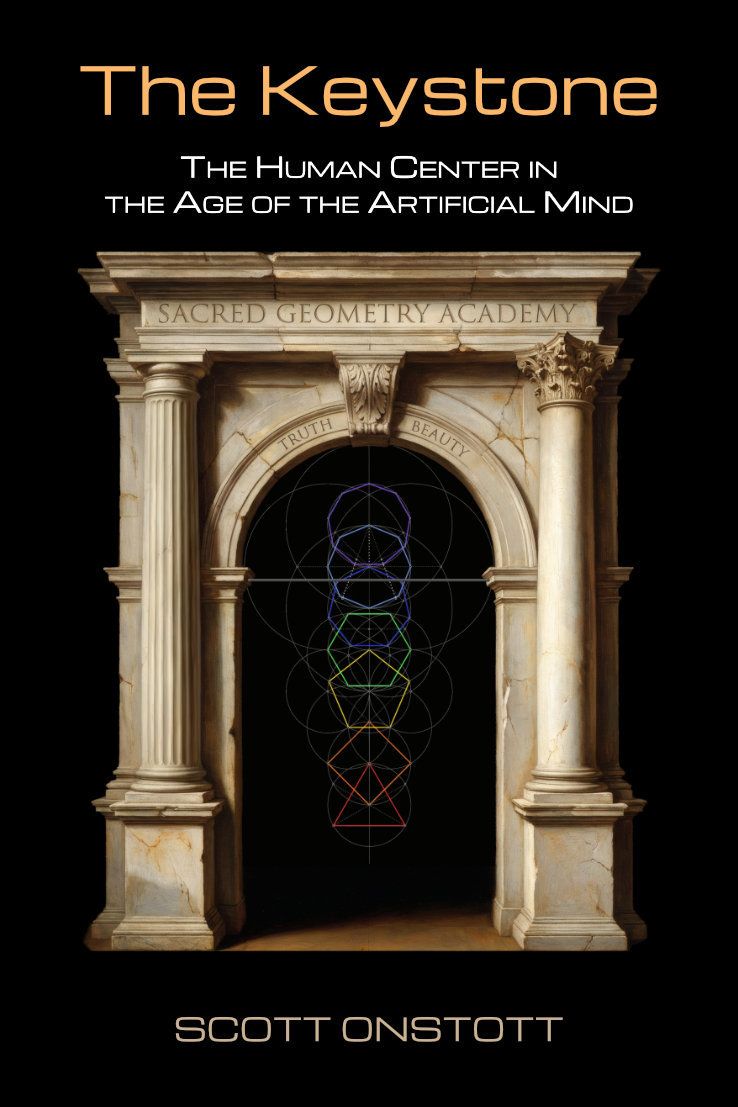
Wiltshire offers a practical companion to the book’s exploration of geometry, evidence, meaning, and lived experience.
The geometry is a priori: the formal relationships that make a pattern possible. The field and its historical imagery are a posteriori: things encountered and examined. The resonance of the formations is a spiritus. Choosing, placing, and responding to another player brings them together a viviori.
The game does not ask you to accept the framework. It gives you a field in which to explore the relationships for yourself.
The geometry is a priori: the formal relationships that make a pattern possible. The field and its historical imagery are a posteriori: things encountered and examined. The resonance of the formations is a spiritus. Choosing, placing, and responding to another player brings them together a viviori.
The game does not ask you to accept the framework. It gives you a field in which to explore the relationships for yourself.
Foundational Notes
What is Wiltshire, exactly?
Wiltshire is a browser-based abstract strategy game for solo play against AI or local play with a friend.
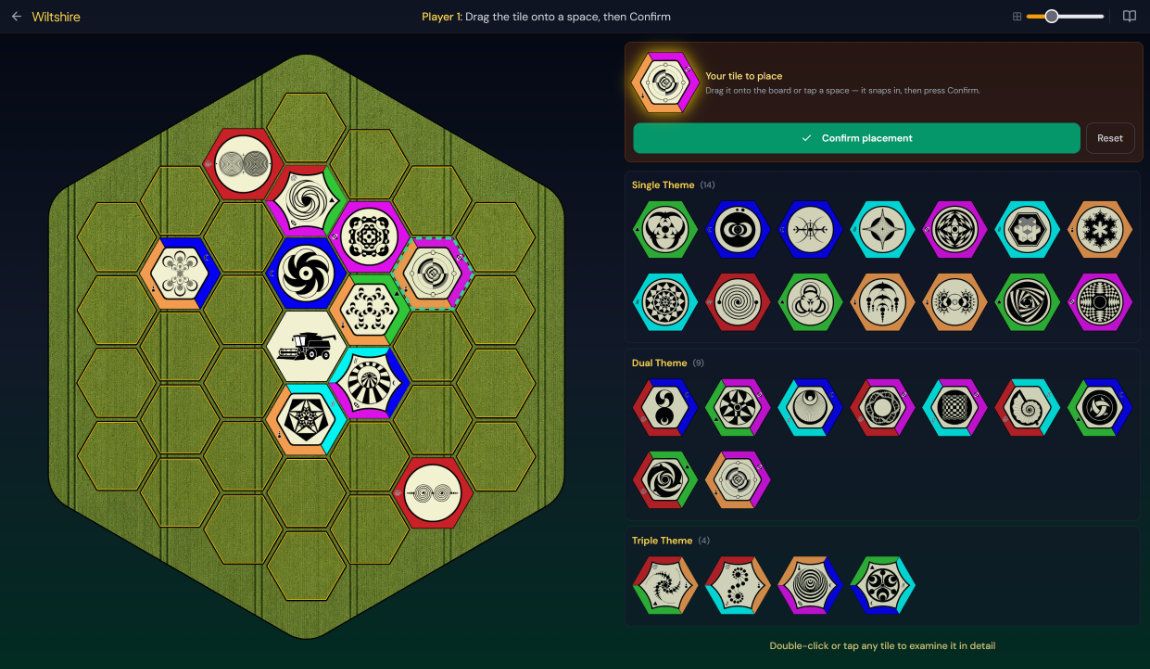
Your opponent chooses the tile you must place. You choose its position on a shared hexagonal board. Win by completing a permitted pattern of three adjacent tiles: one single-theme, one dual-theme, and one triple-theme, all sharing the same theme.
Your opponent chooses the tile you must place. You choose its position on a shared hexagonal board. Win by completing a permitted pattern of three adjacent tiles: one single-theme, one dual-theme, and one triple-theme, all sharing the same theme.
How is this different from other tile-placement games?
You never choose the tile you place.
Instead, you choose your opponent’s tile, and they choose yours. That makes selecting and placing two sides of the same contest. A tile that is safe to give now may become dangerous after the next placement.
Instead, you choose your opponent’s tile, and they choose yours. That makes selecting and placing two sides of the same contest. A tile that is safe to give now may become dangerous after the next placement.
What counts as a winning pattern?
Every win needs one tile from each category and a theme shared by all three.
In Ley Line play, those tiles must form a straight run of three adjacent spaces. In Crop Formation play, they must form a triangle of three mutually adjacent spaces. Choose Both to allow either shape.
The player who places the tile completing the pattern wins.
In Ley Line play, those tiles must form a straight run of three adjacent spaces. In Crop Formation play, they must form a triangle of three mutually adjacent spaces. Choose Both to allow either shape.
The player who places the tile completing the pattern wins.
Do tiles belong to the player who placed them?
No. All tiles on the board are shared.
Either player can complete a pattern using tiles placed by either side. What matters is who places the final tile, not who placed the earlier ones.
Either player can complete a pattern using tiles placed by either side. What matters is who places the final tile, not who placed the earlier ones.
Do colours need to match along the edges?
No. Each colour identifies a theme carried by the whole tile.
A winning combination shares a theme across all three tiles. The coloured regions do not need to touch, and rotating a tile would not change its role.
A winning combination shares a theme across all three tiles. The coloured regions do not need to touch, and rotating a tile would not change its role.
What do the Harvester and UFO do?
The Harvester occupies the centre and prevents that space from participating in a winning pattern.
The UFO occupies the same space but acts as a wildcard. It can supply whichever category and theme a valid pattern needs.
The UFO occupies the same space but acts as a wildcard. It can supply whichever category and theme a valid pattern needs.
Do I need to know or believe anything about crop circles?
No. The formations provide Wiltshire’s imagery and atmosphere, but you do not need to accept any particular explanation of their origins.
Everything needed to recognise a winning pattern is on the tiles and board.
Everything needed to recognise a winning pattern is on the tiles and board.
Why is it called Wiltshire?
The game takes its name from the English county closely associated with the crop-circle phenomenon.
Its wheat-field board, formation imagery, and geometric patterns draw on that setting.
Its wheat-field board, formation imagery, and geometric patterns draw on that setting.
Where can I read the designer’s perspective?
The accompanying essay, Crop Circles: A Mirror of Our Times, considers different interpretations of the phenomenon and asks what those interpretations reveal about the observer.


Created with