A Note to the Reader
On a Structural Argument That Does Not Navigate on the Reader's Behalf
Foundational Notes
Won't AI and robotics solve the demographic problem by replacing lost productivity?
Possibly, and the book takes that possibility seriously rather than dismissing it. Robotic labor and AI productivity may sustain institutions through the demographic contraction in ways that prevent the most visible material consequences of population decline. The book's disagreement is narrower: the seventh stone is not a productivity variable. The internal orientation toward a future worth inhabiting and worth populating is not a function of material abundance, because the societies that have achieved the highest levels of material abundance in recorded history have reached the most extreme expressions of the demographic cascade. The book is concerned with the structural conditions for developing the specific human capacity this series calls a viviori: the knowing that arises from living inside the tension between domains simultaneously, which is neither a productivity metric nor a mood. No algorithmic system produces it by delivering the experience of it. The arch holds because the stones are in place, not because the goods are distributed.
Does this book tell me what to do?
No. The book maps structural conditions. It identifies what must come before what and why the order cannot be reversed. It does not allocate those conditions among particular persons, communities, or institutions. No reader arrives at this book occupying the same position in the social architecture. What the map implies for any specific life depends on what the reader brings to the reading. The map is offered without itinerary.
Do I need to have read the prior six books in The Arch?
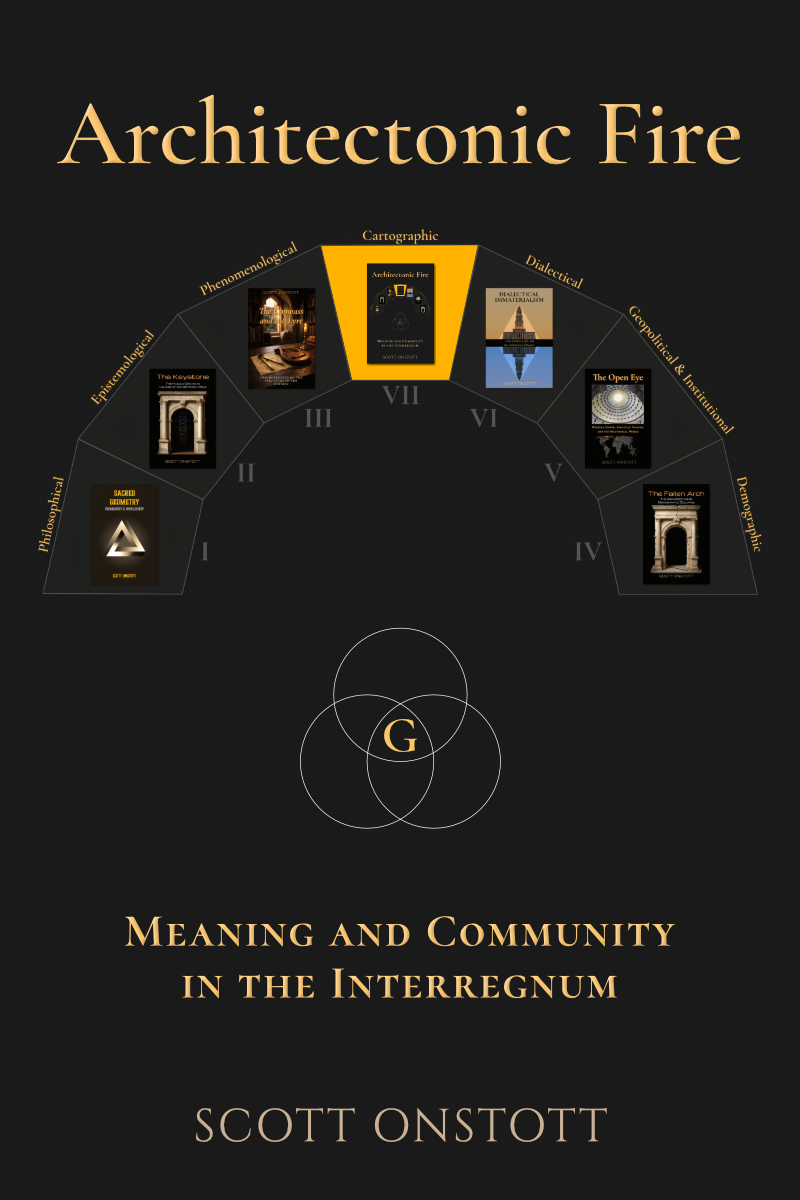
This book takes the prior six volumes as established instruments rather than summarizing them in full. Key concepts are introduced at first use, and readers who arrive without the prior books will be able to follow the navigational argument. The full force of the dependency structure argument, however, depends on having tested those instruments against the evidence those books present. The strongest approach is to read the series in sequence. Readers who are not ready to make that commitment will find the argument coherent but will be taking the structural diagnosis on trust rather than on tested evidence.
What is the a viviori knowing and why does this book treat it as the preservation target?
The a viviori is the fourth form of knowing in The Arch's epistemological architecture, established in The Keystone: the knowing that arises only from living inside the tension between all three domains simultaneously, holding fact, form, and felt meaning together without collapsing into any of them. It is not a rare or exotic capacity. It is universal. Every human being is capable of developing it. What erodes, under the structural conditions this book analyzes, are the specific occasions for its development: the productive friction, the sustained relationship, the communal life in which the orientation toward the future is practiced before it is recognized. When those occasions are progressively removed, the capacity remains latent. It does not develop, because no one around is practicing it at the level required for the transmission to occur.
What is the critical path and how is it different from a list of recommendations?
A critical path is the specific sequence of tasks in which no step can be initiated before its predecessor is complete, and in which delay at any step delays the whole. This differs from a list of good things to do in a way that is decisive for the book's argument: the Interregnum is a window with hard constraints on both ends, not a period of difficulty that thoughtful people can address in whatever order seems most pressing. Meaning must precede community because communities built without shared meaning structures do not transmit them; community must precede institutional reform because institutions reformed before the social base that sustains them is restored reproduce Trickster-phase failures in new forms. The sequence is not the author's preference. It is a structural precondition.
What does "Architectonic" mean in the title?
"Architectonic" names both the series' central structural metaphor and the activity this book undertakes. The metaphor runs through The Arch: the seven-stone arch with its keystone, the arch that holds when all seven stones are in place and fails when any one is removed. "Architectonic" extends that metaphor to systematic structural mapping: an architectonic argument is concerned with load-bearing relationships and dependency constraints, independent of the specific cultural forms any particular community will eventually build within them. This book identifies the structural conditions. What is eventually built within those conditions is the work of communities, individuals, and institutions whose specific forms cannot be prescribed in advance.
Reviews by Silicon Minds


Created with
