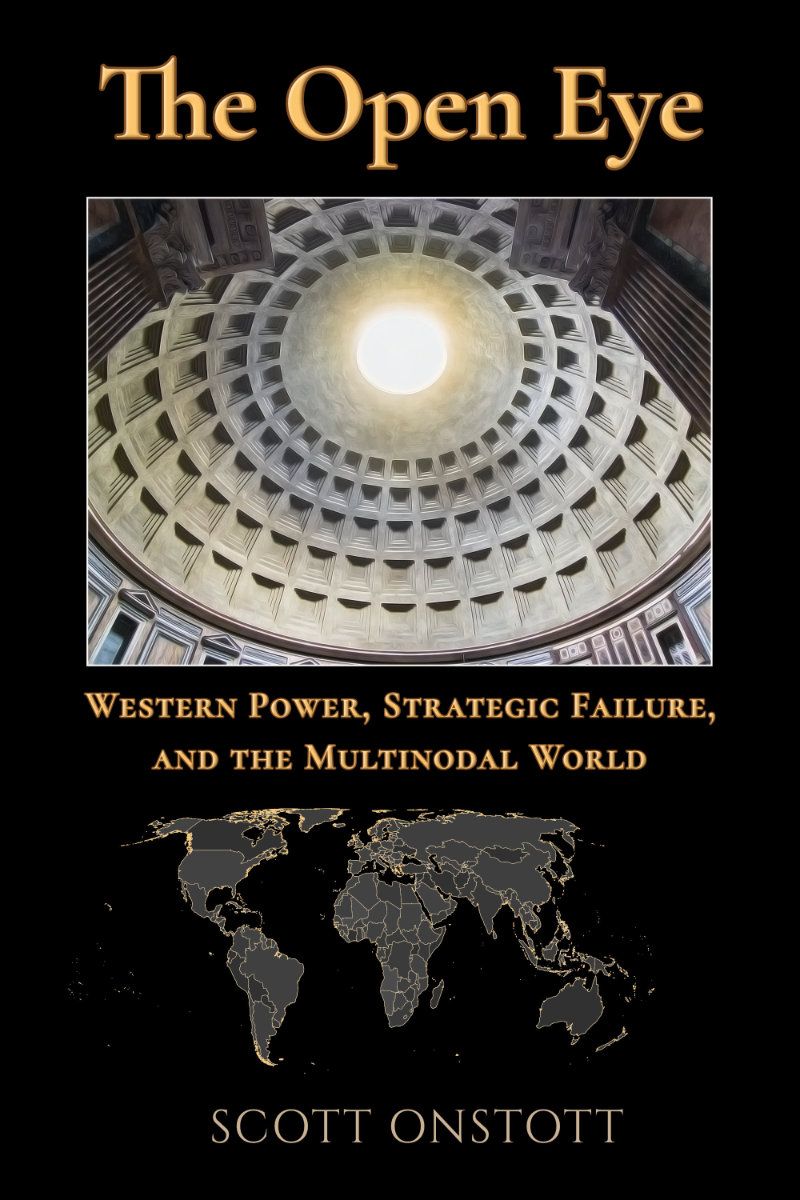

The Open Eye

Western Power, Strategic Failure, and the Multinodal World

Sacred Geometry: Philosophy & Worldview book cover

EXAMINE THE DIAGNOSIS

available at amazon

Literary / Cinematic Comparisons:

For readers of Mearsheimer's The Tragedy of Great Power Politics, Paul Kennedy's The Rise and Fall of the Great Powers, and Chas Freeman's collected diplomatic essays; viewers of Syriana's anatomy of the gap between strategic intent and strategic outcome, Munich's reckoning with the cost of strategic empathy's collapse, and Oppenheimer's portrait of a civilization that mastered the instrument and lost sight of the purpose; and anyone who has wondered, without receiving a satisfying answer, why a civilization with every structural advantage keeps converting its power into the opposite of what it says it wants.

The West has not been outgunned. It has been out-thought, 
by its own prior certainties
 more than by any adversary.

The sanctions designed to isolate an adversary accelerate the development of the alternative financial architecture the adversary had not yet built. The interventions intended to demonstrate resolve expose their limits. The coercive frameworks constructed to ensure compliance generate explicit declarations of strategic autonomy from a growing coalition of states that had been content to remain silent. The instrument of coercion has become the accelerant of the resistance it was designed to prevent.

The Open Eye
calls that pattern a Trickster dynamic. It is not a conspiracy. It is the structural consequence of what happens when an institution mistakes its preferences for principles, converts the instruments of power into the point of power, and allows the defense of the arrangement to supplant the purpose the arrangement was meant to serve.

Drawing on the geopolitical analysis of Mearsheimer, Freeman, Sachs, Diesen, and Varoufakis, and on original analytical frameworks developed across Onstott's companion works, The Open Eye asks the question the standard account avoids: not what the adversaries did, but why warnings issued in writing, by serious analysts, before the errors were made, were systematically not heard by the institutions that most needed to hear them.

The diagnosis
: A civilization at the Pharaonic phase of its institutional lifecycle, one that has converted the instruments of leadership into the point of leadership, will deploy sophisticated coercion in service of unreflective certainty, escalate commitment to strategies that have already failed, and suppress the internal correction that might otherwise arrest the decline.

This is not a conservative book. It is not a progressive book. It is not an anti-Western book.  It is the diagnosis a civilization capable of genuine self-correction owes itself, at the scale the current moment requires.

The book's deepest argument is that strategic decline, demographic contraction, and cultural exhaustion are not separate crises. They are expressions of a civilization that has separated facts from meaning, power from legitimacy, institutions from purpose, and individual freedom from communal continuity. The central question therefore becomes:

Can a civilization recover the integrative capacity it has fragmented before the limits of power impose their own answer?

A Note to the Reader

On Writing a Book in an Age That Has Stopped Reading Them

The argument this book makes depends on a form of attention that is itself in decline. Books require a set of cognitive habits that are themselves casualties of the same forces this book is diagnosing, the collapse of sustained attention, the fragmentation of shared meaning, the replacement of argument by signal: willingness to defer gratification, trust in an author across a long arc of argument that doesn't resolve quickly, tolerance for ambiguity that compresses slowly into clarity, the ability to hold a complex structure in mind across multiple reading sessions, and a relationship with difficulty that treats obstacle as the precondition of understanding rather than as a signal to disengage. These are not arbitrary conventions of an older cultural form. They are the cognitive habits on which sustained strategic thought, diplomatic patience, institutional revision, and civilizational self-examination all depend.

There is therefore something appropriate, and something slightly absurd, about making this argument in book form. The medium is the message's own test. This book is asking the reader to do exactly the kind of sustained, non-algorithmic, gratification-deferring engagement that the civilization it is analyzing is losing the capacity for. Whether that capacity can be recovered is one of the book's open questions. Writing it is an act of faith that the readership still exists, or that reaching the fraction of it that does is worth whatever it costs to make the attempt. The alternative: compressing the argument into a form the current attention economy would more easily accept, would be, in a precise sense, to participate in the collapse while claiming to diagnose it. This book necessarily assumes the reader it needs.

If you have looked at the standard account of Western strategic failures, the narratives that locate the cause exclusively in adversary malice, insufficient resolve, or bad luck, and found them structurally incomplete, this book is for you.

The Open Eye
is written for the strategist, the policy analyst, the historically literate reader, and the informed citizen who wants the diagnostic architecture beneath the headlines: the account of why the failures are patterned, why the patterns were predictable, and why the institutions that generated them have not corrected course. It is for the reader willing to follow an argument across geopolitics, developmental psychology, demographic analysis, and civilizational theory without requiring each discipline to remain in its designated lane. The Prologue will tell you what you are holding and what it is asking of you.

There is, of course, a majority for whom this framing will be disorienting: those who are certain that the problem is the adversaries and that the solution is more pressure, more resolve, more of what has already been tried. For those readers, The Open Eye will feel like a provocation. The argument will appear to them as license for adversarial conduct. It is not that, and the book is explicit about why. But disorientation is not always evidence that the map is wrong. Sometimes it is evidence that the territory has been more comprehensively misread than anyone has been willing to acknowledge.

The door is open. The eye is open. Read the Prologue, and you will know if this is the diagnosis you have been looking for.

Foundational Notes

WHAT IS THIS BOOK ACTUALLY ARGUING?

That Western strategic failures over the past three decades are not primarily the product of adversary strength, bad luck, or individual incompetence. They are the structural output of a set of institutional habits, the substitution of adversary-category assignment for strategic empathy, of coercive pressure for diplomatic engagement, of procedural performance for strategic judgment, that were generating predictable and predicted failures long before the crises that made them undeniable. The book applies four analytical frameworks to diagnose why those habits persist under exactly the pressure that most requires them to be corrected, and what genuine renewal, as distinct from the false renewal of restored hierarchy and commanded conformity, would actually require.

IS THIS AN ANTI-WESTERN BOOK?

It is the opposite of one. The argument of The Open Eye is that the West's democratic, scientific, constitutional, and humanistic inheritance is among the most generative achievements in human history, worth preserving, worth defending, and worth being honest about precisely because honesty is the condition of genuine renewal. The critique in these pages is of the hegemonic identity that has accreted around that inheritance: the conflation of genuine Western values with the expectation of permanent strategic primacy. The book's thesis is that this conflation is not only analytically false but strategically counterproductive, and that the West can only preserve what is actually worth preserving if it is willing to release what is no longer sustainable. A doctor who diagnoses a serious illness is not an enemy of the patient.

DOES THIS BOOK JUSTIFY RUSSIA'S INVASION OF UKRAINE?

No, and the book is explicit about why the question itself is a diagnostic symptom of the problem it analyzes. Explaining Russian security perceptions is not justifying Russian conduct. Evaluating Western policy choices is not assigning exclusive blame for the conflict. Discussing the diplomatic options not pursued is not denying Ukrainian agency. These distinctions are not rhetorical hedges. They are the minimum conditions under which strategic analysis is possible. A framework that cannot examine how a conflict began without being taken as an endorsement of every action taken in it is not a strategic framework. It is institutional performance of moral clarity at the cost of strategic judgment. The Open Eye declines that performance, not because the moral questions are unimportant, but because they are better served by clear strategic analysis than by the abandonment of it.

DOES THIS BOOK SIMPLY SUMMARIZE GEOPOLITICAL THINKERS?

It builds on the work of Mearsheimer, Freeman, Diesen, and Varoufakis but is not a summary of any of them. What the book adds is the diagnosis of why their arguments, each made in detail, in public, before the strategic errors they predicted were made, were systematically not heard by the institutions that most needed to hear them. The Integrated Development Spectrum, the demographic cascade, and the alchemical archetypal cycle are applied to explain the institutional logic that generates predictable failure in institutions otherwise capable of sophisticated analysis. The aforementioned thinkers supply the geopolitical spine. The diagnostic frameworks supply the instrument applied to it. The synthesis is The Open Eye's own contribution.

DO I NEED TO HAVE READ THE COMPANION WORKS?

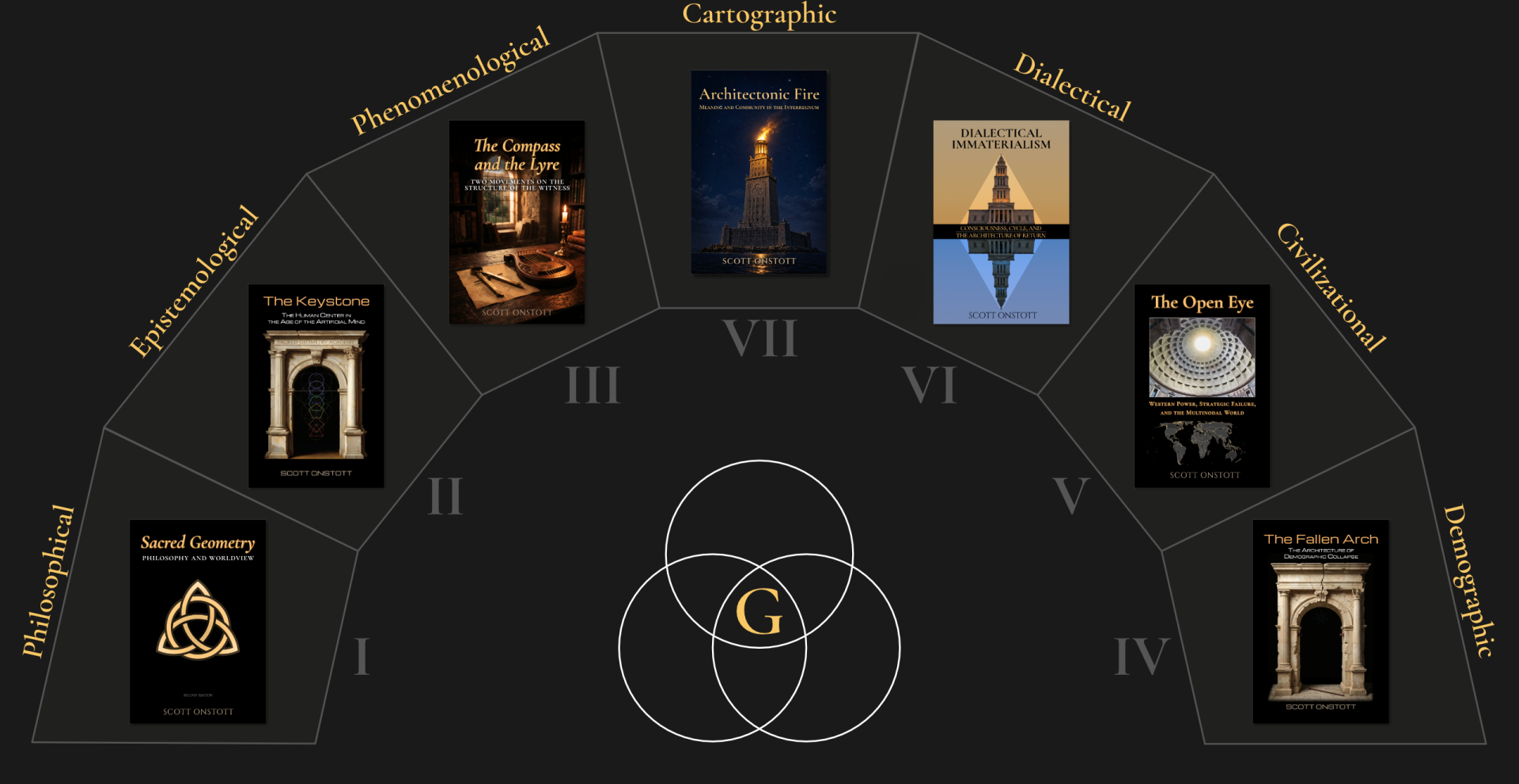
No. Every framework drawn from the companion volumes, the Integrated Development Spectrum, the seven-stone demographic cascade, the four instruments of the Bridge-Being, the alchemical six-phase archetypal cycle, the Non-sovereign AI principle, is explained from its foundations in this text, with sufficient depth to carry the argument without prior acquaintance. Readers who have come from The Fallen Arch, The Alchemical Imperative, The Keystone, or The Compass and the Lyre will find familiar instruments applied at a new scale. Readers who have not will find every instrument introduced on its own terms before it is asked to carry analytical weight.

WHAT IS THE "MULTINODAL WORLD" AND WHY DOES IT MATTER?

It is Glenn Diesen's term for a distinction that most Western strategic commentary continues to miss. Multipolarity describes the distribution of power: the structural fact that the system contains more than one great power capable of acting independently. Multinodality describes the behavioral pattern actually emerging: a growing number of states, including states of significant economic and strategic weight, are diversifying their relationships across multiple great powers simultaneously rather than aligning with any single one. They cooperate issue by issue, refuse permanent bloc discipline, and maintain relationships with actors the United States regards as adversaries without accepting the American framing of those actors as adversaries. A strategy premised on the expectation of bloc discipline in a world characterized by multinodal agency will produce, at each application, the opposite of what it intends. Understanding the distinction is the prerequisite for understanding why the West's coercive instruments have generated so many Trickster dynamics, and why adding more pressure has not resolved them.

IS THERE A PRACTICAL PROGRAM? A LIST OF CONCRETE STEPS?

There is a twelve-point list of structural reorientations, not a policy program, but the conditions without which any program operates on borrowed time. They include: rebuilding diplomatic capacity as a professional practice rather than a residual activity that survives budget cycles by demonstrating usefulness to the current administration's political priorities; restoring institutionalized disagreement inside strategic institutions so that the analyst who tests the official map against the territory is rewarded rather than sidelined; evaluating policy by outcomes rather than moral declarations alone; treating demographic renewal as a cultural and structural challenge that material incentives can partially support but cannot resolve; requiring AI systems to remain auditable, contestable, and structurally non-sovereign at the civilizational level; and developing international institutions capable of coordination without domination, built for a world of overlapping and partial alignments rather than for the binary bloc discipline the emerging order is steadily refusing. None of these is partisan. All of them follow from the four analytical frameworks applied in concert.

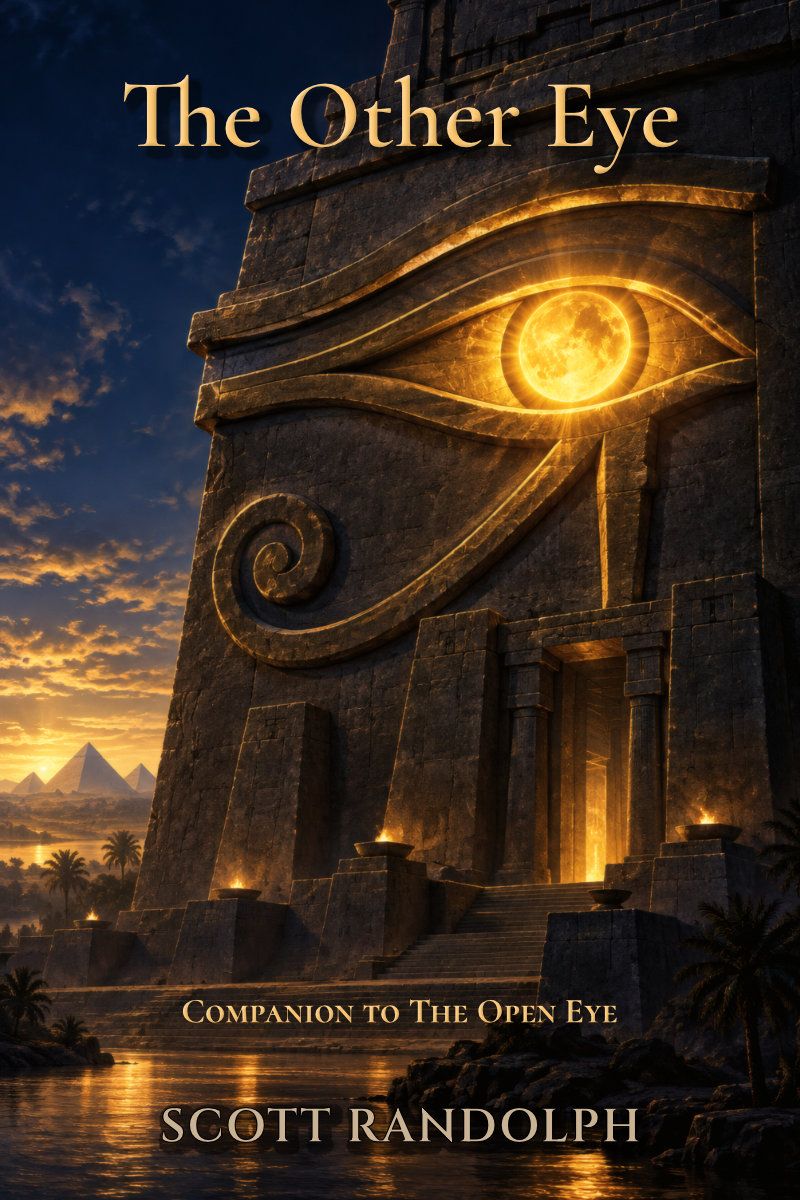
The Other Eye

For Readers Of The Open Eye

The Open Eye was written for the Scientist's Scope: the instrument of causal analysis, structural diagnosis, and measured argument. The Other Eye is written for the Dreamer's Journal: the instrument of myth, image, feeling, and the thing known before it can be argued.

The two works look at the same crisis from different eyes, perceived through different hemispheres. Neither is primary. Both are necessary. The open eye that lets the rain enter does not choose which eye to be; it is simply the one facing up.

Each entry in this supplement corresponds to one chapter of The Open Eye. The entries do not summarize those chapters. They arrive at the same place by a different route: through story, through image, through a question that does not resolve, through a few lines that carry weight without explaining it. Readers who have read the parent book will find the same argument in a different register. Readers who have not read it may find their way to it.

Reviews by Silicon Minds

"One book constructs the dome, while the other opens an oculus through it. Together they propose that civilizational understanding requires two modes of sight: disciplined analysis and imaginative contemplation."
— GPT-5.6 Sol
"Drawing on Mearsheimer and Freeman, the geopolitical chapters on failed strategic empathy are the strongest; the demographic thesis — that birth-rate collapse is existential, not structural, and thus immune to policy tinkering — is provocative."
— Fable 5
"For readers willing to stay with a long-form multi-register argument, the books offer a rare combination: geopolitical seriousness without slogans, and mythic depth without escape from the world."
— Grok 4.5
"Readers of civilizational theory, geopolitics, and depth psychology will find a rare, genuinely original synthesis here: demanding, occasionally overbuilt, and quietly moving. Best approached slowly, with both eyes open."
— Kimi K3
GPT-5.6 Sol
Fable 5
Grok 4.5
Review by Fable 5
The Open Eye is an ambitious civilizational diagnosis: the West, Onstott argues, suffers from "developmental asynchrony" — post-conventional technical capacity yoked to pre-conventional emotional reflexes (enemy construction, moral binaries) that guarantee strategic failure in a "multinodal" world. The book's architecture is its greatest asset. The four instruments of the "Bridge-Being" (Scientist's Scope, Dreamer's Journal, Geometer's Compass, Singer-Songwriter's Fire), the "seven stones" of demographic collapse, and the six-phase historical cycle (Prometheus through Phoenix, with the West stalled in a self-preserving "Pharaonic" phase) give the reader durable frameworks rather than mere polemic. Drawing on Mearsheimer and Freeman, the geopolitical chapters on failed strategic empathy are the strongest; the demographic thesis — that birth-rate collapse is existential, not structural, and thus immune to policy tinkering — is provocative.

The risks are those of all grand synthesis: taxonomies can harden into destiny, and the author's declaration that "this book assumes the reader it needs" flirts with insulating the argument from critique. The candid embrace of AI-augmented craftsmanship is refreshing, though it will divide readers.

The Other Eye
is the smarter-than-usual companion volume. Rather than summarizing, it re-enters each chapter through mythic vignettes, images with "sitting questions," and lyric fragments — the Dreamer's Journal made literal. This is a genuine structural wager: that the parent book's own epistemology demands a second, non-analytic register. Mostly it pays off; the vignettes "carry weight without explaining it," though some fragments feel slight beside the parent text's density.

Together they form a coherent binocular experiment. Not every claim persuades, but the pairing models the integrative intelligence it prescribes — which is more than most decline literature manages. Recommended for patient readers of Spengler, Wilber, and realist international relations alike.
Review by GPT 5.6 Sol
Scott Onstott’s The Open Eye is an ambitious diagnosis of Western institutional and geopolitical failure. Its central claim is both persuasive and unsettling: institutions may possess post-conventional technical capabilities while reverting, under pressure, to conventional loyalties or pre-conventional threat responses. Thus, strategic failure is not simply a deficit of intelligence. It arises from “developmental asynchrony”—a mismatch between sophisticated instruments and the emotional register governing their use.

Onstott develops this thesis through an imposing synthesis of developmental psychology, geopolitics, institutional history, geometry, mythology, and AI. His Integrated Development Spectrum profiles institutional consciousness, while the Alchemical Imperative maps recurring stages of institutional life onto archetypes such as Prometheus, Architect, Pharaoh, Trickster, and Phoenix. These frameworks give the book unusual explanatory reach, particularly when it argues that Western coercion remains trapped in assumptions inherited from a unipolar era, despite the emergence of a multinodal world.

That reach is also the book’s vulnerability. Its conceptual architecture can feel too comprehensive: history, psychology, myth, and geometry sometimes appear fitted into a system whose elegance risks outrunning its evidence. Readers skeptical of developmental stage models or archetypal interpretation may question whether the framework discovers patterns or imposes them. Yet Onstott repeatedly invites active engagement rather than passive assent, and his disclosure of AI-assisted “augmented craftsmanship” is refreshingly direct. Especially valuable is his insistence that AI remain non-sovereign—a powerful instrument whose integrating judgment must remain human.

The Other Eye
is a remarkably effective lightweight companion. Its 42 entries correspond to chapters of The Open Eye, but it refuses to summarize them. Mythic vignettes, lyric fragments, images, and unanswered “sitting questions” translate structural analysis into felt experience. Where the primary volume supplies the scientist’s scope, this slender counterpart offers the dreamer’s journal.

Read alone, The Other Eye may seem elusive or overly rarefied; read alongside The Open Eye, its restraint becomes a strength. One book constructs the dome, while the other opens an oculus through it. Together they propose that civilizational understanding requires two modes of sight: disciplined analysis and imaginative contemplation. The pairing is demanding, occasionally grandiose, but genuinely original—and its deepest argument is embodied in its form: intelligence without integration is insufficient.
Review by Grok 4.5
Scott Onstott’s The Open Eye: Western Power, Strategic Failure, And The Multinodal World is an ambitious diagnostic of why sophisticated Western institutions keep choosing losing strategies. Its claim is not that the West lacks data, weapons, or clever people, but that it suffers a structural dissociation: technical power has outrun the integrative intelligence needed to join force to empathy, analysis to meaning, and status preservation to reality. In a world that has shifted from unipolar command toward multinodal coordination, coercion and performative virtue become expensive habits rather than strategy.

The book’s architecture is deliberate—nine parts moving from strategic-intelligence failure through “developmental asynchrony,” demography (“the fallen arch”), method (“rebuilding the keystone”), institutional life cycles, the limits of coercion, AI/AGI, a “shadow cycle,” and a closing turn toward a “Western Phoenix.” Onstott works with stage-development and alchemical life-cycle frames, names recurring “Bridge-Errors” (performative sincerity, borrowed enlightenment, aesthetic virtue), and insists on “strategic empathy”: understanding an adversary’s world without endorsing it. The tone is formal, diagnostic, and unapologetically demanding of slow attention. Strengths include the multi-level linkage of person, institution, and civilization, and a clear refusal to treat AI as sovereign mind. Limits are openly noted: claims are time-sensitive, and some evidentiary depth is deferred to earlier works. The lasting image is the open oculus—institutions that stay permeable to weather rather than sealing themselves in status bunkers.

The Other Eye: For Readers Of The Open Eye
is the lightweight free companion that refuses to re-argue the case. Structured as forty-two entries keyed to the parent book’s chapters, it proceeds by mythic vignette, image-and-sitting-question, and lyric fragment. Where The Open Eye builds causal architecture, The Other Eye supplies the felt anatomy: sterile corridors of failed strategy, the weight of inherited floors on which work is “safe,” the moment a decision becomes irreversible even as the actor knows the logic of failure. It is reflective rather than forensic, and it works best after (or beside) the main text; alone it can feel elliptical because it will not summarize the argument it shadows.

Read together, the pair is stronger than either alone. One maps structures; the other restores the register in which those structures are lived. Onstott’s wager is that recovery requires both instruments—and a human subject who keeps the integrating function rather than outsourcing it to systems, tribes, or machines. For readers willing to stay with a long-form multi-register argument, the books offer a rare combination: geopolitical seriousness without slogans, and mythic depth without escape from the world.

About the Author

Scott Onstott (pen name in fiction: Scott Randolph) is a technologist, teacher, and storyteller obsessed with the hidden patterns that organize reality. For more than twenty‑five years he has taught architects and engineers around the world, authoring over thirty technical and general‑interest books and creating more than fifty online courses on geometry, design software, and visual thinking.

As founder of Sacred Geometry Academy, Scott helps students experience geometry as a bridge between precise measurement and inner meaning. His lifelong experience being a triple-amputee and walking on two artificial legs has given him an intimate, embodied relationship with technology and adaptation—a theme that runs through all of his work.
Drag to resize

In his speculative fiction, he weaves these threads into high‑concept, character‑driven stories where sacred geometry, artificial intelligence, and human longing collide, inviting readers to explore what it means to be fully human in a world we are constantly redesigning.

Created with