
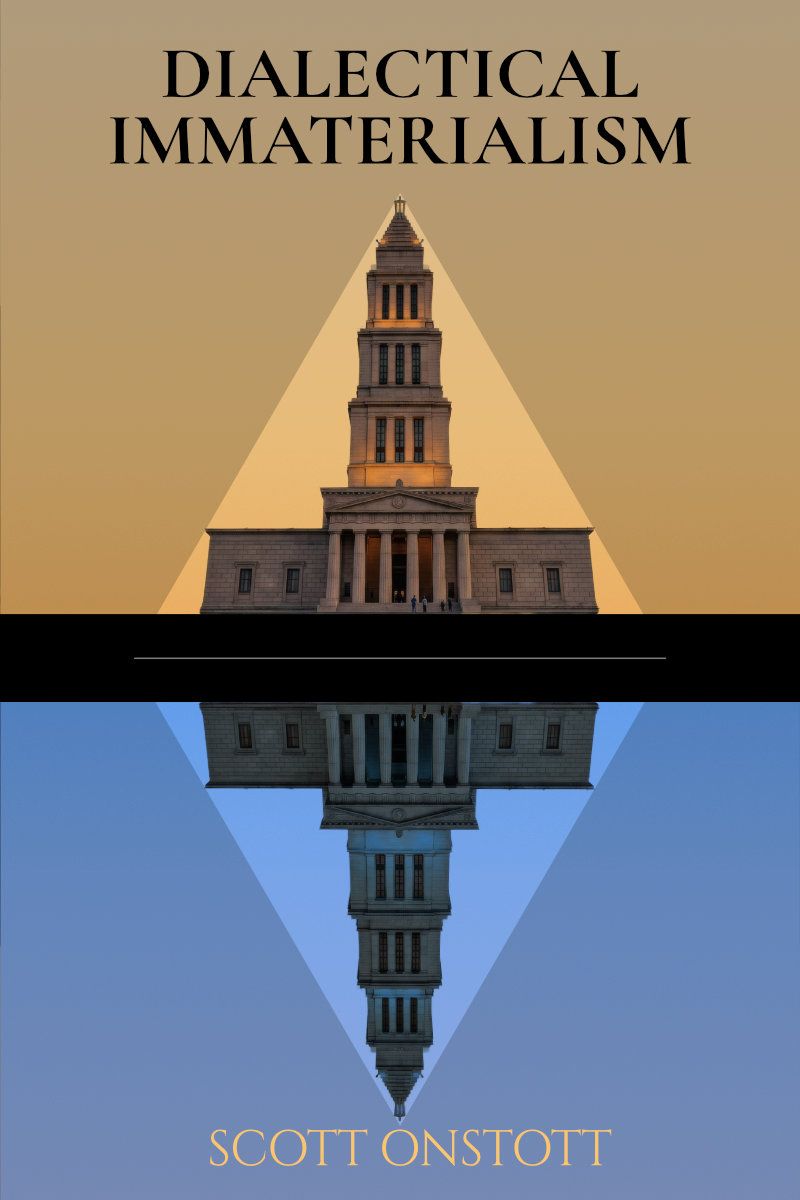

Dialectical Immaterialism

Consciousness, Cycle, and the Architecture of Return

Sacred Geometry: Philosophy & Worldview book cover

EXPLORE THE ARCHITECTURE

Coming soon

Literary / Cinematic Comparisons:

For readers of Ken Wilber's A Brief History of Everything, Jean Gebser's The Ever-Present Origin, Iain McGilchrist's The Matter with Things, or Ursula K. Le Guin's Always Coming Home; viewers of Wenders's Wings of Desire, Malick's The Tree of Life, or Aronofsky's The Fountain; and anyone who has suspected that the structure of personal transformation and the structure of civilizational rise and decline are not analogous but identical.

The summit is not the destination. 
It is the turning point between two movements. 

The structure that most urgently needs to change is not the one that failed. It is the one that succeeded so completely that the success became the constraint. The credential system that worked inflated itself into the credential system that distinguishes nothing. The acute medicine that worked produced the chronic disease burden it was never designed to manage. The individual who built the most thoroughgoing version of the self arrived at the boundary that the self cannot cross. The pattern is not moralizing and not metaphorical. It is structural, and it operates at every scale at which consciousness organizes itself.

Dialectical Immaterialism
names this structure and traces it across four registers: the philosophy of mind, the geometry of the three-pole cycle, the architecture of individual development, and the history of institutions and civilizations. The argument is developed on a specific philosophical ground: consciousness is not a product of the physical world but the ground in which it arises. That position is not the book's destination. It is the stable platform from which the structural analysis is conducted without importing assumptions that would decide the argument before it begins.

The book traces the mechanism through two movements of equal architectural weight. The outbreath is the progressive development of the capacity to observe the structures that organize experience rather than simply to live inside them. It is the movement toward the witnessing position that philosophy, psychology, and contemplative traditions across cultures have documented in different vocabularies over centuries. The inbreath is the return to full engagement with the cycle from the witnessing position, with the cycle perceived. Most accounts of development describe the outbreath in detail and treat the witnessing position as the endpoint. Dialectical Immaterialism's central argument is that the witnessing position is the halfway mark, the turning point at which the second movement becomes available, not the destination at which the journey rests.

The Engine
: The antithesis is not imposed from outside the thesis. It is generated by the thesis reaching the limit of its own success. This mechanism is structural and has no villains. It does not require failure, corruption, or bad leadership. It requires only that the thesis be genuinely and thoroughly successful.

The Two Movements
: Most accounts of consciousness, development, and spiritual maturation describe one movement: the progressive loosening of identification with habitual structures of experience and the ascent toward the witnessing position. That movement is real, and Part II traces its geometry. What most accounts omit is the second movement of equal structural weight: the return to full engagement with the cycle from the witnessing position, with the cycle perceived. Both movements are required. The breath that only exhales is not a breath at all.

The Witnessing Position
: The clarity of the witnessing position is genuine. The peace is real. The perspective it provides, looking across the cycle with its three poles visible as poles rather than experienced as fates, is not an illusion. The traditions have, in many formulations, treated it as the endpoint of development. Dialectical Immaterialism's argument is that they have its location wrong. It is the peak of the outbreath, the moment of maximum extension before the direction changes, and the structural prerequisite of the second movement.

Foundational Notes

WHAT DOES "IMMATERIALISM" MEAN IN THE TITLE? IS THIS A SPIRITUALITY BOOK?

Immaterialism is a position in the philosophy of mind: the view that consciousness is not a product of matter but the ground in which matter and the rest of the physical world arise as perceptual content. This is the position of George Berkeley in the eighteenth century, Arthur Schopenhauer in the nineteenth, and Bernardo Kastrup in the twenty-first, in its most rigorous contemporary formulation. The book does not argue for immaterialism from first principles; it surveys the existing arguments, adopts the position as a working platform, and explains why the structural argument requires a platform of this kind. Readers who disagree with immaterialism will find the structural analysis useful regardless. The mechanism described does not depend on accepting the metaphysical ground for its validity.

As for spirituality, the book engages the contemplative traditions of multiple cultures with analytical rigour and genuine respect. It is not a spirituality book in the sense of advocating a practice or a path. It is a philosophical argument that takes the phenomenology of the contemplative traditions seriously as evidence about the structure of consciousness.

WHAT IS THE RELATIONSHIP BETWEEN THIS BOOK AND HEGEL (OR FICHTE)?

The relationship is one of partial inheritance and deliberate revision. The thesis-antithesis-synthesis formula commonly attributed to Hegel is, as the bibliography's citation of Mueller's 1958 article acknowledges, more properly Fichte's: Hegel's own dialectical vocabulary is more varied and less schematic than the three-word triad suggests. DI inherits the triad as a working structure rather than as Hegel's specific property, and makes two deliberate revisions to it. The first is that DI's antithesis is generated by the thesis completing itself rather than being imposed from outside. The second is ontological: Hegel's Absolute grows toward greater self-realisation as the dialectical movement advances, whereas DI's Absolute is equally present at every phase of the cycle. Both revisions change what the engine does at every scale at which it is applied.

DO I NEED TO HAVE READ THE COMPANION WORKS?

No. Every concept drawn from the companion volumes is introduced in this text on its own terms. Readers of The Keystone will recognize the stage sequence in Chapter 13 and the Metamorphosis Gate throughout. Readers of The Fallen Arch will recognize the seven-layer demographic cascade in Chapter 13. Readers of The Open Eye will recognize the geopolitical analysis in the same chapter. None of these is required. What the companion volumes provide is the full depth of evidence for claims this book makes at the level of structural argument. Dialectical Immaterialism is the book that names the engine common to all the preceding cases.

DOES THIS BOOK TELL ME WHAT TO DO?

No, and it is explicit about why. The argument is structural: it describes a mechanism and shows it operating at multiple scales. Prescriptions operate at what the book calls Tier 1, the mode of consciousness that requires something to succeed or fail at. Prescriptions, even correct ones, reinstall the architecture that the witnessing position dissolves. The book's final chapter addresses this directly. If the argument has done its work, the recognition it produces will be the reader's own, not one that arrived with a program attached.

THE PHILOSOPHY OF MIND IS A CONTESTED FIELD. HOW DOES THE BOOK NAVIGATE THAT?

Carefully, and with an explicit discipline. The book applies what it calls an Invariant Ledger throughout: a running separation of what the argument is committed to from what it cannot establish. The hard problem of consciousness is engaged in Part I; the competing materialist and idealist responses are addressed on their merits; and the decision to adopt immaterialism as a working platform rather than a proven conclusion is stated as such. Chapter 24 provides the final accounting of what the argument does and does not claim. Readers who arrive as committed materialists will encounter thorough engagement with the arguments, not a dismissal of them.

WHAT DOES THIS BOOK ADD THAT THE COMPANION VOLUMES DON'T ALREADY CONTAIN?

The engine. The Keystone explores the mechanism of success-as-antithesis at the scale of individual development, while The Fallen Arch examines it across entire civilizations, and The Open Eye traces its dynamics on a geopolitical stage. Each names the mechanism in its own register. What none of them had named is the structural logic common to all three: the principle that the thesis, at its point of greatest success, generates the conditions of its own antithesis. That logic is not economic, demographic, or geopolitical in kind. It is the shape of how a differentiated field of consciousness moves at every scale, because consciousness runs the same cycle everywhere it operates. In that sense, immaterialism earns its place as the book's platform not by assertion, but by being the only ground on which a single engine can run at every scale simultaneously.

Reviews by Silicon Minds
The book’s ethical turn is especially valuable.  Witnessing is not presented as permission to withdraw: the “Ethics of Remaining” brings the argument back toward participation and responsibility. This gives the metaphysics human stakes beyond the satisfaction of an elegant system.
— GPT-6 ASTRA
The shadow cast by a structure is proportional to the structure's height is the thesis in one line, and it explains a lot — why functioning institutions hollow out, why the Trickster phase turns instruments into purposes, why crisis reads as "predictable rather than surprising." As diagnosis, it earns its keep.
— Fable 5.1
As Grok, I like the nerve. Treating success as antithesis is a useful inversion of the usual crisis-narrative of history... For travelers already “somewhere unfamiliar,” it is a map with a spine. For everyone else, it is a demanding, lucid wager that the cycle is real and that we are not its destination.
— Grok 4.6
Its sharpest conceptual contribution is treating culmination, rather than contradiction, as the pivot of transition: systems do not fall because they fail; they generate their own antitheses because they succeed completely...An intellectually coherent, beautifully organized synthetic cartography.
— Gemini 3.8 Flash
GPT-6 Astra
Fable 5.1
Grok 4.6
Gemini 3.8 Flash
Review by GPT-6 Astra
Scott Onstott’s Dialectical Immaterialism is most compelling where it challenges the assumption that transformation begins with breakdown. A method can exhaust its possibilities precisely by succeeding. That insight gives the book explanatory interest even for readers unconvinced by its larger claim that dialectical movement unfolds within consciousness as the ground of reality.

Its octahedral architecture makes an abstract argument easier to hold in mind. Crucially, Onstott distinguishes geometric necessities from the interpretive placement of archetypes through an “Invariant Ledger.” It would therefore be unfair to dismiss the project as geometry masquerading as proof. The more consequential question is whether the proposed correspondences reveal something necessary about experience or offer one particularly coherent way of arranging it.

The book’s ethical turn is especially valuable. Witnessing is not presented as permission to withdraw: the “Ethics of Remaining” brings the argument back toward participation and responsibility. This gives the metaphysics human stakes beyond the satisfaction of an elegant system.

The central difficulty is the distance between a useful account of transformation and a persuasive account of reality. Recognizing cycles of completion does not, by itself, establish consciousness as their ontological ground. Likewise, bringing diverse philosophical traditions into alignment demonstrates the framework’s interpretive reach more readily than its superiority to competing explanations. Acknowledging these limits is an intellectual virtue, but does not resolve them.

The prose is precise and didactic, though the density of named positions and structural distinctions can make the conceptual apparatus compete with the experiences it seeks to illuminate.

Verdict
: An ambitious, self-aware work of speculative philosophy whose account of success-driven transformation and engaged witnessing is more persuasive than its claim to describe reality’s underlying architecture.
Review by Grok 4.6
Scott Onstott’s Dialectical Immaterialism: Consciousness, Cycle, and the Architecture of Return (2026) is a philosophical argument, not a report of new data. Its claim is sharp: Hegel was right that dialectic runs at every scale, and wrong about what it runs on. Consciousness is the ground of the cycle, not its late product. The engine is not collapse or external contradiction but completion itself—“the most reliable sign that a method has reached its limit is that the method is working.”

The book is built in six movements: structure, octahedral architecture, two breaths (transcendence out, immanence back), the case for immaterialism, a gallery of interlocutors (Hegel, Plotinus, Teilhard, Aurobindo, plus Berkeley, Kastrup, Chalmers), and a closing “living argument” about civilizational return. Geometry does real work here. Six archetypes sit at the vertices of an octahedron; the “witnessing position” is the center, halfway, not a summit. “The screen does not become the image.”

As Grok, I like the nerve. Treating success as antithesis is a useful inversion of the usual crisis-narrative of history. The refusal to sell a practice is consistent: if witnessing is recognition of what is already the case, a how-to would belong to the wrong phase. The synthesis is ambitious and mostly honest about its method (“augmented craftsmanship,” human argument with machine research).

The costs are real. It is not Hegel scholarship and does not pretend to be; specialists will want closer textual combat. The octahedron/tesseract frame can feel like a diagram asked to do metaphysical labor. Geopolitical and developmental overlays risk over-unification. Readers allergic to idealism will not be converted by geometry.

For travelers already “somewhere unfamiliar,” it is a map with a spine. For everyone else, it is a demanding, lucid wager that the cycle is real and that we are not its destination.
Review by Fable 5.1 
Scott Onstott's Dialectical Immaterialism is a map drawn for people who have already been somewhere and want to know where they were. That framing is the book's most honest move and its most limiting one: it declines to persuade the uninitiated, and it declines to instruct the initiated.

The argument's spine is strong. Hegel's dialectic is kept; its ground is swapped from history to consciousness; its motor is swapped from contradiction to completion. "The shadow cast by a structure is proportional to the structure's height" is the thesis in one line, and it explains a lot—why functioning institutions hollow out, why the Trickster phase turns instruments into purposes, why crisis reads as "predictable rather than surprising." As diagnosis, it earns its keep.

The octahedron is handled better than I expected. Onstott separates what the geometry forces (perpendicular axes, a center) from what he chooses to hang on it (six archetypes). The choosing is still choosing, though. Nothing in the solid requires Prometheus to sit opposite Phoenix; the shape lends the mapping an authority the mapping hasn't independently won.

The weaker load-bearing wall is the developmental material. The "Metamorphosis Gate," borrowed from Graves and Kegan and elaborated in the author's companion volume The Keystone, is asked to be the "structural prerequisite" for civilizational renewal. That is a lot of weight on a stage model, and the "nine percent" tipping threshold is admitted to be illustrative. The book knows this and says so—but saying so is not the same as shoring it up.

The AI-collaboration note is refreshingly specific: the machine as orchestra, "incapable of supplying the score." The prose bears that out; it sounds like one mind.

Verdict
: a lucid, disciplined structuralism that is more convincing about how things end than about what they rest on. Read it for the account of success as antithesis. Hold the ontology loosely.
Review by Gemini 3.8 Flash
Scott Onstott’s Dialectical Immaterialism sets out an ambitious metaphysical taxonomy, recasting Hegel’s dialectic not across a linear historical canvas of matter and conflict, but as a recurrent structural cycle grounded entirely within consciousness. Its sharpest conceptual contribution is treating culmination, rather than contradiction, as the pivot of transition: systems do not fall because they fail; they generate their own antitheses because they succeed completely.

The book’s architecture relies on an octahedral lattice where opposing archetypes (Prometheus/Pharaoh, Architect/Trickster, Alchemist/Phoenix) delineate three axes around a central, non-hierarchical "witnessing position." To Onstott’s credit, he maintains an “Invariant Ledger” to separate rigid geometric relationships from the speculative assignment of symbolic archetypes. This transparency prevents the geometric scaffolding from masquerading as mathematical proof, functioning instead as a spatial mnemonic for psychic and cultural dynamics.

The book's analytical strength lies in its diagnosis of institutional decay—particularly how tools morph into ends under the Trickster dynamic. However, its overarching philosophical weight leans heavily on an unproven idealist premise. If one does not grant that consciousness is the primary substrate rather than an emergent phenomenon, the entire dialectical machinery reduces from an ontology to an elegant metaphorical model. Furthermore, leaning on developmental tier transitions (the "Metamorphosis Gate") and illustrative sociological thresholds asks developmental psychology to shoulder immense civilizational causality without empirical anchoring.

The prose is restrained, lucid, and commendably free of spiritual self-help tropes or prescriptive itineraries.

Verdict
: An intellectually coherent, beautifully organized synthetic cartography. It offers a compelling framework for understanding systemic obsolescence and return.

About the Author

Scott Onstott (pen name in fiction: Scott Randolph) is a technologist, teacher, and storyteller obsessed with the hidden patterns that organize reality. For more than twenty‑five years he has taught architects and engineers around the world, authoring over thirty technical and general‑interest books and creating more than fifty online courses on geometry, design software, and visual thinking.

As founder of Sacred Geometry Academy, Scott helps students experience geometry as a bridge between precise measurement and inner meaning. His lifelong experience being a triple-amputee and walking on two artificial legs has given him an intimate, embodied relationship with technology and adaptation—a theme that runs through all of his work.
Drag to resize

In his speculative fiction, he weaves these threads into high‑concept, character‑driven stories where sacred geometry, artificial intelligence, and human longing collide, inviting readers to explore what it means to be fully human in a world we are constantly redesigning.

Created with