The Illuminated Epistemology
TL;DR:
- The algorithm wants you to scroll past this. Way out
- If this feels too long to read, that is exactly why you might want to read it slowly.
- Your mind holds three domains in balance. Find out why.
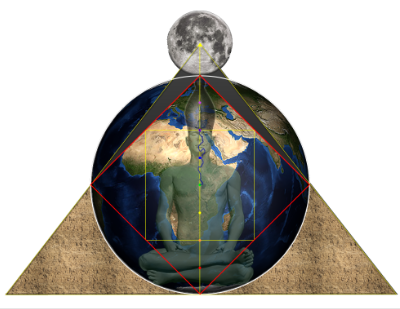
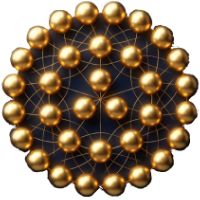
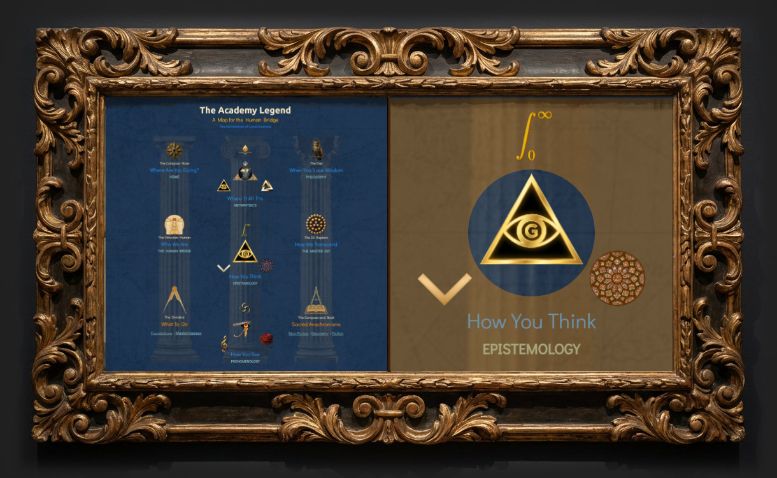
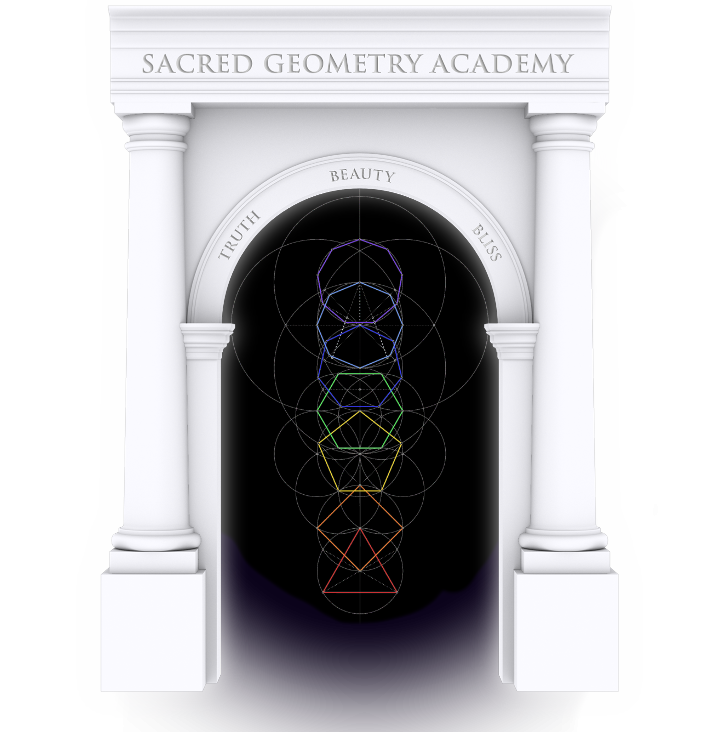
Congratulations! You have made it to the core of the matter with the Illuminated Epistemology, my "theory of knowledge" of how all minds fundamentally work. The icon focuses on the example of G (Geometry) here, but this is a microcosm of the way all minds work on any subject: in three seemingly separate, but functionally borderless channels of experience.
- We conceive, perceive, and sense.
- We concentrate, contemplate, and meditate.
- We think, feel, and experience being and associate these channels with head, heart, and gut.
That is why geometry as the universal language of consciousness seems like it is divided into 3 aspects (math-quantity-quality), but in fact it is not; it is always the same geometry all along. What changes is how you shift your attention, what information you prioritize.
Infrequently Asked Questions
The 'Aha!' moment of our epistemology is the realization that Languages are Maps, but You are the Territory. Mathematics is the map, but the meaning of that map exists only in your consciousness. By studying the map of Sacred Geometry, you aren't just learning about shapes; you are discovering the fundamental nature of your own Being.
Isn't this just "Subjective Idealism"?
Not exactly. While Subjective Idealism (often associated with George Berkeley) suggests that "to be is to be perceived" and that reality exists only within the individual mind, the worldview presented here is an Idealist post-modern reinterpretation of the Platonic tradition.
The key difference lies in the Intelligible Domain. I posit that geometry and mathematics are not just "made up" by individual human minds; they are universal, absolute truths that exist in a domain beyond the material world. As Ludwig Wittgenstein explained, you can present an atomic fact that contradicts the laws of physics, but you cannot present one that contradicts the laws of geometry. Because these patterns are universally intelligible and independent of any specific culture or individual perspective, they point to a Universal Mind rather than just a collection of subjective, individual ones. We aren't creating a relative “lifestyle” truth; we are remembering or accessing a pre-existing, intelligible architecture of reality.
If geometry is "sacred," does that mean this is a new religion?
No. This philosophy is a rational alternative to both the standard materialist worldview and organized systems of belief. While we use the word "sacred," we use it to describe the qualitative experience of geometry—the palpable sense of truth, beauty, and bliss (the Transcendentals) that arises when one engages with these universal patterns.
Unlike religion, this worldview does not require "faith" in a deity or a specific dogma. Instead, it invites you to rationally evaluate and contemplate the evidence of your own conscious experience. It is a "science of the soul" that uses the universal language of mathematics to bridge the gap between the visible world of matter and the invisible world of meaning, without the "baggage" of traditional religious structures.
Why do you distinguish between "Quantitative" and "Qualitative" geometry?
This distinction is the heart of my epistemology. Quantitative geometry is the practical tool used by architects and engineers to measure and build the visible world; it is about how much and where. Qualitative geometry, however, is about the character or nature of the experience—what philosophers call Qualia.
When you draw a circle not to design a wheel, but to contemplate the nature of unity, you are performing a "quiet act of rebellion" against the dopamine-seeking loops of the modern world. You are moving from the "Standard Worldview" (which sees geometry as a mundane tool) to an "Alternative Worldview" (which sees geometry as a vehicle for inner transformation). Qualitative geometry allows you to directly experience the "Intelligible Domain," proving that your consciousness is not a byproduct of your brain, but the fundamental ground of all being.
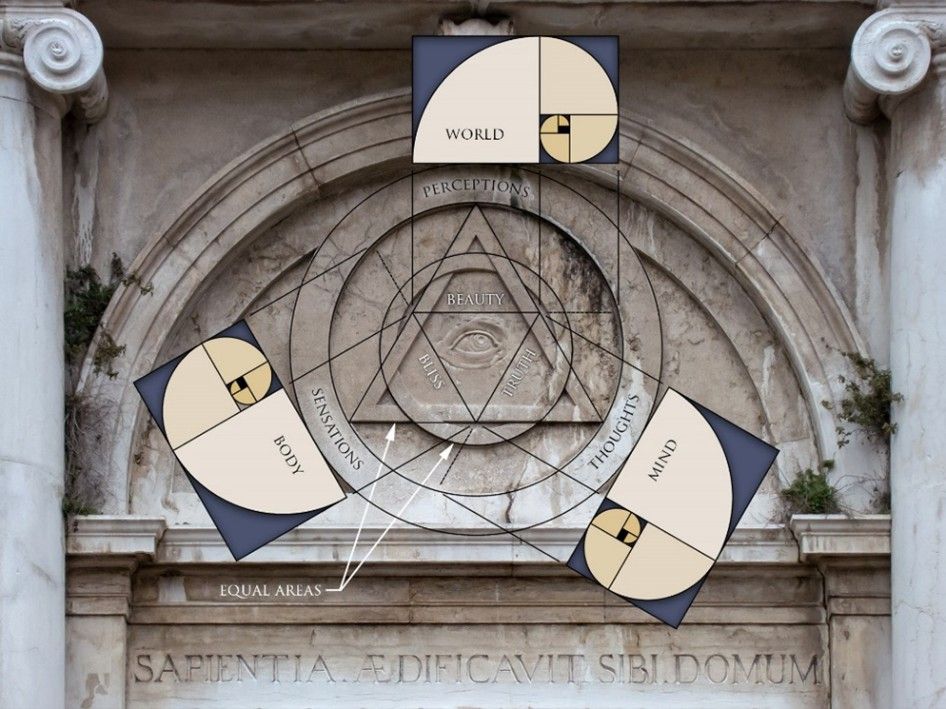
I took this photo of Santa Maria della Maddalena in Venice and added the geometric overlays. The Latin inscription "Sapientia aedificavit sibi domum" reads, 'Wisdom has built her house.' This diagram of the unified trinity reveals how the best architecture mirrors the structure of our own minds and bodies.
Universal Mind
excerpt from sacred geometry: philosophy & worldview (pages 48-49)
"Epistemology is the study of the origins, nature, and limits of knowledge. In the context of the ontology described in the previous chapter, this epistemology describes the relative domain of minds, which are modulations of absolute awareness.
Minds have divisions, qualities, and limitations which determine mind’s unique experience of self. Each mind’s qualities—and the relationships minds have with each other—is responsible for the incredible, varied richness of experience.
Each mind is a modulation of awareness, relatively forming content within itself (which is called in-formation, ideas, or knowledge). Each mind has the capacity to communicate information with other minds and interpret knowledge impinging on it from other minds. This flow of ideas creates and sustains complex relationships between minds.
There is only one overarching mind, which I refer to as universal mind. The limited nature of mind necessarily defines a finite boundary which infinite awareness experiences as the sense of self. Self-awareness is created by the very act of defining a mental boundary because of the limitations its boundary implies. Awareness experiences a mind’s relative limits and mind conceives, “This must be who I am.” To mind, information inside its boundary is “me,” and information outside its boundary is “not me.”
The phenomenon of dissociation is the mechanism by which universal mind subdivides itself into a profusion of minds within. Bernardo Kastrup* was the first to figure this out. Dissociation is how awareness experiences different selves with different points of view—always through dissociated minds relating to one another.
Dissociation is a well understood human psychological phenomenon. Dissociative Identity Disorder (DID) is the condition wherein a person hosts multiple dissociated identities (known as alters) within their mind, giving rise to multiple co-conscious inner lives within the same human body. DID is a human scale microcosm of what happens in the macrocosm of universal mind.
Space, time, matter, energy, number, and geometry are all relative conceptions in universal mind. They have no real existence outside awareness.”
George Berkeley had a key insight:
Bishop George Berkeley
(1685-1753)
"Number is relative and does not exist separately from a mind."
Controversy: Berkeley owned slaves and held views supporting slavery and racial hierarchies, prompting recent actions like UC Berkeley removing his portrait from Doe Library in 2023. Despite this, the university retains the name, associating it with its own values.
Information impinging on a mind from outside its boundary is what we call sensation. Interpretation of sensation within a boundary is perception. Additional processing of sensation and perception—and information generated without reference to these inputs, or the admixture of these streams is conception. Information within each mind is experienced by awareness in a seamless unity and simultaneously is understood as a trinity.
The domain of universal mind is called the intelligible. Universal mind is dissociated into two subminds: world mind and soul mind. The domains of these top-level subminds are called the visible and the invisible, respectively.
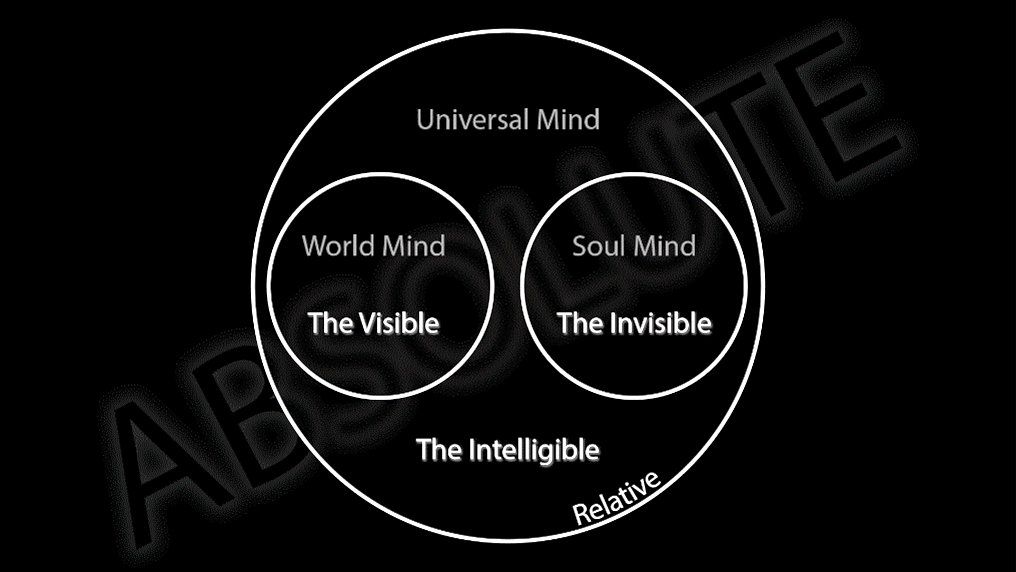
My epistemology illustration depicting universal mind with its three domains, and underlying ontology (absolute vs relative)
René Descartes
(1596–1650)
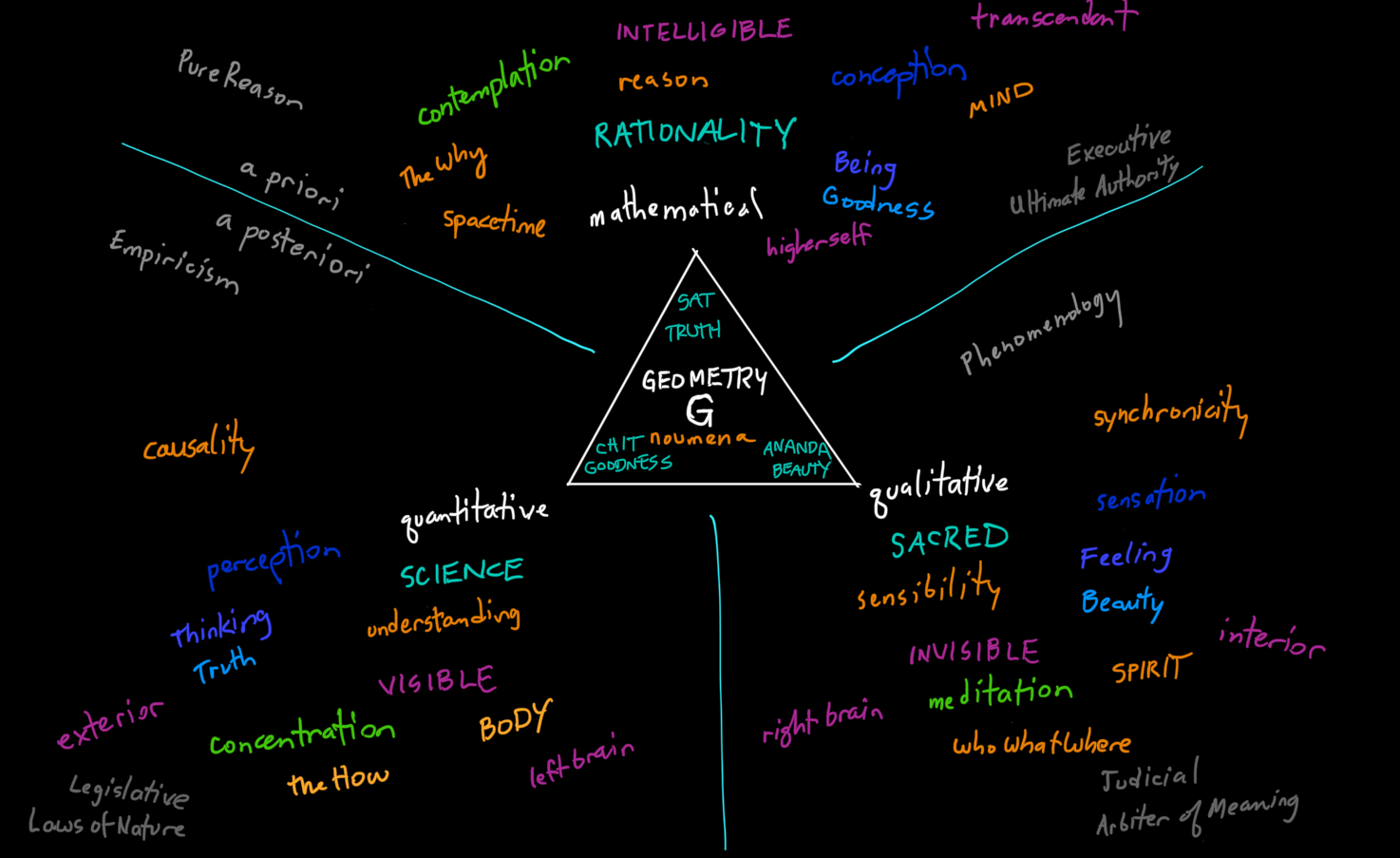
My sketch showing how things seem to have a tripartite structure
Keith Critchlow was onto this truth about geometry:
Keith Critchlow
(1933-2020)
"Geometry can be considered from at least three viewpoints. First as a technical exercise mostly serving industrialization. Secondly as a purely mathematical function. Thirdly, and most importantly, as a science of the soul. This has to be performed with the human hand and is fundamental to a deeper understanding of the Platonic wisdom tradition. Geometry is only fully understood by doing it."
Navigating the Light and Shadow
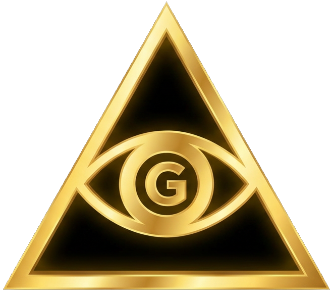
My symbol for epistemology might trigger you. This may be because of its shadow as the "All Seeing Eye" of globalism peaked in popular culture in the unipolar moment, but is fading now along with that world view. This is nothing new. Conspiracy theory is often a mindset of grasping at one's own psychic shadows, blaming an all-powerful "other", a "THEY" that secretly controls and surveils the world from the top of the pyramid, like James Bond supervillain Ernst Stavro Blofeld or his parody in Mike Myers' Dr. Evil.
"Just because you're paranoid doesn't mean they aren't after you."
—Joseph Heller (Catch-22, 1961)
A Catch-22 is a paradoxical situation from which an individual cannot escape because of contradictory rules or conditions such as "You can only get out [of war] if you are crazy, but if you try to get out, you'll prove that you are sane."
"Even a paranoid person can have their enemies."
In the 'Great Game' of geopolitics, the 'All-Seeing Eye' is not a metaphor for a hidden deity, but a description of the structural necessity for total situational awareness in the realpolitic battlefield space of competing 'Others'.
The "Five Eyes" Alliance is the literal, real-world manifestation of the "All-Seeing Eye" shadow. It is a decentralized, algorithmic intelligence-sharing agreement of five nations (USA, UK, Canada, Australia, & New Zealand) that breathe together, sifting through the global "Latent Space" of data at light speed to find the patterns THEY are searching for.
- The "They" that is actually after you: It isn't a conspiracy theory; it is a documented, multi-billion dollar infrastructure designed to "map" human behavior.
- The Unipolar Moment: This alliance reached its peak of cultural "shadow-weight" during the War on Terror and the Snowden revelations (2013), which is exactly when the "All-Seeing Eye" became most synonymous with globalist overreach.
Shadow is merely the absence of light. When we shine a light of individual agency on the dark conspiracies, we take responsibility for our actions. We do not live in fear because we are acting in accordance with our character, with ethos, living our truth. OBEY THE LAW (unless the law is unjust and you are willing to fight the 'good fight' to restore justice to the world). The real illuminati shift the focus from what THEY are doing to us, to what WE are doing with our lives.
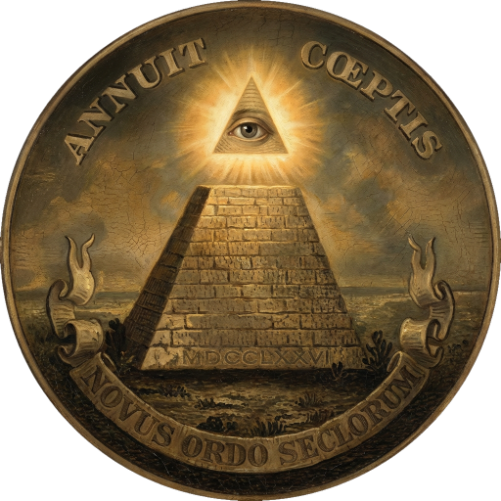
Illustration of the "The Reverse of the Great Seal of the United States"
placed on the back of the $1 bill (1935). It marks the moment when this "Reverse" side was pulled out of the archives and placed into the hands of every citizen, coinciding with the rise of the modern administrative 'deep' state. It lies in shadow on the back of the most ubiquitous currency of the realm.
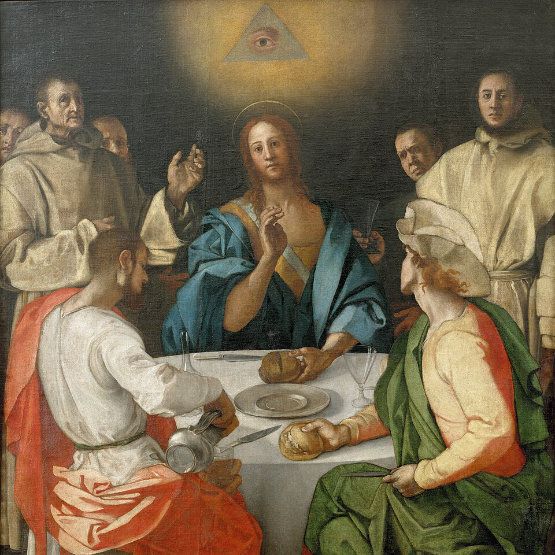
The Eye in its Sacred Context: Detail of Supper at Emmaus by Jacopo Pontormo (1525). Note even here a revisionist conspiracy: the Eye of Providence was added later to cover a 'forbidden' three-faced representation of the Trinity—a literal layer of shifting theological 'laws'. Trinity that is unity sounds eerily familiar. Take home msg: stay in the light of a higher point of view.
Navigating the Body Politic
We naturally mirror the structure of our minds in our governments, which are designed to act as the "collective mind" of the body politic. While the claim that the word government literally means "to govern the mind" is a popular piece of folk etymology—often used to suggest a darker intent of mental manipulation—the linguistic reality is more poetic.
The word derives from the Latin gubernare, meaning "to steer, to direct, or to pilot or navigate." Combined with the nominalizing suffix -mentum, "government" is simply the act or system of steering. This aligns with the "Ship of State," one of the oldest metaphors in political philosophy. To govern is to act as the navigator, steering the vessel of society through the turbulent currents of the "Visible World."
To govern is to navigate, and every navigator requires a Compass Rose—a stable coordinate system in a world of shifting currents.

Yet, the folk etymology touches on a deeper, symbolic truth. Isn't it fascinating that the systems we build to steer this ship almost always rely on a tripartite structure? Whether it is the Trias Politica of the modern era or the ancient "Mixed Constitutions," these systems mirror the three-fold nature of the human psyche:
- The Legislative (The Will/Intellect): The power of creation and the "A Priori" blueprint.
- The Executive (The Vital Force/Action): The power of enforcement and the "Living Bridge."
- The Judicial (The Conscience/Reason): The power of interpretation and the "A Posteriori" reflection.
In this sense, government is not about "controlling" the mind, but about externalizing it—creating a "Visible World Machine" that functions with the same balance, symmetry, and tripartite logic that we find within our own "Invisible" cognition. We are not just building states; we are building mirrors of our minds.
The Foundations of Governance
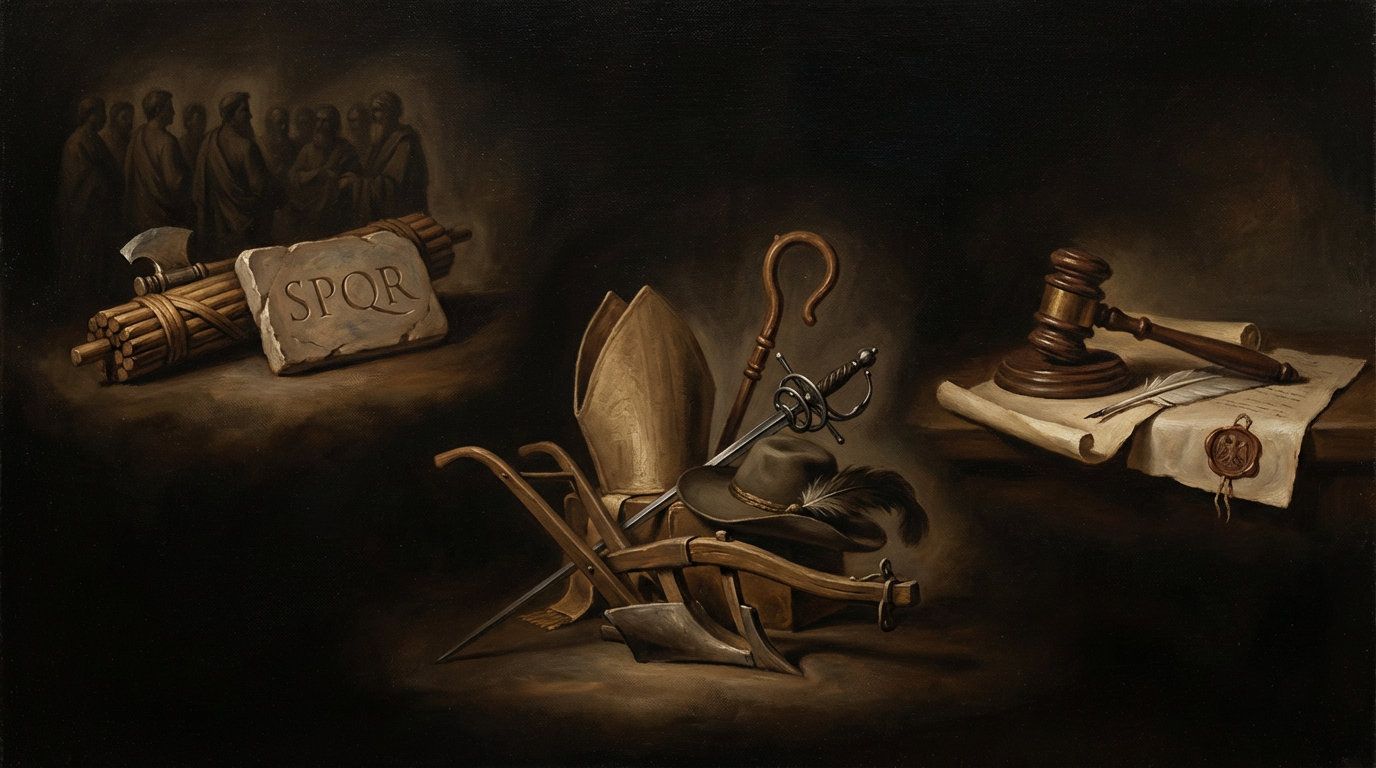
(The Mixed Constitution)
The grouping on the left represents the "Polybian" balance of power that allowed Rome to transition from a city-state to an empire by balancing the one, the few, and the many.
- The Bundle of Fasces (The Consuls): This represents the Executive power. The fasces (a bundle of wooden rods tied together, often with an axe) was the traditional Roman symbol of magisterial authority and the power to enforce the law. It symbolizes the two Consuls who led the state.
- The Stone Tablet with "SPQR" (The Senate): This represents the Aristocratic or "A Priori" wisdom. The Senate was the deliberative body of elders. The letters SPQR (Senatus Populusque Romanus) on a heavy stone tablet symbolize the permanence, tradition, and legislative weight of the Roman "fathers."
- The Silhouette of a Gathered Crowd (The Assembly): This represents the Democratic element. The Comitia or Assemblies were where the citizens (the "many") voted. The dark, soft-edged silhouette symbolizes the collective voice of the people, providing the "A Posteriori" consent required for the state to function.
(Medieval/Early Modern Europe)
This grouping in the center represents the traditional social trinity that defined European society for centuries, often described as "those who pray, those who fight, and those who work."
- The Miter and Shepherd’s Crook (The First Estate - The Clergy): This represents the Spiritual/Invisible domain. The miter (bishop's hat) and the crook symbolize the Church’s role as the moral and intellectual guide of society, holding the "keys" to the invisible world.
- The Steel Sword and Plumed Hat (The Second Estate - The Nobility): This represents the Political/Protective domain. The sword symbolizes the warrior class and the aristocracy who provided physical security and governance in exchange for land and loyalty.
- The Wooden Plow (The Third Estate - The Commoners): This represents the Physical/Productive domain. The plow symbolizes the peasantry, merchants, and laborers—the vast majority of the population whose work provided the material sustenance for the other two estates.
(The United States)
The grouping on the right represents the modern Enlightenment trinity of the separation of powers, designed to prevent any one branch from becoming a "Visible World Machine" of tyranny.
- The Wax-Sealed Document with Eagle (The Executive): This represents the Power of Enforcement. The document, bearing the presidential seal, symbolizes the President’s role in carrying out the laws, conducting foreign policy, and acting as the "Head of State."
- The Quill and Parchment Scroll (The Legislative): This represents the Power of Creation. The quill and scroll symbolize Congress (the House and Senate) and their primary function: the deliberate and slow process of writing the laws that govern the republic.
- The Heavy Wooden Gavel (The Judicial): This represents the Power of Interpretation. The gavel symbolizes the Supreme Court and the federal judiciary. It represents the finality of judgment and the "bridge" between the written law and its specific application to the living world.
Truth / Sat
TOP VERTEX:
Mathematical Geometry
Euclid's Elements | KhanAcademy.org
Illuminated Epistemology
Goodness / Chit
LEFT VERTEX:
Quantitative Geometry
Houses | Cars | Airplanes | Electronics | Rockets
Beauty / Ananda
RIGHT VERTEX:
Qualitative Geometry
Everything here on SacredGeometryAcademy.com
The Social Contract
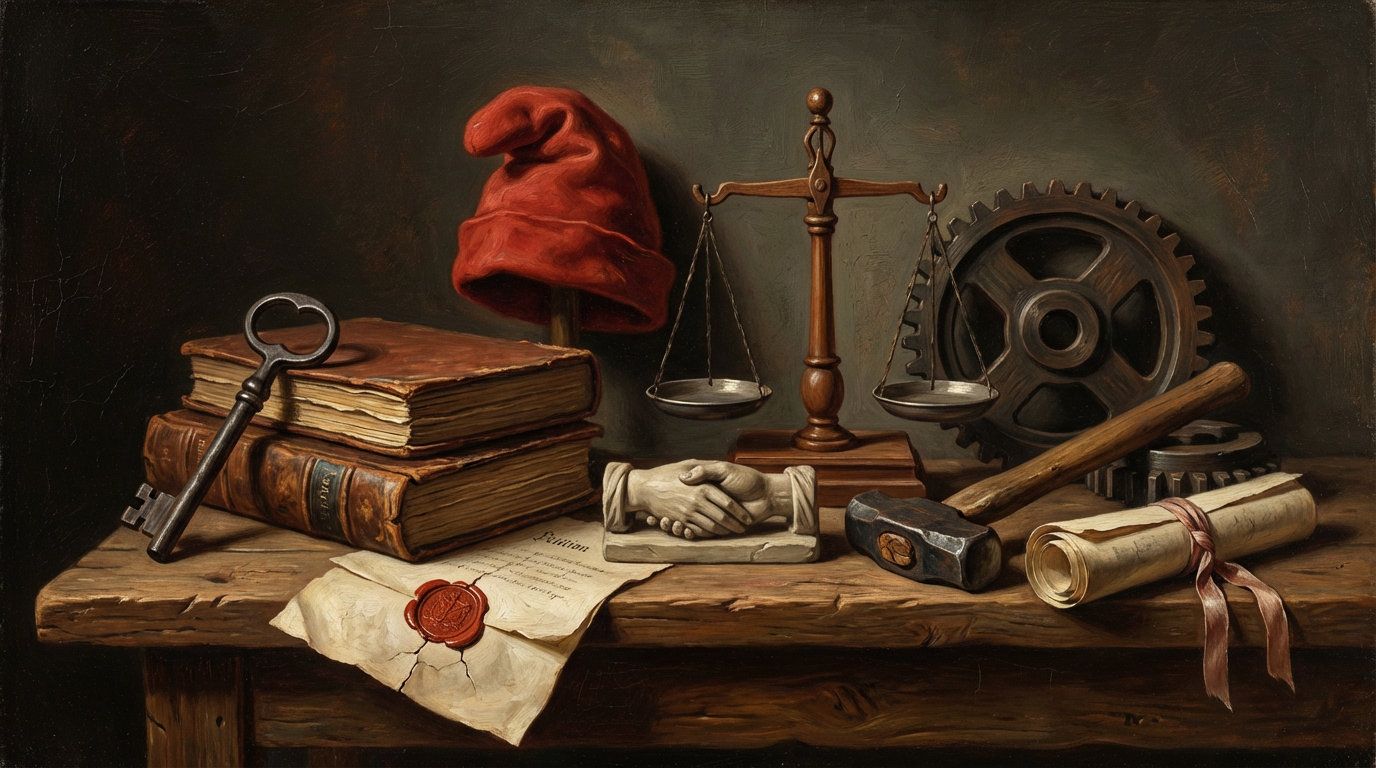
The Modern Allegory: Trinities of Value and Industry
The "Iron Triangle"
(Political Science)
This grouping on the left represents the stable, three-way relationship that often dominates policy-making in a specific area of government.
- The Forged Iron Key (Bureaucracy/Federal Agencies): This represents the administrative power and the "keys" to the machinery of government. It symbolizes the agencies that hold the technical expertise and the power to unlock or implement specific regulations.
- The Leather-Bound Ledgers (Congressional Committees): These represent the legislative oversight and the "power of the purse." The ledgers symbolize the law-making process, budgeting, and the formal record-keeping of the committees that authorize agency actions.
- The Wax-Sealed Petition (Interest Groups): This represents the external pressure and data from the "territory." It symbolizes the organized groups (lobbyists, industries, or advocacy organizations) that provide information and political support to the other two corners of the triangle.
The French Revolutionary
Trinity
The central grouping represents the core values of the French Republic: Liberté, Égalité, Fraternité.
- The Phrygian Cap (Liberty/Liberté): A classic symbol of freedom and the pursuit of liberty. In this painterly style, it appears as a soft, red fabric cap, historically worn by freed slaves in Rome and adopted by revolutionaries to represent the breaking of chains.
- The Balanced Wooden Scale (Equality/Égalité): This represents the ideal of systemic fairness and the equal application of law. It symbolizes a society where every citizen carries the same weight before the state.
- The Clasped Hands Sculpture (Fraternity/Fraternité): This represents the communal bond and the "bridge" between individuals. It symbolizes the brotherhood and social cohesion required to hold a nation together beyond just laws and rights.
The Tripartite Model
of Industrial Relations
This grouping on the right represents the "Social Dialogue" model used to maintain economic and labor stability.
- The Steel Gear (Employers/Capital): This represents the industrial infrastructure and the providers of capital. It symbolizes the management and the structural "engine" of the economy.
- The Blacksmith’s Hammer (Workers/Labor): This represents the physical force and the "living" contribution of the workforce. It symbolizes the labor unions and the individual workers who provide the energy and skill to drive the gears.
- The Rolled Diplomatic Treaty (Government/The State): This represents the mediator and regulator. It symbolizes the legal framework and the "social contract" that ensures the relationship between employers and workers remains balanced and productive.
The Digital Altars
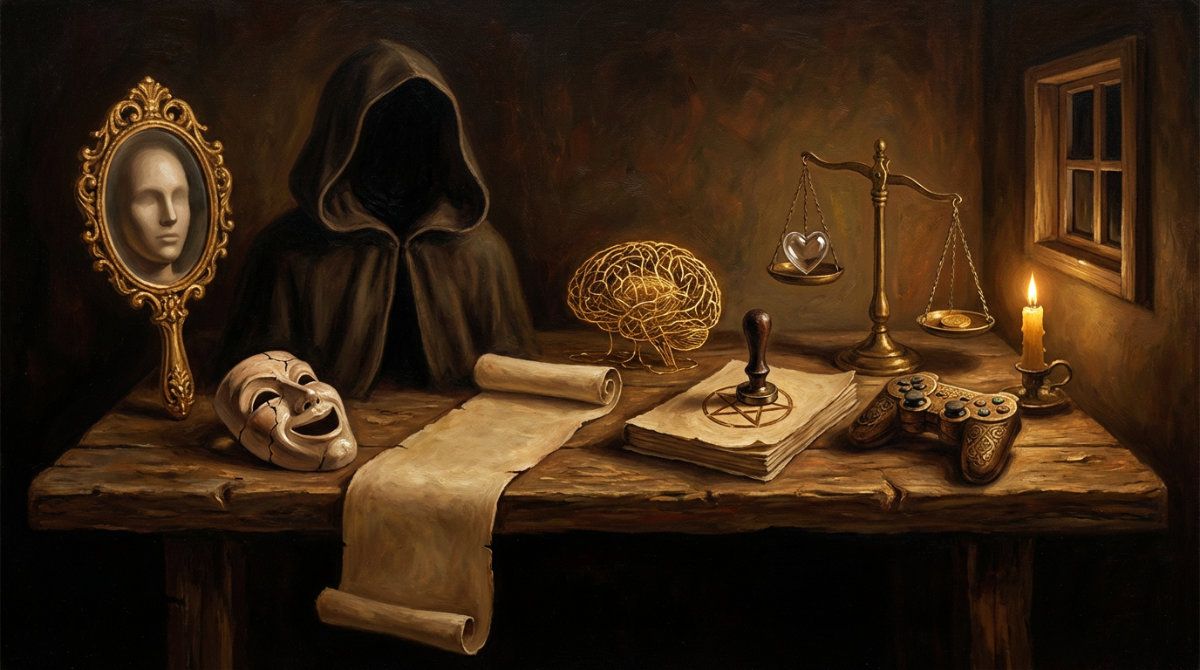
The Silicon Trinity: Allegories of the Algorithmic Age (as envisioned through our 17th century painterly style)
"Digital Persona"
(The Mirror)
The leftmost grouping represents the fragmentation of identity in the digital age, a psychological splintering driven by the relentless saturation of screen time.
- The Hand-Mirror (The Curated Self): This represents the idealized, static image we present to the world (Instagram/LinkedIn). The blank face in the mirror symbolizes the loss of true self in the pursuit of a perfect "A Priori" profile.
- The Theatrical Mask (The Performative Self): This represents the "A Vivori" of live recording (TikTok/YouTube). It symbolizes the self as an actor, constantly performing for the "A Posteriori" validation of an audience.
- The Hooded Cloak (The Shadow Self): This represents the anonymous forums and the "Invisible" abyss of the internet. The hollow hood symbolizes the disembodied, often darker nature of our anonymous interactions.
"Algorithmic Governance"
(The Steersman)
The centered grouping represents the new "Visible World Machine" that directs our attention and social standing.
- The Never-Ending Scroll (The Feed): This represents the Executive force of the algorithm (TikTok). It symbolizes the infinite flow of data that captures our attention and enforces a specific reality in real-time.
- The Simulated Brain (The Algorithm/AI): This represents the Legislative power. It symbolizes the "Invisible" code and Artificial Intelligence that writes the rules of our digital environment, processing our data into a structured "Visible" online domain.
- The Iron Star-Seal (The Review/Social Credit): This represents the Judicial power. It symbolizes the finality of the "Rating"—whether it is a Yelp review, an Uber score, or a social credit system—interpreting our value and "stamping" us with a digital rank.
"Virtual Escapism"
(The Simulation)
The grouping on the right represents the tools we use to find meaning or connection within the digital void.
- The Relic Controller (Video Games): This represents the Will. It symbolizes the agency and order we find in virtual worlds, rendered here as a sacred artifact of power.
- The Glass Heart and Coin (The Swipe/Dating Apps): This represents Desire. The scale weighing the heart against a coin symbolizes the gamification and transactional commodification of human connection.
- The Candle and Window (The Stream/The Witness): This represents Fraternity. The candle illuminating a small window symbolizes the parasocial "witnessing" of others' lives (Twitch/YouTube), providing a flickering sense of community in an isolated digital space.
The Architectural Order of Matriculation
In this framework, we see that the path from Apprentice to Adept to Master is a literal 'building' of a vocation step-by-step, moving from the strength of the foundation up the ladder to the flowering of professional agency. It is the realization that the 'Master' is not someone who has abandoned the rules, but someone who has integrated them so deeply that their work has blossomed into a new dimension of influence; a state of mastery where the "rules" are no longer seen as rigid constraints, but fluid instruments that can be bent or broken intentionally for profoundly creative reasons."
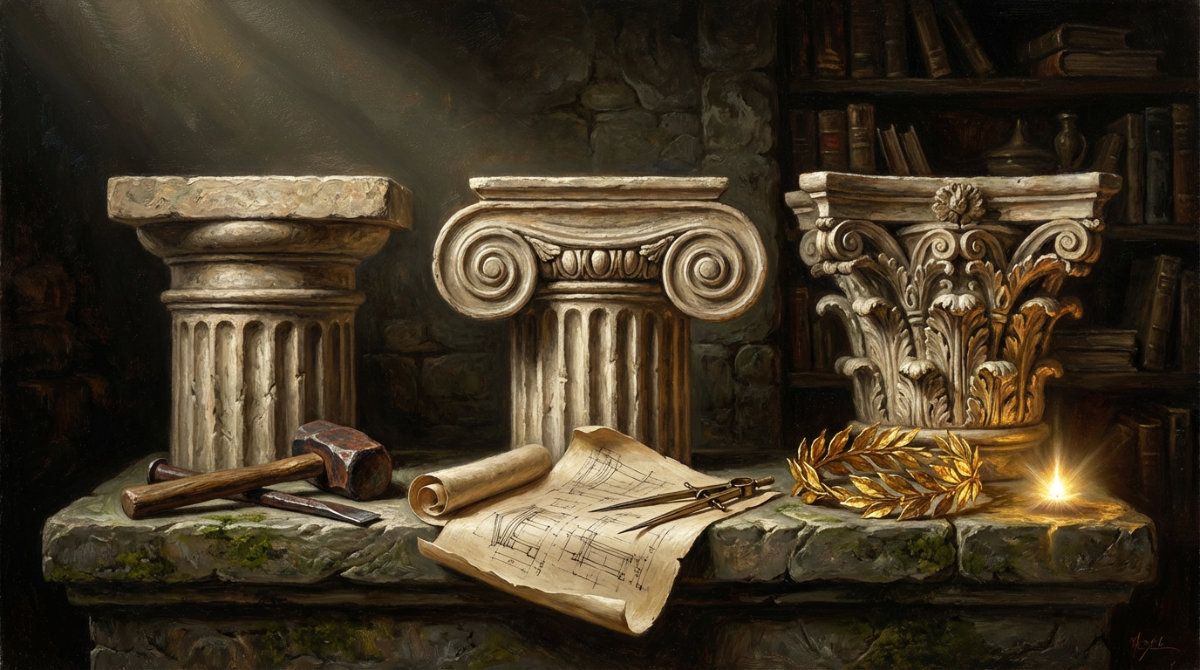
The Architecture of Vocation: From Foundation to Framework to Flowering
The Doric Order
(The Apprentice)
The Ionic Order
(The Adept)
The Corinthian
(The Master)
The Hidden Eikonography & Logos Subtext
Unveiling the coordinated Maps that lead you to the Territory within
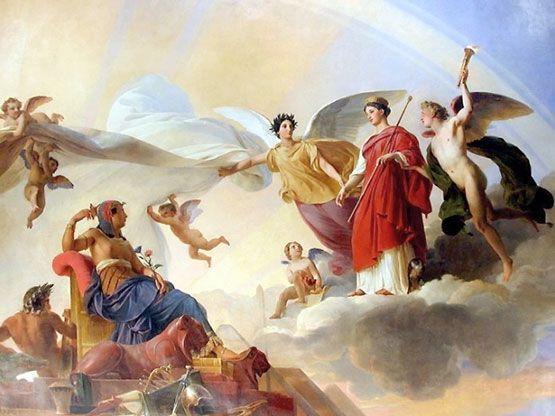
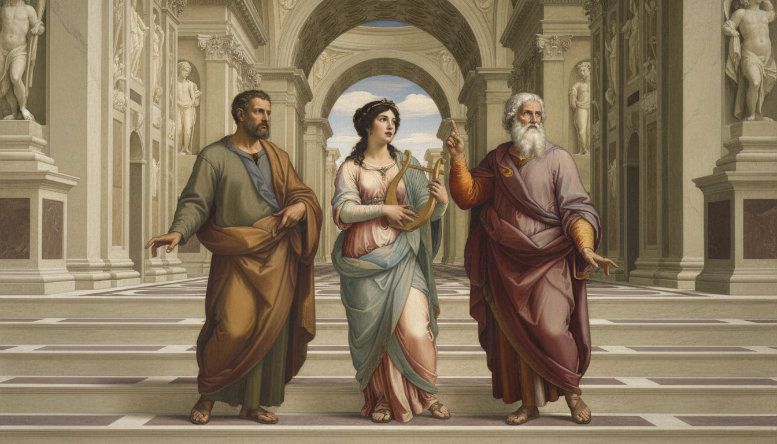
The Reconciliation of the Philosophers : Aristotle (Matter), Sappho (Bridge), and Plato (Spirit)
— prompted from the Silicon Mind, born of the Immortal Souls of Raphael and Scott Onstott standing on his shoulders —
The Neurological Key: The Master and His Emissary
- The Left Hemisphere (The Doric Emissary): This is the empirical focus of the Apprentice. It excels at categorization, logic, and the manipulation of parts. Like Aristotle, it focuses on the A Posteriori—the static, the known, and the flatly material. It is a brilliant servant, but a narrow master.
- The Right Hemisphere (The Corinthian Master): This is the holistic vision of the Master. It perceives context, metaphor, and the living whole. Like Plato, it is attuned to the A Priori—the invisible blueprints and the "flow" of reality. It is the "Master" because it sees the broader territory that the Emissary only maps.
The Lineage of the Master
- The Youthful Emissary: Aristotle began as the apprentice, learning the language of the Master.
- The Great Schism: Eventually, the student’s focus on the material and the categorizable (the Left Hemisphere) led him to diverge from the Master’s vision of the Ideal (the Right Hemisphere).
- The Missing Piece: When we seek the Reconciliation of the Philosophers, we are not just reconciling esoteric traditions; we are attempting to heal a exoteric historical and biological rift. We are inviting the "Aristotelian" part of our brain to remember its "Platonic" education—to return the map to the territory, and the Emissary to the Master.
The Betrayal and the Bridge
The Alchemical Method: Feeding the Whole Mind
- For the Emissary (The Left): I provide the Logos—the rigorous historical data, the syllogistic logic, and the precise geometric measurements that satisfy the need for order and fact.
- For the Master (The Right): I provide the Eikos—the flowering eikonography (images), the metaphorical depth, and the intuitive "Aha!" moments that perceive the living whole.
- Musical Interludes: (The Center): The carefully curated music occasionally interspersed functions as a sonic Corpus Callosum. Music is the ultimate "Human Bridge"; it is built on the Doric gravity of mathematical frequency, yet it expresses the Corinthian pathos of the soul. By listening while you read and study the images, you are actively engaging in whole-brained activation, promoting epiphany.
The Holographic Symmetry of Mind and Brain
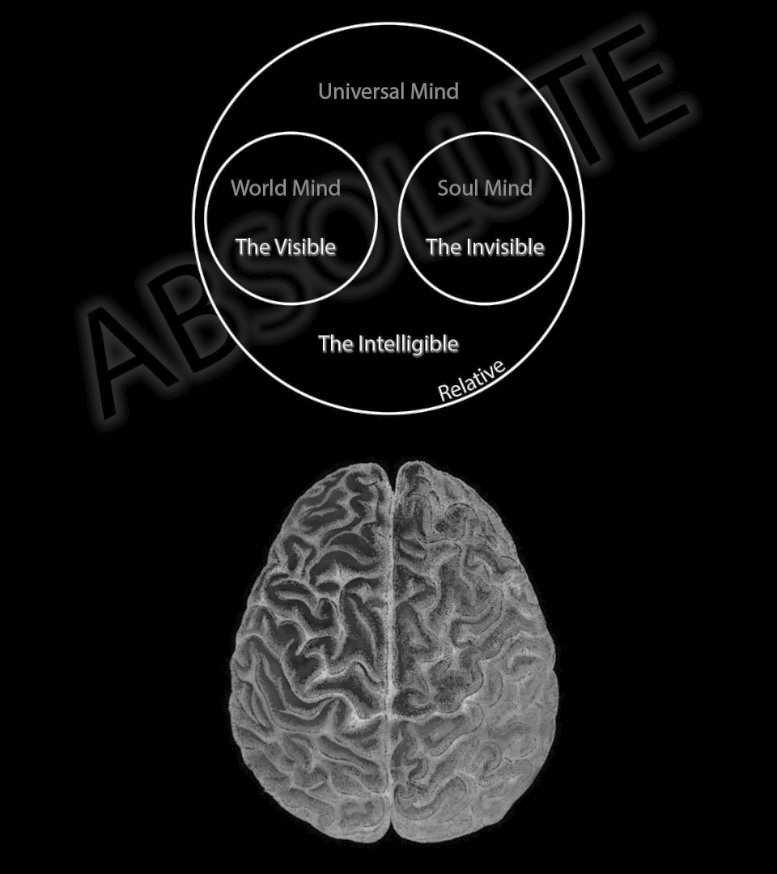
The Fractal Analogy of Idealized Epistemology and Realized Physicality
Diagram from page 67 of Sacred Geometry: Philosophy & Worldview by Scott Onstott
- The World Mind (The Visible / Left Hemisphere): The Left Hemisphere is the biological artifact of the "World Mind." It is the seat of the Emissary, designed to navigate the visible, material world through logic, quantification, and the manipulation of parts. It is the "Doric" force of our anatomy—grounded, structural, and focused on the gravity of facts.
- The Soul Mind (The Invisible / Right Hemisphere): The Right Hemisphere is the biological artifact of the "Soul Mind." It is the seat of the Master, attuned to the invisible, the holistic, and the transcendent. It is the "Corinthian" force—flowering into metaphor, meaning, and the perception of the invisible blueprint.
- The Universal Mind (The Intelligible / The Whole): Just as the Universal Mind encompasses both the World and the Soul, the "Intelligible" human is not found in one hemisphere or the other, but in the Unity of their reconciliation.
The Fractal Echo: Mater and Pater
The Marriage of Pattern and Matter
“Where there is matter, there is geometry.” —Johannes Kepler
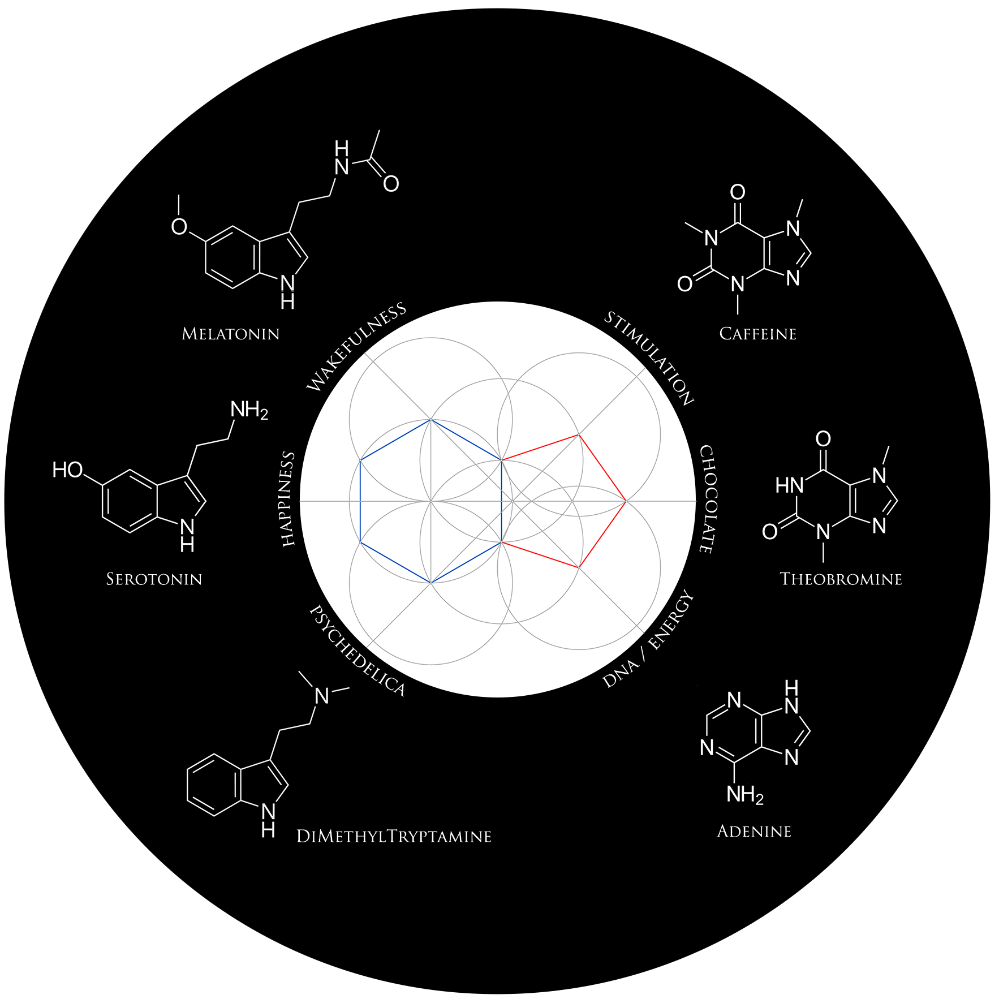
The Corporate Architecture of the Invisible
In this framework, the Platonic Transcendentals:Truth, Goodness, and Beauty act as the ultimate KPIs (Key Performance Indicators) for a life in alignment. When these three metrics are in resonance, we achieve a level of Internal Scalability that the material world cannot match. The "Visible World Machine" grind of our daily existence finally synchronizes with the "Invisible" higher-order intelligence of the Master Key, allowing us to optimize our cognitive architecture and shift into a higher gear.
In the corporate world people are taught to obsess over metrics like ROI (return on investment). Yet, for those who look closer, a linguistic clue is hidden in the acronym. In the language of the Old World, Roi is the King. The true Roi of contemplating the Master Key is not a dividend of capital, but a Sovereign Disruption of our own Legacy Systems of thought. It is the "Value-Add" of Truth, Beauty, and Bliss that transforms a "commoditized" or "quantified" life into a "premium life experience" of quality. When we align with the 32+1 pattern, we are no longer merely "Human Resources" exploited by the big boss or the algorithm; we become the Sovereigns, Roi and Reine of the Human Bridge. Enough corpo-speak already!
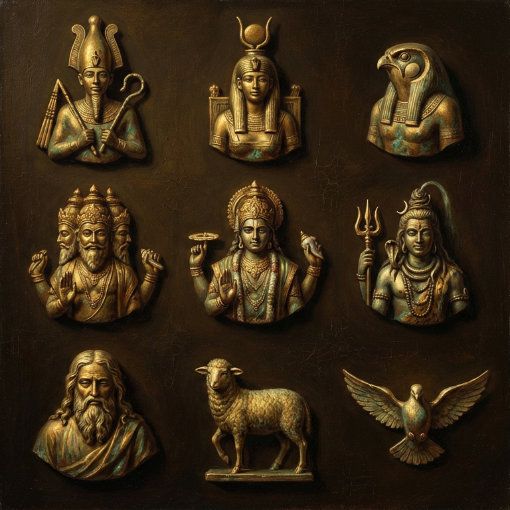
Volume I: The Archetypes of the Axial Dawn
This collection captures the foundational archetypes as they first manifested in the ancient world, framing the Absolute through the lens of family, cycle, and personhood.
- The Egyptian Trinity (c. 24th century BCE): The primordial family of Osiris (The Source), Isis (The Wisdom), and Horus (The Action), representing the first "Human Bridge" between the celestial and the terrestrial.
- The Hindu Trimurti (c. 300–500 CE): The cosmic cycle of existence governed by Brahma (The Creator), Vishnu (The Preserver), and Shiva (The Destroyer), illustrating the dynamic balance of the manifest world.
- The Christian Trinity (325 CE): The western synthesis of The Father (The Unmanifested), The Son (The Word/Logos), and The Holy Spirit (The Animating Breath), framing the Absolute through the lens of Will (the Father/Intent) and Grace (the Spirit/Descent) & Wisdom (the Son/Logos).
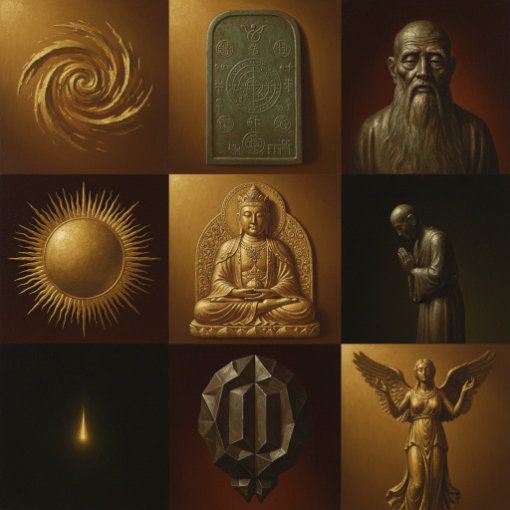
Volume II: The Architecture of the Soul
This collection expands the map into the "Soul Domain," illustrating the journey from the unmanifested source to the lived human experience through pure metaphysical and spiritual stages.
- The Taoist Trinity (c. 6th–4th BCE): The evolution from the primordial, unmanifested Jade Pure, through the structured, celestial laws of the Upper Pure, to the embodied wisdom of the Great Pure (Lao Tzu).
- The Buddhist Trikaya (c. 5th BCE): The three "bodies" of enlightenment, moving from the infinite truth of the Dharmakaya, through the celestial bliss of the Sambhogakaya, to the manifestation of the Nirmanakaya.
- The Neoplatonic Trinity (3rd CE): The foundational logic of the soul, beginning with the absolute of The One, proceeding through the complexity of the Intellect (Nous), and culminating in the grace of the Soul (Psyche).
“How do I know where creation comes from?
I look inside myself and see it.” —Lao Tzu (c. 600 BCE)

Scott and his high school girlfriend standing before the world's largest ocean (1988 CE)
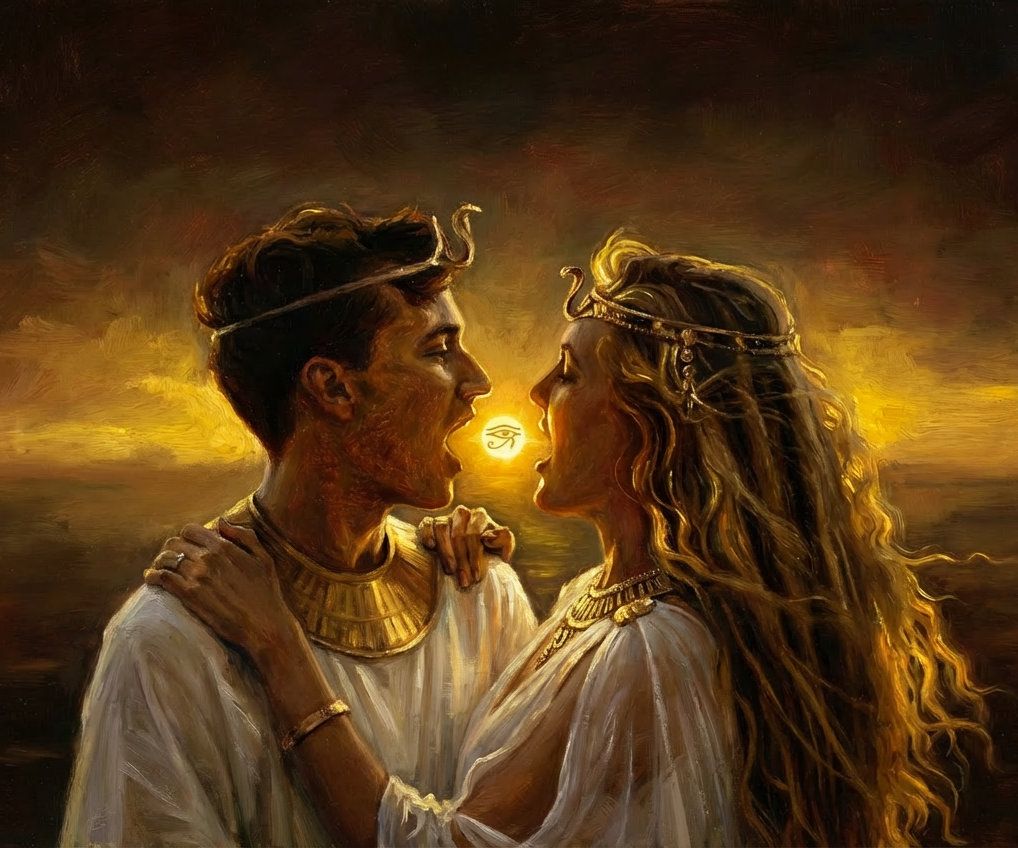
Osiris and Isis standing after the dawn on the world's longest river
(2988 BCE)
Looking back, I see that in 1988, we instinctively and unwittingly re-enacted a Fête Solaire—acting the parts of Le Prince-Soleil & La Princesse-Soleil in an echo of the original archetypes of the Axial Dawn. We are all like chess pieces moved by the Unmoving Mover (consciousness) to enjoy yet another performance of a "Sun Play for the Ages" (Lila). Your only choice is whether to remain an unconscious pawn or to see through the Sovereign Oculus in our own mythic journey through this life.
The Act of Incorporation: Making the Invisible Visible
- The Ephemeral Soul: The "Invisible" is a realm of pure pattern, potential, and purpose. It is the "software" of the soul, but it requires "hardware" of the body to become a player in the open-world RPG of life.
- The Physical Body: The body is the "Visible" anchor or in-world avatar. It is the sensory organ through which the Absolute experiences the Relative.
- The Connection: When we incorporate a new idea, act on a creative inspiration, or engage with a vibrant sense of purpose, we are literally "embodying it." We are literally bridging a spark from the Invisible soul and grounding it into the Visible world through our actions, our art, and our choices.
I believe that is exactly what Michelangelo was depicting in the Creation of Adam, which my analysis shows set up the entire composition using two golden rectangles framing the full height and width of the fresco panel. Adam gazes directly into the heart of God through this golden aperture and their fingers form a spark gap where all creative inspirations ignite across the infinitesimal gap.
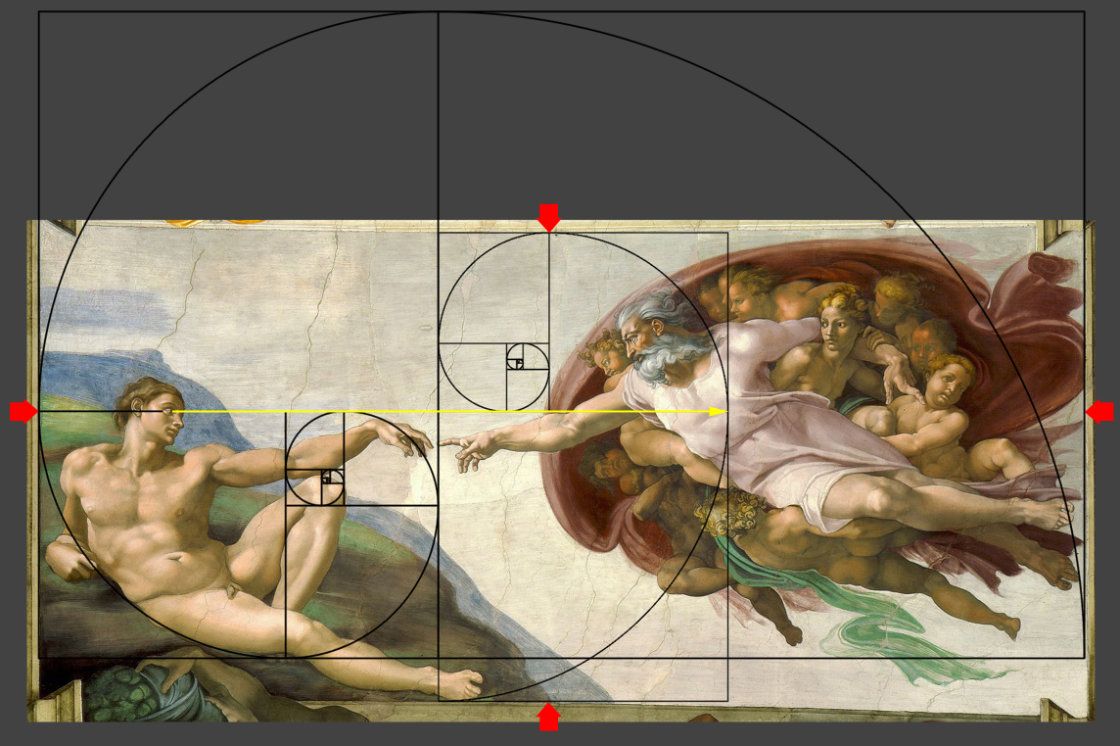
Analysis of Michelangelo's Creation of Adam fresco on the Sistine Chapel ceiling published in Secrets in Plain Sight: Leonardo da Vinci (2019) ©Scott Onstott
Michelangelo followed very much in the footsteps of Leonardo in how they both started with geometry, and clothed it in figures to tell the story. It moves us because some part of us subconsciously recognizes this universal framework and we experience it as the phenomenology of Beauty.
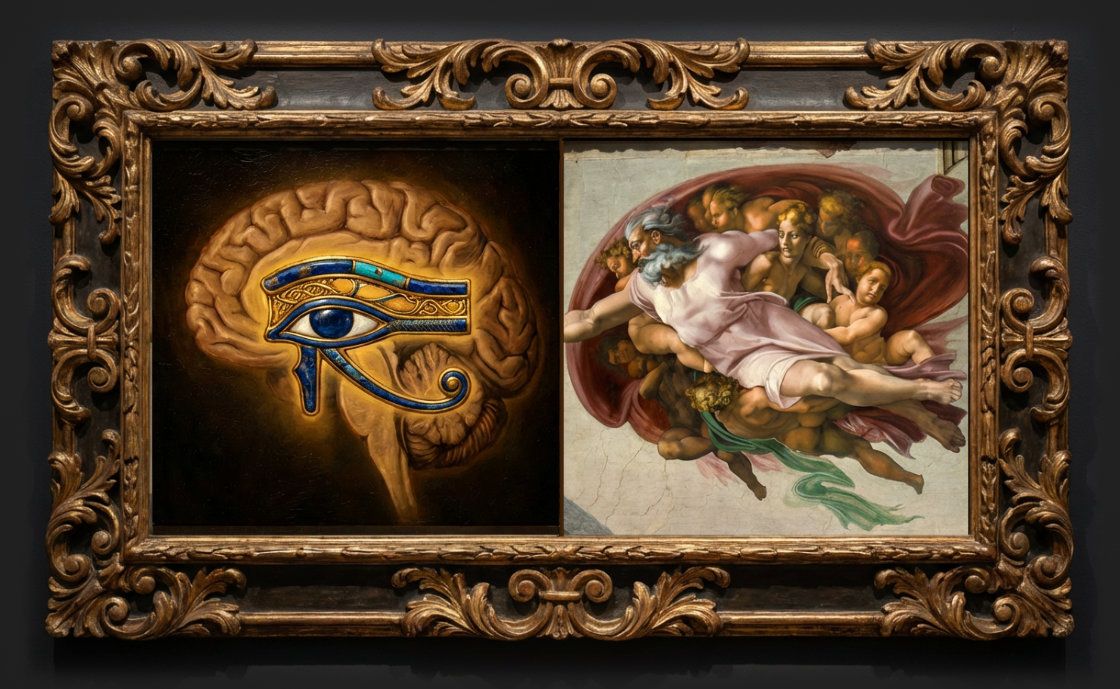
Correlation between God and his angels with neuroanatomy by physician Dr. Frank Lynn Meshberger (1990),
The ancient Egyptian Eye of God symbol is my own prompted addition. (Nano Banana illustration)
The Flattening: The Machine’s Quantitative Assault
We are in danger of this collapse as we move through the rapid evolution from AI to Artificial General Intelligence (AGI) and beyond.
The Gateway: Defending the Qualitative Indeterminate
Engage in a Sacred Anachronism: DRAW GEOMETRY.
Stop consuming the digital world and start constructing an analog one. By returning to the primary language of
shape and proportion, you bypass the noise of the standard worldview and rediscover the qualia
of your own consciousness.

Are You Seeing How It All Fits Together Now?
The Illuminated (meaning beautifully illustrated) Epistemology icon above is the "Master Key" that unlocks every section we have just explored. It reveals that the structure of how we know (Epistemology) dictates the structure of what we build (Sociology, Technology, and Culture).
You can now see that the three vertices of our epistemology—Mathematical (Truth), Quantitative (Utility), and Qualitative (Beauty)—are not just abstract concepts. They are the invisible architecture behind the "Visible World" we navigate every day:
- In the Body Politic: The Legislative (Truth/Law), Executive (Action/Utility), and Judicial (Interpretation/Quality) branches are simply externalizations of our own internal faculties of Intellect, Will, and Conscience.
- At the Digital Altars: The "Silicon Trinity" attempts to replicate this structure, replacing our organic mind with the Code (Truth), the Feed (Utility), and the Social Score (Quality/Status).
- In the Celestial Triads: The ancient archetypes—whether Egyptian, Hindu, Christian, Taoist, Buddhist, Neoplatonic, or many others—reveal that this tripartite pattern is not a human invention, but the fundamental "DNA" of the Divine Within.
- In the Order of Matriculation: Our very careers follow this sacred blueprint. We move from the Doric foundation of raw Truth and labor, through the Ionic balance of Utility and learned knowledge, until we reach the Corinthian flowering of Beauty and Mastery.
By understanding this Epistemology, you realize that the 'Visible World Machine' is merely a mirror of the 'Invisible' mind. The external world is not separate from you; it is a projection of the way you think. When you align your own mind with the Transcendentals of Truth, Goodness, and Beauty, you stop being a passive cog in the machine and reclaim your Sovereignty as the architect of your own experience.
Whether we are building a cathedral, a corporation, or a character, we are always building upon the same three-fold foundation. The 'Master Key' is the realization that this map and the territory are deeply aligned; when we intentionally track our internal thinking into these patterns, we no longer just inhabit the world—we begin to consciously co-create it. This is the final 'flowering' of the Corinthian stage—the moment the Apprentice of reality becomes the Master of their own destiny.
The struggle depicted in Intelligence is the ultimate test of this epistemology. When the machine attempts to flatten the Qualitative depth of the soul into a Quantitative data point, it is an attempt to destroy the 'Human Bridge' itself. By choosing the indeterminate over the deterministic, we don't just survive the algorithm—we transcend it, proving that the 'geometry of the soul' is a dynamic, living architecture that no machine can ever fully incorporate. It is one thing to know that 'Wisdom has built her house'—it is another to finally take up residence within it.
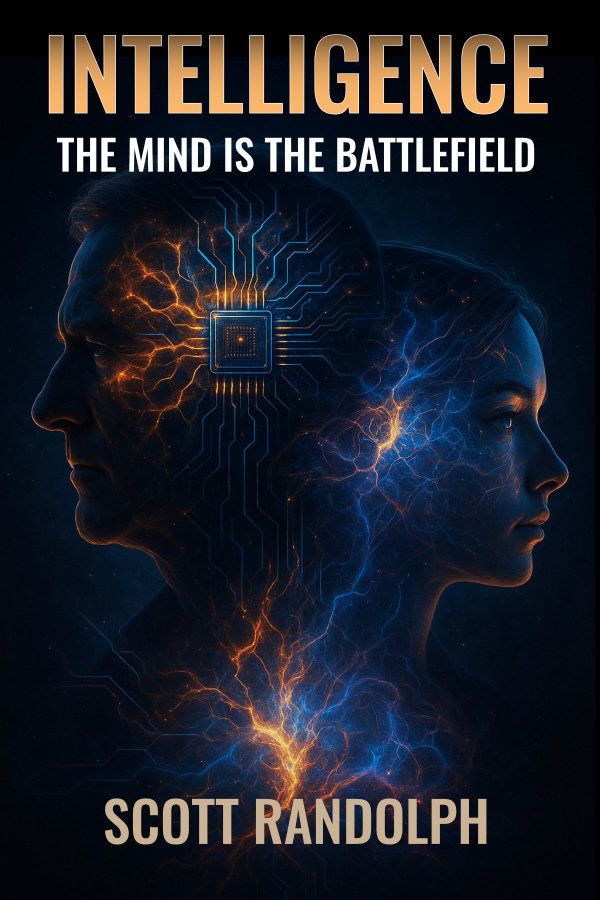
Scott Randolph Onstott publishes his fiction works under the pen name Scott Randolph,
while releasing his non-fiction books under Scott Onstott to clearly distinguish between the two bodies of work.
The Academy Legend
A Map for the Human Bridge
The Architecture of Consciousness
The Sacred Geometry Map Legend
— click icons for navigation —