Stages of Mind
The Musical Octave of Human Development
Just as music is organized into octaves where each note is a necessary frequency that builds step by step on the way to a higher unison, the human mind develops through discrete, transpersonal stages, common to all people across cultures. Each successive stage transcends, yet still includes the ones before it. When we understand this "Octave of Mind," the chaos of our modern world—from culture wars to personal identity crises—suddenly resolves into a coherent map of natural growth in harmony with the universe and the expressions of number in time (music).
In Tier 1, we firmly believe our specific worldview is the only correct objective model of reality. This is the birthplace of the "Culture War," where opposing views are seen as existential threats.
1. Animistic (Purple*): A world filled with spirits and magic, where the boundaries between self and nature are fluid and enchanted.
2. Egocentric (Red): The emergence of the "Default Mode Network." A focus on power, heroic self-assertion, and breaking free from the tribe.
3. Absolutistic (Blue): The "Traditional" stage. Seeing the world in concrete black and white; protecting the Anchor of lineage, religion, and family.
4. Multiplistic (Orange): The "Modern/Rational" stage. The world of the corporation and nation; protecting the Logos of progress, science, and achievement.
5. Relativistic (Green): The "Post-Modern" stage. Sensitive to interiors, environment, and intersectionality; protecting the Harmony of inclusion.
* Here the stage names are my own but I'm using the color conventions of Spiral Dynamics.
"Different phenomenological worlds, real worlds, come into being with each new level of consciousness development."
Tier 2 represents what I call the Metamorphosis Gate. Here, we stop trying to "win" the culture war, realizing its utter futility, and begin the work of Synthesis. We recognize that all previous stages (perspectives aka partial truths) are all necessary, unavoidable stages in the full human developmental story.
6. Systemic (Yellow): The "Integral" stage. This is the birth of systems thinking. You begin to see the "Octave" as a whole, understanding how the previous stages interact. You stop being a soldier for one stage and become an architect of the entire system, recognizing that every level has a "healthy" version that must be supported.
7. Universalistic (Turquoise): The "Non-Dual" stage. The realization of the Oculus archetype or the Turiya state. You recognize yourself as the consciousness that builds and maintains the universe of experience. From this vantage point, stewarding the health of all living and non-living systems is reintegrated as a sacred responsibility.
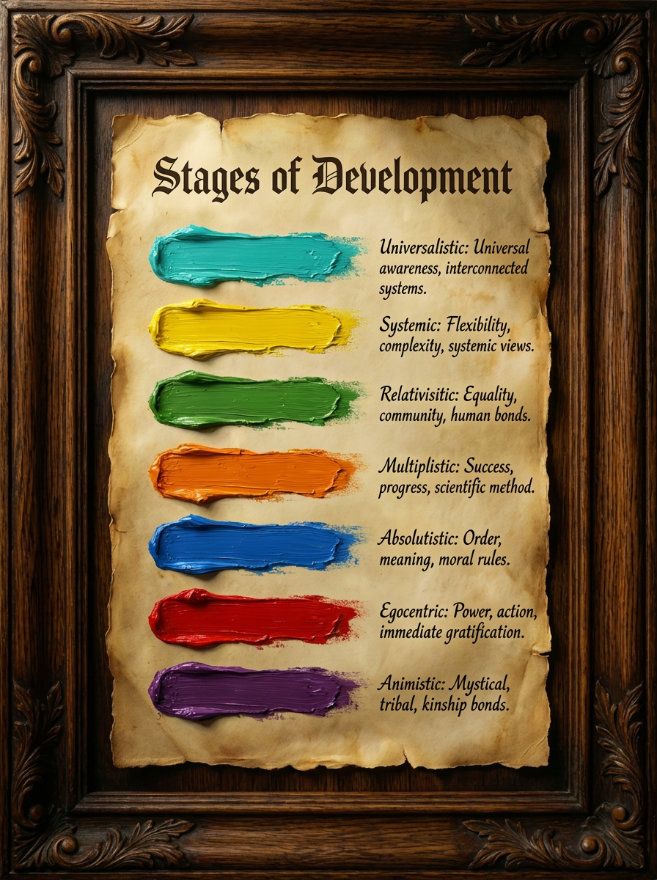
My synesthesia of stage theories of human development (free essay).
Our circles of concern increase in scope with each successive stage of soul development from mother (animistic) to self (egocentric), to family, tribe, religion (absolutistic), to guild, corporation, nation (multiplistic), to the environment and intersectionality (relativistic), and eventually to stewarding the health of all living and non-living systems (universalistic). The individual has the capacity to be influenced by each of these collective minds and corresponding worldviews as one’s soul develops in time. However, it's far from this pretty picture of peaceful progress.
The 'Multiple Wars' of modern political and mental confusion arise from deep-seated conflicts between stages of human development. This friction is fueled by the fundamentalist belief that one's specific worldview is the only correct objective model of reality.
We see this across the board but acutely in the transition from Green to Yellow. In the 'before times,' the university campus was the sacred ground where ideas were freely exchanged and tested in the fire of debate. Today, that architecture has been replaced by the 'Safe Space,' where those with differing viewpoints are shouted down to prevent their ideas from 'harming' the collective. It is the tragic irony of a system designed for liberation becoming a mechanism for suppression. This goes directly against basic emotional regulation adults are supposed to have and Aristotle's concept of education. When we lose the ability to entertain the 'other,' even in our own minds, we lose the ability to matriculate into the higher order vision-logic of the Turquoise stage and are stuck in the tyranny of Tier 1.
"It is the mark of an educated mind to be able to entertain a thought without accepting it."
“It is impossible for the same attribute at the same time to belong and not belong to the same subject in the same respect.”
This is Aristotle’s classic statement that outright contradictions cannot both be true; critical examination is necessary.
The tattered and scorched frame of the triptych below is a symbol of these ongoing battles. We are not just fighting over policies; we are fighting over the very 'Order of Matriculation' of the human mind—and the uncomfortable distinction that not everyone is equal in all ways at all times. That would be logically absurd.
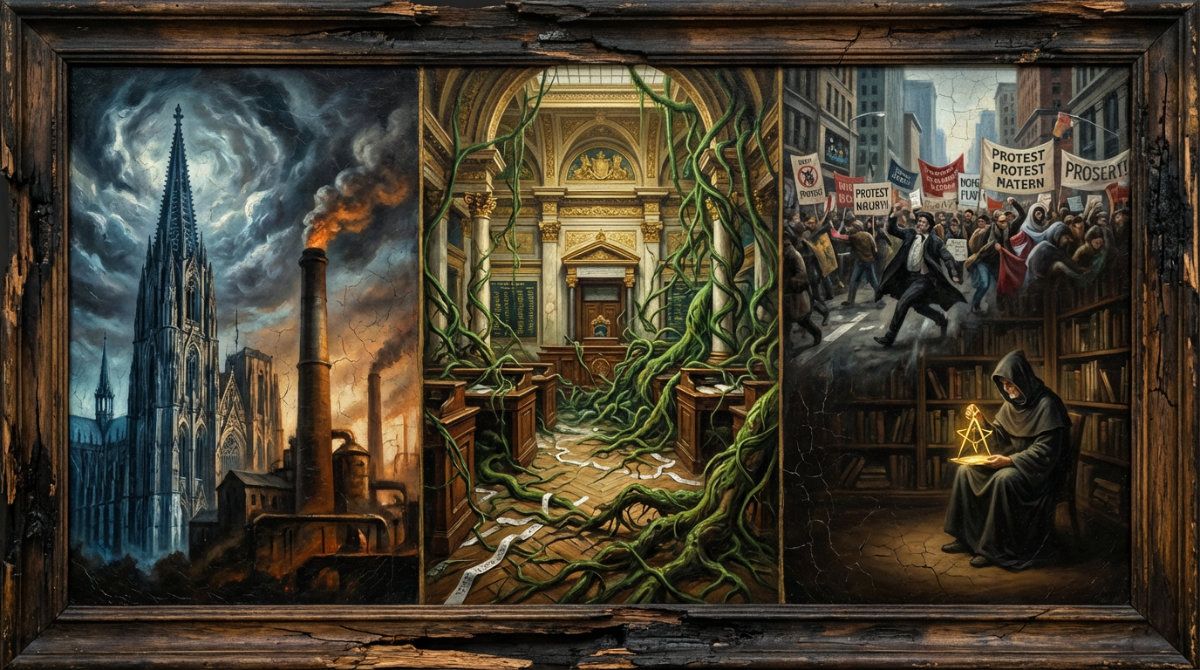
The Architecture of Conflict: The Triptych of the Three Stage Wars of the Mind and Culture
Stage War I: The Traditional Front
(Blue vs. Orange)
The clash between Traditionalism/Religion and the rise of Scientific Materialism and Industry. It is the struggle between the "Sacred Spire" and the "Smoking Chimney."
Stage War II: The Materialist Front
(Orange vs. Green)
The 'Capitalism vs. Socialism' debate—the friction between the Gilded Floor of market expansion and the Wild Vine of environmental and social reclamation.
Stage War III: Epistemological Front
(Green vs. Yellow)
The 'Woke vs. Intellectual' debate—the struggle between the collective emotionality of the safe space and the solitary, systemic logic of the individual holding the geometric compass.
While Stage War III is currently being fought between the emotionality of Green and the systemic logic of Yellow, the
Master Key is only found by those who can stand on the beach of that
Turquoise horizon. I want to invite you to share this view with me.
From this vantage point, we don't just 'analyze' the stages; we integrate them. We recognize that all the colors of the spectrum from the stages of mind are not competing factions, but the single, breathing cantankerous primate we love called humanity. To speak from Turquoise is to realize that the 'other' is not an enemy to be defeated by logic, but a necessary and beautiful frequency in the total harmony of the One. We are not just looking at the map; we have become the territory.
Stage War III is the final conflict zone. Most remain trapped in Stage Wars I and II. Some few remain trapped in the 'Yellow' library, using logic as a final shield against the 'Green' chaos raging outside its walls. But the goal of this exegesis is not to win the argument; it is to matriculate into the Turquoise vision-logic, where the tattered frame of the triptych finally falls away. At this level, we no longer see 'Wars'; through synesthesia we hear the Sacred Geometry of the human scale being played in real-time. We stop fighting the stages and start inhabiting the music.
It's more complicated than just 3 Stage Wars. It's a real internecine war on consciousness, where the real insurgency is within.
1. The Survival Polarity (Purple vs. Red)The Conflict: Tribal Safety vs. Individual Power
- Animistic (Purple - "We"): Politics of the Tribe. Focus: Safety, kinship, ancestors, and "our people." Political Manifestation: Ethno-nationalism, strict identity politics, protectionism. "We must protect the bloodline/tradition."
- Egocentric (Red - "Me"): Politics of the Warlord. Focus: Power, dominance, liberation from tribal taboos, immediate gratification. Political Manifestation: Dictatorships, anarchy, revolutionary insurrection. "I will do what I want, and you can't stop me."
The Clash: The Tribe tries to suppress the Warlord to keep peace; the Warlord tries to break the Tribe's rules to gain power.
2. The Traditionalist vs. Progressive Polarity- Absolutistic (Blue): This is the home of Traditionalism. It prioritizes order, moral rules, and "one right way" to live. It maps to the conservative desire for stability and established authority.
- Relativistic (Green): This is the home of Progressivism. It prioritizes equality, community, and human bonds. It seeks to dismantle the rigid hierarchies of the Blue stage to ensure everyone is included and heard.
3. The Nationalist vs. Globalist Polarity
- Animistic (Purple) & Absolutistic (Blue): These stages map to Nationalism. Purple focuses on tribal/kinship bonds (the "blood" of the nation), while Blue focuses on the "soil" and the legal/moral order of the nation-state.
- Systemic (Yellow) & Universalistic (Turquoise): These stages map to Globalism. Yellow sees the complexity of global systems, and Turquoise views the world as a single, interconnected organism where national borders are secondary to universal awareness.
4. The Populist vs. Elite Polarity
- Egocentric (Red) & Multiplistic (Orange): Populism often resonates here. Red values raw power and action against "the system," while Orange values individual success and progress. Populist movements often use Red energy to disrupt Orange/Blue institutions.
- Systemic (Yellow): This stage maps to the "Expert Elite." It values complexity and systemic views. From this stage, leaders try to manage the lower stages as a functional whole, which can often feel "out of touch" or "elitist" to those in the Red or Blue stages.
5. The Authoritarian vs. Libertarian Polarity
- Absolutistic (Blue): Maps to Social Authoritarianism (order and moral rules enforced by the state).
- Egocentric (Red): Maps to a raw, "might makes right" form of authoritarianism.
- Multiplistic (Orange): Maps to Right-Libertarianism. It prioritizes the scientific method, progress, and the individual's right to achieve success without interference.
- Relativistic (Green): Maps to Left-Libertarianism. It values human bonds and equality but often rejects the rigid "moral rules" of the Blue stage in favor of personal expression.
The following diagram details the individual body and individual soul dissociations within world and soul minds, respectively, illustrating the visible exterior (left) and invisible interior (right) stages of mind in human development.
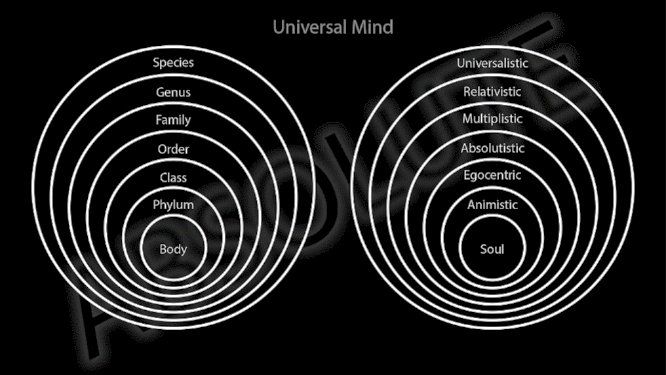
Body and Soul minds both go through developmental stages
All the stages shown here exist as transpersonal dissociations. The individual body and soul move through these levels during their development through time, where each successive stage transcends yet still includes its previous manifestations.
Focusing on the left side of the diagram, the human body develops as a dissociation within the World Mind in the visible domain. Ontogeny (the physical developmental history of an individual) reflects the vast course of evolution—not by linearly recapitulating it, but by passing through developmental characteristics common to their phylum, class, and order. These stages represent transpersonal "world minds" whose scope encompasses other species.
As we approach the end of gestation, we acquire the specific qualities of our family and genus, until finally, the unique characteristics of our species develop just prior to birth. You once possessed gill slits and a tail in utero; you have traveled a long way through the biological "context" of history to arrive at your current "content" as a human being.
"The embryo successively adds the organs that characterize the animal classes in the ascending scale. When the human embryo, for instance, is but a simple vesicle, it is an infusorian [microscopic organism]; when it has gained a liver, it is a mussel; with the appearance of the osseous [skeletal] system, it enters the class of fishes; and so forth, until it becomes a mammal and then a human being."
Karl Ernst von Baer (1792-1876)
Founding father of embryology, whose ideas are the basis of evolutionary developmental biology.
While von Baer famously corrected the idea that we 'become' these animals, he proved that we share their fundamental developmental blueprints.
Most of us are "lived by" our soul mind worldviews. We don't realize that the lens through which we see the world is actually a filter that limits our possibilities. Breaking through the "Metamorphosis Gate" into Tier 2 changes everything:
Reclaim Your Energy: Stop wasting life force on the "internal friction" of defending your rightness. Tier 2 allows you to hold multiple truths simultaneously, freeing your mind for pure creativity.
Become a Bridge-Builder: In a world of "terminal silos," the ability to speak the value-languages of every stage is a superpower. You stop seeing "enemies" and start seeing a developmental ecosystem that needs balance.
Achieve Emotional Sovereignty: Move from reacting to responding. By dis-identifying from a single stage, you are no longer "triggered" by opposing views. You gain the calm, vertical clarity of the observer.
Play the Full Octave: Don't limit your life to one or two notes. Integration gives you the flexibility to access the strengths of every stage—tradition, logic, empathy, and wisdom—exactly when they are needed.
Jiddu Krishnamurti
(1895-1986)
"True teaching is not an accumulation of knowledge; it is an awaking of consciousness which goes through successive stages."
To navigate the mind, we must understand the three different speeds at which our inner world operates. Most confusion arises when we mistake a passing "dynamic" for a permanent "stage."

Dynamics of Mind (Seconds to Minutes):
These are the flickering "weather patterns" of the mind. A sudden burst of anger, a flash of inspiration, or a moment of doubt. Dynamics flit through our awareness like birds across a window.

States of Mind (Hours to Days):
These are the "climates" of our experience. Whether it is the flow-state of deep work, the heavy fog of a depressive episode, or the expanded clarity of a meditative retreat, states color our entire world for a duration of time before shifting.

Stages of Mind (Years to Decades):
These are the "geology" of the mind. Stages are the deep, structural foundations of how we interpret reality. They evolve slowly over years of experience, providing the stable "center of gravity" from which we live our lives.
The 4th State | 7th Stage
The transition into Tier 2 is more than just a new way of thinking; it is the awakening of the Oculus—the "Fourth State" known in the East as Turiya. While a state is a temporary glimpse—a peak experience that may last for hours or days—a stage is a durable transformation. It is the difference between visiting a mountaintop and living there.
In Tier 1, we are like actors lost in a play, convinced that our current "note" on the piano is the only sound in the universe. We are "embedded" in our stage, playing the game without knowing who we really are, mistaking our temporary costumes of body and mind for our eternal essence.
When we move into Tier 2, we step into the position of the Witness. We become like Arjuna in the Bhagavad Gita, pausing in the stationary chariot between two armies to receive the wisdom of Krishna. We are in the world, but no longer entirely of it.
We realize that we are not the notes being played, but the Silence upon which the entire Octave of life unfolds. This is the Oculus: a vantage point that sits behind the dynamics, the states, and even the stages themselves. From this stable center, we don't just see the truth; we inhabit it.
From this Non-Dual perspective:
- You are the Space in which the culture war happens, rather than a soldier within it.
- You recognize that the "Absolute" (the silent keyboard) and the "Relative" (the music being played) are not two separate things.
- You gain the ability to consciously "play" the appropriate note for the situation, moving with the fluidity of a master musician rather than the rigidity of a beginner.