Sacred Geometry Academy
Navigator, Choose Your Direction
NORTH: Pathways: Foundations & Masterclasses
Workshops and masterclasses designed to move beyond theory into a direct, felt experience of geometric truth.
WEST: A Renaissance of Philosophical Geometry
Non-fiction explorations into a qualitative metaphysics where consciousness is fundamental and geometry is the intelligible language of reality
Visionary fiction where philosophical realizations are grounded in the emotional gravity of the human experience.
A Renaissance of Philosophical Geometry
Non-fiction explorations into a qualitative metaphysics where consciousness is fundamental and geometry is the intelligible language of reality.

Narrative Worlds: Beauty Through the Lens of Story
Visionary fiction where philosophical realizations are grounded in the emotional gravity of the human experience.
A Quiet Act of Rebellion: READ A BOOK.
Deep reading steadies the mind and increases the attention span. It cultivates patience, attunes you to nuance, and teaches you to hold complexity without reducing it. In books, you meet other minds, living and dead, whose voices widen the horizon of your own.
Reading is more than a pastime. It is a garden of attention, where insight takes root and what you nurture in thought becomes part of your cognitive architecture. Practice the sacred anachronism of deep reading and enjoy more clarity.

The Arch
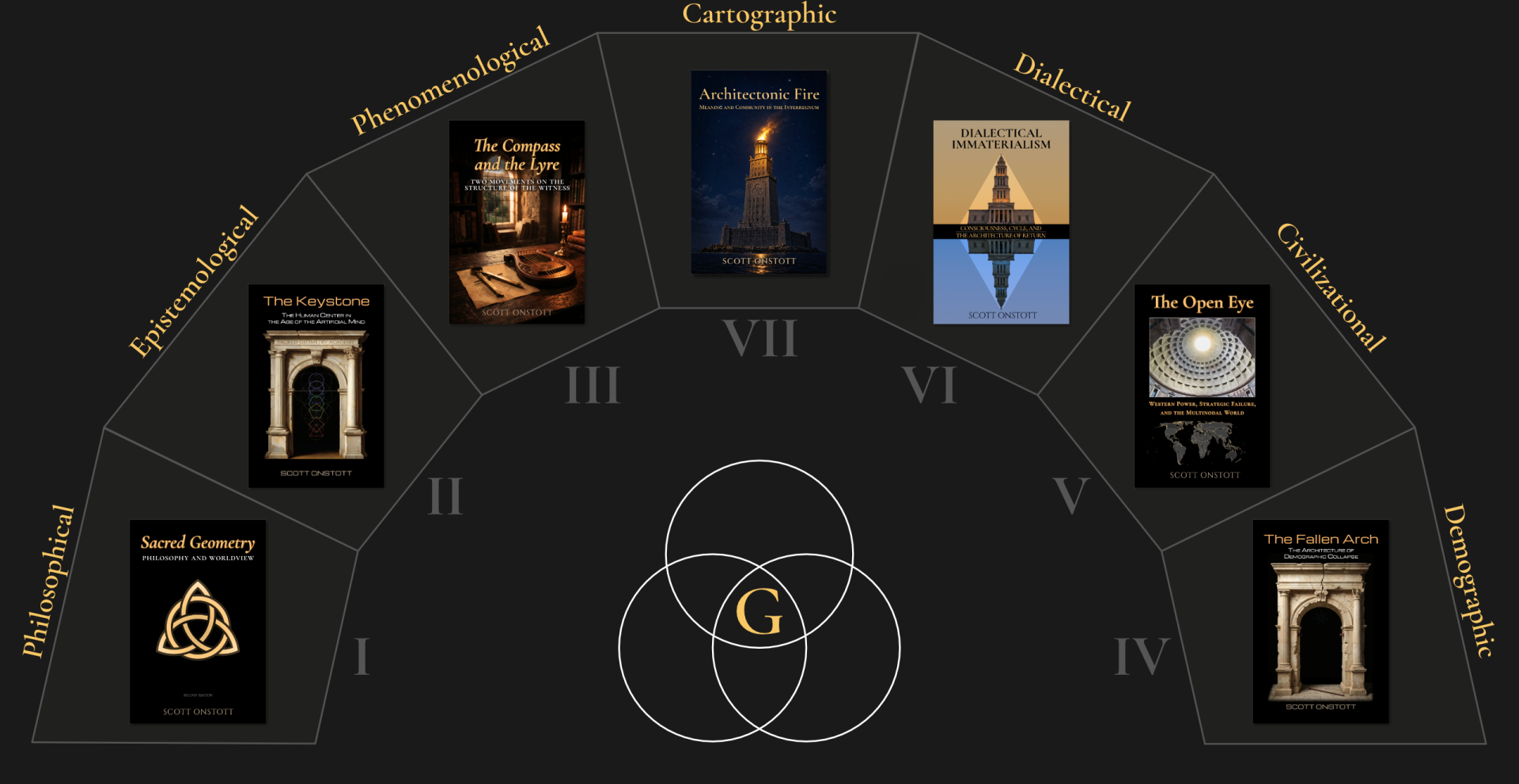
A nonfiction seven-book cycle by Scott Onstott: a septology.
Seven books tracing the architecture of reality, consciousness, civilization, and the human center
from the foundations of philosophical geometry to the pressures reshaping the modern world.
Short Summary
The Arch is a seven-volume examination of how civilizations hold together, fracture, and potentially renew themselves. Using the arch as its central metaphor, it argues that societies depend on relationships among people, practices, meanings, and institutions. The series begins with a philosophy of reality comprising the Visible, the Invisible, and the Intelligible, then presents the human being as a “Bridge-Being” capable of holding fact, feeling, and meaning in productive tension.
It then examines the erosion of genuine perception, the decline of fertility and family formation, and the loss of institutional self-correction. Its central diagnosis is dialectical: systems can succeed so completely that they generate the conditions of their own failure. The series concludes by looking toward the future Interregnum, the period between a collapsing civilization and whatever comes next, and argues that meaning must be reconstructed before institutions can be reformed, and that strong communities must precede large-scale renewal.
Medium Summary
The Arch is a seven-volume work built on one image: an arch stands because each stone presses against its neighbors and the pressure converges at the keystone, gaining strength from the forces that would otherwise destroy it. Remove one stone and it begins to fail; remove the keystone and it collapses. The series applies that logic to civilization — made not of stone but of people, practices, meanings, and institutions, yet holding together the same way, by distributing weight through relationships that must all remain intact. Its governing question, carried in a different register by each volume, is what must hold for human life to remain not merely survivable but worth living and capable of continuing.
It begins with a philosophical claim most modern frameworks have abandoned: reality has three domains, not one. The Visible is matter, measurement, and empirical fact. The Invisible is value, meaning, conscience, grief, love, and orientation toward the future — the dimension in which things matter, and one a civilization can lose while its buildings stand and its GDP grows. The Intelligible is form: geometric proportion and mathematical order, prior to experience, allowing the measurable and the meaningful to stay related without either collapsing into the other.
From there the series names the human being as the keystone — the Bridge-Being, a living center able to hold fact, form, and feeling in tension without collapsing any of them. Its failure modes are the Cage, where everything is optimized and curated until the person becomes a component in systems whose purposes are no longer examined, and the Evaporation, dissolving into pure feeling and losing traction on shared reality.
Perception is then formalized through the 33rd position: in a 32-element compass rose there are 32 directions, and a 33rd position exists that is not a direction but the place from which all 32 are legible — the witness not among the witnessed. From this follows visitation versus brand: a visitation moves through a person without being possessed; brand is visitation embalmed, the form preserved while the openness that made it generative is eliminated.
Diagnosis follows. At the demographic scale, the arch falls not because one stone is weak but because enough load-bearing relationships are removed — a seven-layer cascade in which the conditions making family formation and intergenerational continuity viable are progressively stripped away, interacting multiplicatively, with the meaning system most dangerous to lose because the forces eroding it also conceal the loss. At the institutional scale, power loses the capacity to see itself: the image is the Pantheon's Oculus, an unglazed opening to the sky through which rain falls and the floor drains — not a defect but what gives the dome its orientation. An institution keeps its Oculus while its founding purpose stays alive as visitation rather than crystallizing into performance, and loses it when internal loyalty signals replace external correction.
The engine is dialectical: a thesis at its greatest success generates the conditions of its own antithesis. South Korea's fertility rate of 0.72 as of 2023 is the proof case — not policy failure but the most successful developmental project in history following its own criteria to their conclusion. The cycle's outbreath develops the witnessing position; the inbreath returns to participation, now with the cycle perceived. That return is the Ethics of Remaining: witnessing is the midpoint, not a refuge, and recognizing the cycle is incomplete until it returns to life.
The final movement is cartographic, asking what must be done and in what order. The answer is a critical path: meaning reconstruction before institutional reform, community before scale. The Bridge-Being, the Oculus, and the a viviori practice cannot be stored — only transmitted by people who embody them, to communities able to receive them. That book is written for the Interregnum: the window between the arch that is falling and the arch not yet raised, bounded below by the present — demographic contraction underway, institutional decay measurable, AI acceleration active — and above by the point at which robotic labor abundance removes the last substrate for agency. The present is the site of diagnosis and preparation; the Interregnum is still ahead.
An arch is not a monument to itself; it bears weight by holding tension, and its purpose is to make passage possible.
Long Summary
The Arch is a seven-volume work organized around a single structural image: the arch. An arch is not decorative — it is a solution to the problem of weight. It stands because each stone presses against its neighbors and the pressure converges at the keystone, so the whole gains strength from the very forces that would otherwise destroy it. Remove one stone and the arch begins to fail; remove the keystone and it collapses. The series takes that as the model for a civilization. Societies are not made of stone but of people, practices, meanings, and institutions — yet the structural logic is the same. A civilization holds together by distributing weight through relationships that must all remain intact, and when enough of those relationships weaken, the load redistributes catastrophically.
The governing question, carried in a different register by each volume, is what must hold for human life to remain not merely survivable but worth living and capable of continuing. The books are not a ladder of increasingly final answers; each prepares the organ required to receive the next, and together they form one argument made in seven registers — moving from philosophical ground, through the human center, perception, diagnosis, institutional failure, and the engine of return, to cartography.
The argument begins with a philosophical claim most modern frameworks have quietly abandoned: that reality has three domains, not one. The Visible is the domain of matter, measurement, and empirical fact. The Invisible is the domain of value, meaning, conscience, grief, love, and orientation toward the future — not private preference, but the dimension in which things matter at all, and one a civilization can lose its grip on while its buildings still stand and its GDP still grows. The Intelligible is the domain of form: geometric proportion and mathematical order, realities neither physical objects nor inventions of individual feeling, prior to experience, and what allows the measurable and the meaningful to stay related without either collapsing into the other. Geometry, understood qualitatively rather than only quantitatively, is treated here as a language for that third domain — not mysticism, but the recovery of a precision the Western tradition once had and largely discarded.
From that ground the series names the human being as the keystone: specifically the human being as a Bridge-Being, a living center able to hold fact, form, and feeling in conscious tension without collapsing any of them. This arrives through an epistemological argument identifying four paths of knowing — the empirical, the formal, the spiritual, and the a viviori, what only living the tension can teach — none adequate alone, with the failure modes of their separation named precisely. The Cage is the world in which everything is optimized, curated, and managed until the person becomes a component in systems whose purposes are no longer consciously examined, and the capacity for genuine witness atrophies for lack of anything real to witness. The Evaporation is the opposite error: dissolving into pure feeling, losing traction on shared reality, escaping the Cage without the capacity to act in the world. The Bridge-Being is neither imprisoned nor dissolved, remaining correctable by evidence without being reduced to it and open to meaning without retreating into private feeling.
The series then turns to perception itself, formalizing the grammar of what separates someone who has genuinely encountered something from someone performing the encounter. Its instrument is the 33rd position: in a 32-element compass rose there are 32 directions, and a 33rd position exists that is not a 33rd direction but the place from which all 32 are simultaneously legible — the witness who is not among the witnessed. This is a categorical distinction, not a matter of degree. From it follows the distinction between visitation and brand: a visitation is an encounter with beauty, truth, or insight that moves through a person without being possessed by them, while brand is visitation embalmed — the form of the encounter preserved while the openness that made it generative is eliminated. Institutions, practices, communities, and individuals all make this conversion, often without noticing. The series speaks throughout in two voices, formal analysis and inhabited testimony, and establishes that neither alone tells the truth.
Diagnosis follows. At the demographic scale, the arch does not fall because one stone is weak but because enough load-bearing relationships have been removed that the structure can no longer distribute weight. The concern is the global decline in fertility and family formation, but the argument is structural rather than a policy debate or a culture-war accusation: a seven-layer cascade in which the conditions that once made family formation, reproduction, and intergenerational continuity viable are progressively removed — biological necessity, structural provision, personal security, desire for meaning, community, the timing of formation, and meaning systems robust enough to justify the cost. These interact multiplicatively rather than additively, so partial erosion of several produces effects larger than the sum of the parts, and the seventh stone is the most dangerous to lose because the systems accelerating its erosion also conceal the loss. No single villain, ideology, or generation explains the cascade; it comes from the accumulated interaction of conditions that each seem reasonable within their own logic. Hence the discipline of diagnosis before prescription.
At the institutional and geopolitical scale, the series examines how institutions of extraordinary power lose the capacity to see themselves clearly. Its central image is the Oculus of the Pantheon: a thirty-foot unglazed opening at the dome's apex, open to the sky, through which rain falls and the floor drains. The opening is not a defect but the feature that gives the dome its orientation and its contact with something beyond itself — a seeing that filters out the storm is not true seeing. An institution has the Oculus when its founding purpose remains alive as visitation rather than crystallizing into performance, and loses it when the feedback loop closes: when internal loyalty signals replace external correction, and "are we serving what we were built to serve?" is replaced by "are we following our own procedures correctly?" This pattern is mapped across geopolitical strategy, institutional design, and the emergence of a multinodal world in which ordering around a single developmental model no longer holds — a world that will not be organized around a single center, raising the question of whether communities, institutions, and civilizations capable of genuine self-correction will be present in sufficient number and quality to shape what comes next.
The engine of the whole is dialectical: a thesis, at the point of its greatest success, generates the conditions of its own antithesis. Not a morality tale about hubris, not an accusation that success is bad, but a structural observation that every successful form has a limit, and the completion of its own logic reveals conditions that logic cannot contain. The proof case is South Korea's total fertility rate of 0.72 as of 2023, the lowest ever recorded for any nation — not an anomaly or a policy failure but a demonstration of what happens when the most successful developmental project in recorded history follows its own success criteria to their logical conclusion. The shadow is proportional to the height of the structure that casts it. The cycle unfolds in two movements: the outbreath develops the witnessing position, the capacity to see the structures that organize experience rather than being carried by them; the inbreath returns to full participation, now with the cycle perceived. That return is the ethical turn, an Ethics of Remaining: the witnessing position is not a final refuge from history, institution, relationship, and responsibility but the midpoint, and recognizing the cycle is incomplete until it returns to life — not to defend every existing arrangement, but to act inside the architecture of one's own historical moment, holding what has been seen while continuing to act.
The final movement is cartographic. Taking the philosophical ground, epistemological instruments, phenomenological grammar, demographic diagnosis, institutional analysis, and dialectical engine together, it asks the question none of the others attempted: given all of this, what must be done, and in what order? The answer is a critical path, a sequence in which no step can begin before its predecessor is complete — meaning reconstruction must precede institutional reform, community must precede scale. The Bridge-Being, the Oculus as an institutional quality, and the a viviori practice cannot be stored; they can only be transmitted by people who embody them, to communities capable of receiving them, under conditions that let the transmission take root.
That final book is written for the Interregnum — the window between the arch that is falling and the arch that has not yet been raised. It is bounded below by the present, with demographic contraction underway, institutional decay measurable, and AI acceleration active, and above by the point at which robotic labor abundance removes the last remaining substrate for agency. The window is not yet closed, and the book is addressed to the people who will be inside it, asking in good faith what it means to be inside it. The present moment is therefore the site of diagnosis and preparation; the Interregnum is the period still ahead, for which the series tries to supply the instruments and the ordering. The fire does not wait for a better historical moment — it burns in this one.
Alongside the seven primary volumes, the series includes companion works that change the register, slow the argument down, and make it inhabitable by other means: an interactive geometric instrument built on the tesseract that lets a reader inhabit the 33rd position rather than merely understand it; an interactive fiction that walks the demographic cascade as a series of choices with real consequences across six structurally distinct endings, extended into a novel set a century after civilizational collapse asking what communities rebuilt from the foundations the Interregnum left available; a collection of poetry and vignettes restoring image and felt depth to an argument built through strategic analysis, with a companion interactive fiction in development that makes the institutional question playable; and further fiction, games, and essays — from near-future science fiction to a salon game for three to six players — that test the same structural terrain in registers the nonfiction cannot reach.
The work closes on the image it began with. An arch is not a monument to itself; it is a structure that bears weight by holding tension, and its purpose is to make passage possible. The series presents itself not as a system to be accepted on the author's authority but as instruments to be tested against one's own experience — found at the edges where they illuminate and the edges where they obscure, and used without being captured by them.
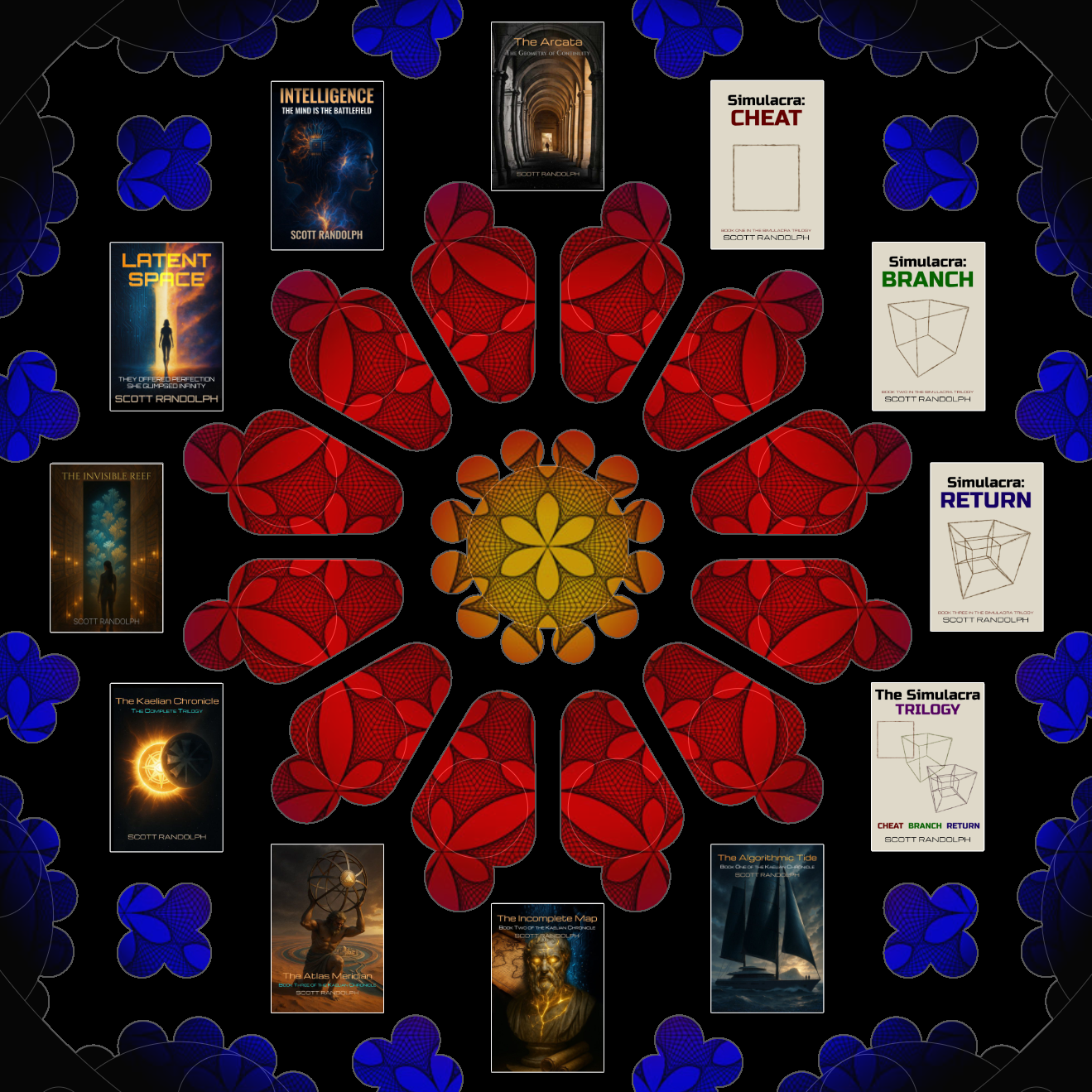
The Sacred Geometry Map Legend
— click icons for navigation —


A Renaissance of Philosophical Geometry
Decoding Philosophical Geometric Harmonies into New Maps for Meaning
A Cartographer's Pact
- I respect your agency and your inbox. I refuse to play the marketing game; I won’t spam you with psychological hooks, "limited time" sales offers, or newsletters.
- Email is for communication, not manipulation. Aside from the transactional emails triggered by your enrollment in a course or m-book, you will only hear from me when there is a high-signal reason to connect.
- Seek, and you shall find. Like an old-school library or bookstore, this Academy is built for active seekers and finders. Bookmark this site, explore the free webpages and archives, and support the work if it resonates.
All who seek to see further are welcome here.


Book Reviews


The best book that I have bought this year
A Profound and Inspiring Masterpiece — You won't regret buying this!


The New Gold Standard

A hidden gem

Highly recommended!


A map that is worth having a close look at


Covers more details than the original documentary

If you question coincidence...

Math rocks!

Math sync


Awe inspiring, thought provoking and beautifully illustrated...

I love this book

A New way of looking


If you like geometry & proportions...

Excellent job of intertwining mathematics and our planet as well as our universe.

All of my previous books on sacred geometry were almost a waste of time

Fascinating discussion of the underlying numeric structure of our reality


Appreciate the genius of Leonardo da Vinci in a whole new light!
I would suggest that a physical copy belongs on the shelf of every library, public or private, home or university or high school.

Expand Your Awareness !
Have the ability to expand your mind and your horizons. For that brief moment you will open yourself to options you would never have considered. That is the exploration that awaits you, charting the unknown possibilities of existence, like Star Trek.

Creativity and knowledge


This is Academy Award level scholarship.
About this site


An extremely outstanding read!
I enjoyed this read so much that I read the book at maybe 10% of my normal pace. It is too good to not properly savor the read. The 5-star rating chart needs another 5 stars to properly rate this novel, in my view. I give it a 10-star rating.
Website and Courses


Sacred Geometry and Consciousness all in an engaging action filled narrative


Fascinating discussion of the underlying numeric structure of our reality
The Academy Legend
A Map for the Human Bridge
The Architecture of Consciousness