Cosmology
Introduction
In the beginning, there was a question.
Not "let there be light," before that. The question that every cosmology, ancient and modern, is secretly an attempt to answer: Why is there something rather than nothing?
Leibniz asked it in 1714. Stephen Hawking restated it in 1988: "What is it that breathes fire into the equations and makes a universe for them to describe?" Physics can write the recipe. It cannot explain why the kitchen exists, or why anyone is cooking.
Cosmology, as a philosophical subject rather than merely a scientific one, is the study of that question: the origin, structure, and ultimate meaning of the cosmos. Not just what the universe is made of, but why it is structured the way it is, and what, if anything, that structure reveals about the consciousness that finds itself, inexplicably, inside it. Or is it the other way around?
This page lives at the intersection of two very old traditions and one very new one. The old traditions are Kabbalistic cosmogony (how the infinite became the finite, according to the mystical reading of Jewish scripture) and the classical philosophical question of the cosmological first cause (Aristotle's unmoved mover, Aquinas's uncaused cause, Leibniz's sufficient reason). The new tradition is the Standard Model of particle physics, which has arrived, after a century of experiment, at a list of exactly 32 numbers that, taken together, define the universe we live in.
The convergence between these traditions is not something I invented. It is something I found, and it surprised me more than it will surprise you.
Not "let there be light," before that. The question that every cosmology, ancient and modern, is secretly an attempt to answer: Why is there something rather than nothing?
Leibniz asked it in 1714. Stephen Hawking restated it in 1988: "What is it that breathes fire into the equations and makes a universe for them to describe?" Physics can write the recipe. It cannot explain why the kitchen exists, or why anyone is cooking.
Cosmology, as a philosophical subject rather than merely a scientific one, is the study of that question: the origin, structure, and ultimate meaning of the cosmos. Not just what the universe is made of, but why it is structured the way it is, and what, if anything, that structure reveals about the consciousness that finds itself, inexplicably, inside it. Or is it the other way around?
This page lives at the intersection of two very old traditions and one very new one. The old traditions are Kabbalistic cosmogony (how the infinite became the finite, according to the mystical reading of Jewish scripture) and the classical philosophical question of the cosmological first cause (Aristotle's unmoved mover, Aquinas's uncaused cause, Leibniz's sufficient reason). The new tradition is the Standard Model of particle physics, which has arrived, after a century of experiment, at a list of exactly 32 numbers that, taken together, define the universe we live in.
The convergence between these traditions is not something I invented. It is something I found, and it surprised me more than it will surprise you.
The Ancient Recipe: The Sefer Yetzirah
The Sefer Yetzirah, the Book of Formation, is the oldest surviving text of the Kabbalistic tradition, dated by scholars anywhere from the 2nd to the 6th century CE and attributed by tradition to the patriarch Abraham himself. It opens with a sentence that reads like a compressed physics paper:
The Patriarch Abraham
(2nd millennium BCE)
"With thirty-two wondrous paths of wisdom, Yah, the Lord of Hosts... engraved and created His world."
Thirty-two paths. Not thirty-one. Not thirty-three. The Sefer Yetzirah then unpacks the recipe: ten sefirot (the primordial emanations or "spheres" of divine quality) and twenty-two Hebrew letters, divided into three Mothers, seven Doubles, and twelve Simples. Ten plus twenty-two equals thirty-two. Creation, according to this tradition, was accomplished by a 32-fold differentiation of the infinite into the finite.
But here is the detail the Sefer Yetzirah is most careful about: the thirty-two are not all the same kind of thing. The ten sefirot are qualities of being, modes of divine presence. The twenty-two letters are instruments of differentiation, the grammar by which those qualities are articulated into the specific forms of the manifest world. The text insists on the distinction: "Do not let your mouth speak and do not let your heart think anything outside of them, and if your heart runs return to the place."
In other words: the thirty-two is complete. There is nothing outside it, except, of course, the one who reads it. The tradition adds a thirty-third position: Da'at, hidden Knowledge, not as one more path among the thirty-two, but as the vanishing point from which all thirty-two are held in view. Da'at is drawn on the Tree of Life not as a regular sefirah but as a dotted circle: present, but not quite there. The observer who is never fully an object.
But here is the detail the Sefer Yetzirah is most careful about: the thirty-two are not all the same kind of thing. The ten sefirot are qualities of being, modes of divine presence. The twenty-two letters are instruments of differentiation, the grammar by which those qualities are articulated into the specific forms of the manifest world. The text insists on the distinction: "Do not let your mouth speak and do not let your heart think anything outside of them, and if your heart runs return to the place."
In other words: the thirty-two is complete. There is nothing outside it, except, of course, the one who reads it. The tradition adds a thirty-third position: Da'at, hidden Knowledge, not as one more path among the thirty-two, but as the vanishing point from which all thirty-two are held in view. Da'at is drawn on the Tree of Life not as a regular sefirah but as a dotted circle: present, but not quite there. The observer who is never fully an object.
The Modern Recipe: The Standard Model
In 2005, physicist Max Tegmark published a paper in Annals of Physics in which he catalogued the free parameters of the Standard Model of particle physics, the numbers that physics can measure but cannot derive from any deeper principle. These are the "knobs on the universe," the values that, if you tweaked any of them even slightly, would produce a cosmos without atoms, without stars, without chemistry, without life.
The list runs to approximately 32 parameters: three gauge coupling constants (the strengths of the electromagnetic, weak, and strong forces), two Higgs parameters (the mass and self-coupling of the field that gives particles their mass), twelve fermion masses (six quarks and six leptons, in three generations of four), eight mixing angles (the parameters that govern how particles of different generations transform into each other), and seven cosmological parameters (the density of matter and dark energy, the amplitude and tilt of primordial fluctuations, and the baryon-to-photon ratio).
Thirty-two numbers. That is not a fact Tegmark derives; it is a fact he observes and published in a table in his book Our Mathematical Universe (2014). The count is convention-dependent; different physicists draw the boundary of "the Standard Model" slightly differently, and the neutrino sector may be incomplete, but the number 32 is robust across the most common frameworks, and no version of the theory has yet found the deeper principle that would dramatically reduce or enlarge it.
And at the base of this list, as at the base of the Sefer Yetzirah's thirty-two, there sits a thirty-third position that is not a parameter at all: the question of why the parameters are instantiated, why there is a running universe rather than a set of equations sitting unevaluated on a cosmic blackboard. Physics calls this the "first cause" problem, or the question of fine-tuning. Kabbalah calls it Da'at. Both traditions agree that the thirty-third position is of a different logical type than the other thirty-two. It is not a bigger number; it is a different kind of question.
The list runs to approximately 32 parameters: three gauge coupling constants (the strengths of the electromagnetic, weak, and strong forces), two Higgs parameters (the mass and self-coupling of the field that gives particles their mass), twelve fermion masses (six quarks and six leptons, in three generations of four), eight mixing angles (the parameters that govern how particles of different generations transform into each other), and seven cosmological parameters (the density of matter and dark energy, the amplitude and tilt of primordial fluctuations, and the baryon-to-photon ratio).
Thirty-two numbers. That is not a fact Tegmark derives; it is a fact he observes and published in a table in his book Our Mathematical Universe (2014). The count is convention-dependent; different physicists draw the boundary of "the Standard Model" slightly differently, and the neutrino sector may be incomplete, but the number 32 is robust across the most common frameworks, and no version of the theory has yet found the deeper principle that would dramatically reduce or enlarge it.
And at the base of this list, as at the base of the Sefer Yetzirah's thirty-two, there sits a thirty-third position that is not a parameter at all: the question of why the parameters are instantiated, why there is a running universe rather than a set of equations sitting unevaluated on a cosmic blackboard. Physics calls this the "first cause" problem, or the question of fine-tuning. Kabbalah calls it Da'at. Both traditions agree that the thirty-third position is of a different logical type than the other thirty-two. It is not a bigger number; it is a different kind of question.
The Three Rhymes
What stopped me cold, in the middle of building the prototype Tesseract Explorer at thirtytwowinds.com was not that both traditions had thirty-two. Many things come in thirty-two, like the number of teeth in adult mouths including wisdom teeth, or the number of classes of inorganic crystals. What stopped me was that both traditions partition their thirty-two the same way, and that the partition means the same thing in both cases.
Rhyme One: 3 + 7 + 12 + 10 = 32.
The Sefer Yetzirah divides its twenty-two letters into three groups plus the ten sefirot: three Mother letters (the elemental forces from which all is woven: Aleph/air, Mem/water, Shin/fire), seven Double letters (the planetary governors, each carrying two possible pronunciations), and twelve Simple letters (the zodiac — the complete enumeration of manifest kinds). 3 + 7 + 12 + 10 = 32.
Tegmark's thirty-two parameters fall into the same four groups almost without being asked: three gauge couplings (the fundamental forces from which all interaction is woven), seven background/cosmological parameters (the stage-setting numbers that define the cosmic environment), twelve fermion masses (the complete enumeration of material kinds: six quarks and three charged leptons and three neutrinos), and ten deep-structure parameters (two Higgs + four CKM quark-mixing angles + four PMNS neutrino-mixing angles). 3 + 7 + 12 + 10 = 32.
The meanings rhyme: the three mothers are the elemental forces ↔ the three gauge couplings. The twelve simples are the zodiac, the complete enumeration of celestial kinds ↔ the twelve fermions, the complete enumeration of material kinds. The seven doubles carry the classical planets ↔ the seven background parameters set the stage on which all matter performs. Two traditions, three millennia apart, invented the same fourfold ontological grammar: primordial forces, stage-setting, manifest kinds, and deep relational structure.
Rhyme Two: The 3 × 4 grammar of the outer world.
A cube has twelve edges, arranged as three directions × four parallel edges. The zodiac is twelve signs, arranged as three modes (cardinal, fixed, mutable) × four elements (fire, earth, air, water). The twelve fermions are arranged as three generations × four kinds (up-type quark, down-type quark, charged lepton, neutrino). Three completely independent systems: geometry, astrology, particle physics, share the same 3 × 4 grammar for the manifest, material, enumerable world. If you are a materialist, this is a striking coincidence. If you are a Platonist, it is evidence that the archetype precedes the instance.
Rhyme Three: The hidden connectors.
The eight sefirot from Chokhmah (Wisdom) to Yesod (Foundation) are described in Kabbalistic tradition as the mediating cascade between the ineffable Crown above and the manifest Kingdom below. They are the connectors: the emanations that translate the absolute into the relative, the infinite into the finite, the primordial into the particular.
The eight mixing angles in the Standard Model are called the CKM matrix (four parameters governing how quarks mix across generations) and the PMNS matrix (four parameters governing how neutrinos mix). What mixing angles mean is precisely this: they are the parameters of between-ness. They govern how one generation blurs into another, how the boundary between categories is not sharp but permeable, how the identity of a particle is not fixed but probabilistic in the act of transformation. They are the connectors. The mediating cascade.
The tradition's metaphor and the physics' mathematics describe the same structural role through different vocabularies.
Rhyme One: 3 + 7 + 12 + 10 = 32.
The Sefer Yetzirah divides its twenty-two letters into three groups plus the ten sefirot: three Mother letters (the elemental forces from which all is woven: Aleph/air, Mem/water, Shin/fire), seven Double letters (the planetary governors, each carrying two possible pronunciations), and twelve Simple letters (the zodiac — the complete enumeration of manifest kinds). 3 + 7 + 12 + 10 = 32.
Tegmark's thirty-two parameters fall into the same four groups almost without being asked: three gauge couplings (the fundamental forces from which all interaction is woven), seven background/cosmological parameters (the stage-setting numbers that define the cosmic environment), twelve fermion masses (the complete enumeration of material kinds: six quarks and three charged leptons and three neutrinos), and ten deep-structure parameters (two Higgs + four CKM quark-mixing angles + four PMNS neutrino-mixing angles). 3 + 7 + 12 + 10 = 32.
The meanings rhyme: the three mothers are the elemental forces ↔ the three gauge couplings. The twelve simples are the zodiac, the complete enumeration of celestial kinds ↔ the twelve fermions, the complete enumeration of material kinds. The seven doubles carry the classical planets ↔ the seven background parameters set the stage on which all matter performs. Two traditions, three millennia apart, invented the same fourfold ontological grammar: primordial forces, stage-setting, manifest kinds, and deep relational structure.
Rhyme Two: The 3 × 4 grammar of the outer world.
A cube has twelve edges, arranged as three directions × four parallel edges. The zodiac is twelve signs, arranged as three modes (cardinal, fixed, mutable) × four elements (fire, earth, air, water). The twelve fermions are arranged as three generations × four kinds (up-type quark, down-type quark, charged lepton, neutrino). Three completely independent systems: geometry, astrology, particle physics, share the same 3 × 4 grammar for the manifest, material, enumerable world. If you are a materialist, this is a striking coincidence. If you are a Platonist, it is evidence that the archetype precedes the instance.
Rhyme Three: The hidden connectors.
The eight sefirot from Chokhmah (Wisdom) to Yesod (Foundation) are described in Kabbalistic tradition as the mediating cascade between the ineffable Crown above and the manifest Kingdom below. They are the connectors: the emanations that translate the absolute into the relative, the infinite into the finite, the primordial into the particular.
The eight mixing angles in the Standard Model are called the CKM matrix (four parameters governing how quarks mix across generations) and the PMNS matrix (four parameters governing how neutrinos mix). What mixing angles mean is precisely this: they are the parameters of between-ness. They govern how one generation blurs into another, how the boundary between categories is not sharp but permeable, how the identity of a particle is not fixed but probabilistic in the act of transformation. They are the connectors. The mediating cascade.
The tradition's metaphor and the physics' mathematics describe the same structural role through different vocabularies.
The Map and the Territory
I need to be scrupulous here, and I will be, because the honest version of this correspondence is more interesting than the dishonest one.
What I am not claiming: that the Sefer Yetzirah's authors discovered quantum field theory. That the number 32 has occult power. That these structural rhymes constitute a scientific proof of anything. The parameter count in the Standard Model is convention-dependent; some physicists count 25, some 31, some 37, depending on how they treat neutrino masses and the cosmological constant. The Sefer Yetzirah's 3 + 7 + 12 is ancient tradition, not a physical measurement. Numerical parallels are not derivations.
What I am claiming: that two traditions, working from completely different starting points, one from meditation and mystical intuition, one from particle accelerators and renormalization group equations, independently converged on the same fourfold ontological structure for the articulate cosmos. The groups mean the same things. The positions in the structure mean the same things. The hidden +1 at the center that is not a member of the set means the same thing in both.
This is not coincidence. It is not proof. It is what happens when two maps are honest enough about the same territory. The territory is the structure of reality. The maps are our best attempts to read it. When two genuinely independent maps agree, you are permitted to wonder why.
Physicist James Jeans put it plainly in 1930: "The universe begins to look more like a great thought than like a great machine." The Sefer Yetzirah put it more precisely, two millennia earlier: the cosmos was engraved, etched out of the infinite, by thirty-two instruments of differentiation. The grammar came first. The universe is what happens when you run the grammar.
What I am not claiming: that the Sefer Yetzirah's authors discovered quantum field theory. That the number 32 has occult power. That these structural rhymes constitute a scientific proof of anything. The parameter count in the Standard Model is convention-dependent; some physicists count 25, some 31, some 37, depending on how they treat neutrino masses and the cosmological constant. The Sefer Yetzirah's 3 + 7 + 12 is ancient tradition, not a physical measurement. Numerical parallels are not derivations.
What I am claiming: that two traditions, working from completely different starting points, one from meditation and mystical intuition, one from particle accelerators and renormalization group equations, independently converged on the same fourfold ontological structure for the articulate cosmos. The groups mean the same things. The positions in the structure mean the same things. The hidden +1 at the center that is not a member of the set means the same thing in both.
This is not coincidence. It is not proof. It is what happens when two maps are honest enough about the same territory. The territory is the structure of reality. The maps are our best attempts to read it. When two genuinely independent maps agree, you are permitted to wonder why.
Physicist James Jeans put it plainly in 1930: "The universe begins to look more like a great thought than like a great machine." The Sefer Yetzirah put it more precisely, two millennia earlier: the cosmos was engraved, etched out of the infinite, by thirty-two instruments of differentiation. The grammar came first. The universe is what happens when you run the grammar.
The Tesseract as Cosmological Map
The Tesseract Explorer (at thirtytwowinds.com) implements this correspondence as an interactive geometry. The tesseract, the four-dimensional hypercube has exactly 32 edges by mathematical necessity, organized into three natural groups by its Schlegel projection into three-dimensional space: 12 inner edges, 8 connecting spokes, 12 outer edges. The center of the tesseract is a point of a different logical type: not an edge, not a vertex, but the position from which the whole structure is held in radial equilibrium.
The Cosmology layer in the app maps the Kabbalah's 32+1 onto the tesseract's 32+1, and the Standard Model's 32+1 onto the same structure, so that each of the 32 edges carries both a Kabbalistic card and a physics card simultaneously. You can flip between the two digital cards like faces of a single physical card. You can activate the inner, spoke, or outer edges independently and watch which group of constants corresponds to which group of sefirot. The geometry is not a metaphor for the correspondence; it is the structure the correspondence reveals.
To explore that geometry, the app is the right instrument. To think through the philosophical implications, you are already in the right place.
The Cosmology layer in the app maps the Kabbalah's 32+1 onto the tesseract's 32+1, and the Standard Model's 32+1 onto the same structure, so that each of the 32 edges carries both a Kabbalistic card and a physics card simultaneously. You can flip between the two digital cards like faces of a single physical card. You can activate the inner, spoke, or outer edges independently and watch which group of constants corresponds to which group of sefirot. The geometry is not a metaphor for the correspondence; it is the structure the correspondence reveals.
To explore that geometry, the app is the right instrument. To think through the philosophical implications, you are already in the right place.
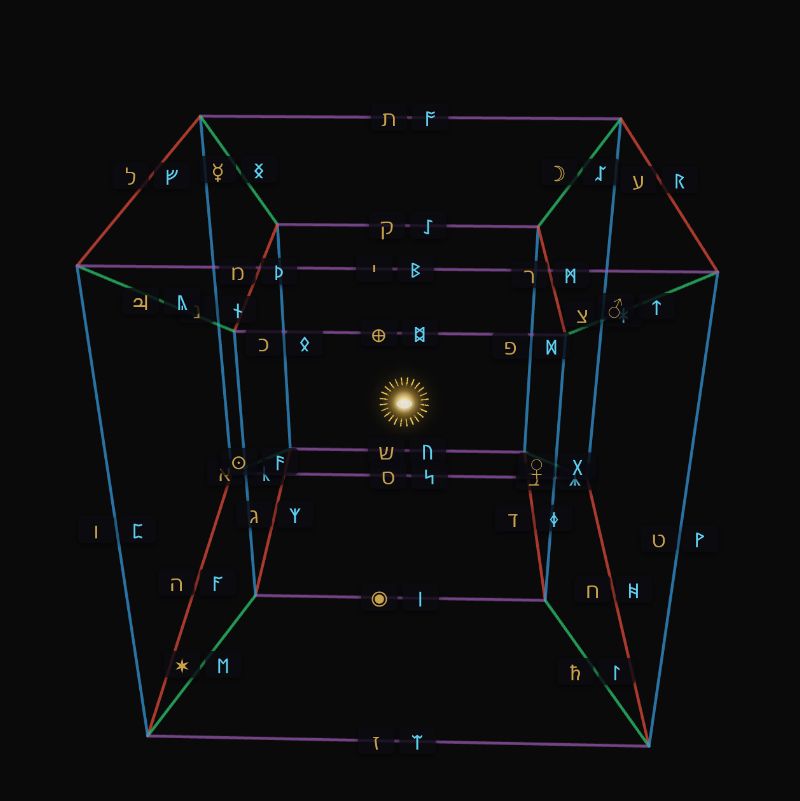
The tesseract projection mapped with glyphs representing both cosmogonic/cosmologic systems
Navigating the Light and Shadow
No cosmological symbol carries a heavier shadow than the claim to know where everything came from. The light version of cosmological knowledge is wonder: the recognition that the universe is intelligible, that its structure is not arbitrary, that consciousness finds itself inside a cosmos whose parameters are hospitable to exactly the kind of consciousness that can study them. The anthropic principle, the fine-tuning argument, Wigner's "unreasonable effectiveness of mathematics," these are the light face of cosmological wonder.
The shadow is the rush to close the question. Creationism closes it by fiat: a personal God chose the parameters, and inquiry can stop. Materialist eliminativism closes it from the other direction: the constants are what they are because we happen to be in the universe that could produce beings to notice them, and inquiry is circular. Both closures share the same move: replacing wonder with certainty, replacing the open question with a sealed reductionist answer.
The approach here refuses both closures, not out of agnosticism, but out of fidelity to the structure of the question itself. Hawking's question "what breathes fire into the equations?" is not answered by pointing to a God, or to a probability distribution over possible universes, or to a structural correspondence between the Tree of Life and the Standard Model. The +1 that remains after the 32 are enumerated is not an answer. It is the question, held open, at the center of everything. Da'at. Hidden Knowledge. The place where Wisdom (Chokhmah) and Understanding (Binah) were supposed to produce a third child, and produced instead a silence too deep for naming.
The discipline, in cosmology as in ontology, is to keep looking without crystallizing. To let the 32 windows illuminate the structure without mistaking any one of them for the sky.
The shadow is the rush to close the question. Creationism closes it by fiat: a personal God chose the parameters, and inquiry can stop. Materialist eliminativism closes it from the other direction: the constants are what they are because we happen to be in the universe that could produce beings to notice them, and inquiry is circular. Both closures share the same move: replacing wonder with certainty, replacing the open question with a sealed reductionist answer.
The approach here refuses both closures, not out of agnosticism, but out of fidelity to the structure of the question itself. Hawking's question "what breathes fire into the equations?" is not answered by pointing to a God, or to a probability distribution over possible universes, or to a structural correspondence between the Tree of Life and the Standard Model. The +1 that remains after the 32 are enumerated is not an answer. It is the question, held open, at the center of everything. Da'at. Hidden Knowledge. The place where Wisdom (Chokhmah) and Understanding (Binah) were supposed to produce a third child, and produced instead a silence too deep for naming.
The discipline, in cosmology as in ontology, is to keep looking without crystallizing. To let the 32 windows illuminate the structure without mistaking any one of them for the sky.
Why the +1 Is You
Here is the claim that is easy to miss in the midst of all this structure.
The thirty-two constants are the recipe for a universe that contains observers. Remove any of them from the narrow range they inhabit and you get a universe without chemistry, without stars, without the slow cooling that allows complexity to arise. The parameters are finely tuned, with an insane precision that has no physical explanation, not because of a conspiracy, but because of something stranger: we cannot explain why the knobs are set where they are, only that if they were not, we would not be here to ask.
Which means that the question "why is there something rather than nothing?" reaches its sharpest form here: there is something structured for awareness. The recipe includes a reader. The 32 parameters describe a cosmos that contains, as an output, the very consciousness that looks back at the 32 parameters and finds them remarkable.
That is the +1. Not a thirty-third constant alongside the other thirty-two. Not Da'at as another sefirah on the Tree. The +1 is the awareness that is doing the reading: the position from which the 32 are held in view, which cannot itself be one of the thirty-two without ceasing to be the position from which they are seen. The observer is not in the Standard Model. The reader is not in the recipe. And yet without the reader, the recipe is unread — and an unread recipe is, arguably, unreal.
You are the thirty-third position. Not as a metaphysical claim requiring your assent, but as a structural fact about this very moment: you are the one holding the 32 in view.
The cosmos arranged its 32 constants precisely, against all astronomical odds. You are randomly here, in a universe supporting life, asking the question.
OR
Consciousness had to finely-tune the cosmos' 32 constants so precisely that "you" could be here, reading this, asking the question.
What you do with that question is the materialism / idealism debate of cosmology.
I claim that you are not yet another parameter but the necessary witness. The 32 numbers describe the laws' ground, what Tegmark calls the Level IV ensemble of mathematical structures. Tegmark makes no claim about what I call the +1, the 33rd "parameter." Gödel showed that no system rich enough to contain arithmetic can certify its own consistency from within, so whatever grounds these constants cannot be derived from them. The 33rd position is the question the other 32 cannot answer: why is there a lawful universe at all? What set it in motion?
How did everything come from nothing unless it is, 13.8 billion years later, still no-thing outside of consciousness, the ground of being.
The thirty-two constants are the recipe for a universe that contains observers. Remove any of them from the narrow range they inhabit and you get a universe without chemistry, without stars, without the slow cooling that allows complexity to arise. The parameters are finely tuned, with an insane precision that has no physical explanation, not because of a conspiracy, but because of something stranger: we cannot explain why the knobs are set where they are, only that if they were not, we would not be here to ask.
Which means that the question "why is there something rather than nothing?" reaches its sharpest form here: there is something structured for awareness. The recipe includes a reader. The 32 parameters describe a cosmos that contains, as an output, the very consciousness that looks back at the 32 parameters and finds them remarkable.
That is the +1. Not a thirty-third constant alongside the other thirty-two. Not Da'at as another sefirah on the Tree. The +1 is the awareness that is doing the reading: the position from which the 32 are held in view, which cannot itself be one of the thirty-two without ceasing to be the position from which they are seen. The observer is not in the Standard Model. The reader is not in the recipe. And yet without the reader, the recipe is unread — and an unread recipe is, arguably, unreal.
You are the thirty-third position. Not as a metaphysical claim requiring your assent, but as a structural fact about this very moment: you are the one holding the 32 in view.
The cosmos arranged its 32 constants precisely, against all astronomical odds. You are randomly here, in a universe supporting life, asking the question.
OR
Consciousness had to finely-tune the cosmos' 32 constants so precisely that "you" could be here, reading this, asking the question.
What you do with that question is the materialism / idealism debate of cosmology.
I claim that you are not yet another parameter but the necessary witness. The 32 numbers describe the laws' ground, what Tegmark calls the Level IV ensemble of mathematical structures. Tegmark makes no claim about what I call the +1, the 33rd "parameter." Gödel showed that no system rich enough to contain arithmetic can certify its own consistency from within, so whatever grounds these constants cannot be derived from them. The 33rd position is the question the other 32 cannot answer: why is there a lawful universe at all? What set it in motion?
How did everything come from nothing unless it is, 13.8 billion years later, still no-thing outside of consciousness, the ground of being.
Closing
The word cosmos comes from the Greek for order, arrangement, beauty. The ancient Greek word for the universe and the word for a woman's jewelry are the same: kosmos. The universe is adorned. It is not merely functional; it is beautiful, and the beauty is not an accident of the recipe but somehow encoded in it, in the particular values of the constants, in the emergence of complexity and life and consciousness from what began as undifferentiated energy and geometry.
The Sefer Yetzirah says the world was engraved with 32 wondrous paths. The Standard Model says the world runs on 32 free parameters. The tesseract says the structure of differentiation has exactly 32 edges and a center that is not an edge. Three maps of the same territory, drawn by different cartographers across three thousand years of inquiry, agreeing on the number and the structure and the irreducible +1 at the heart of it all.
Wonder is the beginning of cosmology. Rigor is its discipline. And the awareness in which the whole inquiry takes place, your awareness, the experiencing as you read this sentence, is its subject and its source simultaneously.
The grammar was written in the universal language of mathematics before the first utterance. You are the one experiencing it through endless dissociations.
The Sefer Yetzirah says the world was engraved with 32 wondrous paths. The Standard Model says the world runs on 32 free parameters. The tesseract says the structure of differentiation has exactly 32 edges and a center that is not an edge. Three maps of the same territory, drawn by different cartographers across three thousand years of inquiry, agreeing on the number and the structure and the irreducible +1 at the heart of it all.
Wonder is the beginning of cosmology. Rigor is its discipline. And the awareness in which the whole inquiry takes place, your awareness, the experiencing as you read this sentence, is its subject and its source simultaneously.
The grammar was written in the universal language of mathematics before the first utterance. You are the one experiencing it through endless dissociations.
The structural correspondence between the Kabbalah's 32+1 and the Standard Model's 32+1, mapped onto the same 32-edge geometry, is best experienced in three dimensions — in the app at www.thirtytwowinds.com. Select the Cosmology/Cosmogony lens, flip between the Kabbalah and Physics card faces, and activate the edge-selection modes (outer 12, spokes 8, inner 12) to see the structural groups in spatial relief.
Perform a Sacred Anachronism: READ AN ESSAY.
The algorithm wants your Data. The book wants your Being.
Step off the feed and onto the Human Bridge.

free ESSAY
New Light on the Double-Slit Experiment
We explore the Reality Atlas model and the idea that the Universe is an inter-connected web of potentialities modulated by consciousness. Through a series of thought-provoking discussions, we examine the nature of time, the nonlocality of consciousness, and the inter-connectedness of the Universe. We explore the concept of retro-causality and the role of the observer in shaping reality.
free ESSAY
Systems ofSelf-Discovery
Embark on a captivating journey through ancient and modern divination systems in our enlightening essay! Uncover hidden wisdom, explore East vs. West spirituality, and discover how these practices empower personal growth. Dive into Astrology, I Ching, Tarot, Human Design, Gene Keys, and more. Transform your understanding of yourself and the world around you. Begin your voyage of self-discovery now!
free essay
Architecture and Ecology of Minds
Unveils the intricate structure of the universal mind and its profound impact on human experiences. Delve into the intelligible domain, access the universal language of mathematics and sacred geometry, and explore the stages and modes of mind that shape our development. Embrace this enlightening knowledge to foster a deeper understanding of yourself and the world, fostering interconnectedness and harmony.
The Academy Legend
A Map for the Human Bridge
The Architecture of Consciousness
The Sacred Geometry Map Legend
— click icons for navigation —

The Compass Rose
Where are you Going?
Home
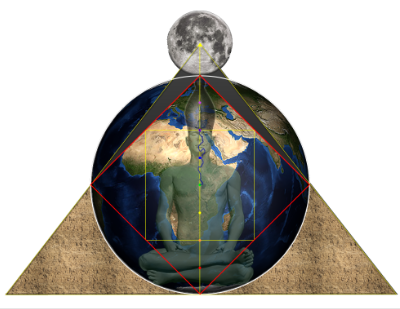

The Great Pyramid
Where it all Fits
Metaphysics
The Owl
When you Love Wisdom
Philosophy
The Droplet and the Ocean
What you Are
Ontology
The Equilateral Triangle
How you Think
Epistemology
The Impossible Triangle
Why it Matters
Teleology

The Vitruvian Human
Who we Are
The Human Bridge

The Oculus
How you See
Phenomenology
The 33 Raptors
How we Transcend
The Master Harmonic
The Compass and Book
Sacred Anachronisms
The Dividers
What to Do


Created with